The Latin America, Middle East and Africa High Performance Computing Market is expected to reach $7.25 billion by 2032 and would witness market growth of 9.5% CAGR during the forecast period (2025-2032).
The Brazil market dominated the LAMEA High Performance Computing Market by Country in 2024, and would continue to be a dominant market till 2032; thereby, achieving a market value of $1,625 million by 2032. The Argentina market is showcasing a CAGR of 10.2% during (2025 - 2032). Additionally, The UAE market would register a CAGR of 8.6% during (2025 - 2032). The Brazil and UAE led the LAMEA High Performance Computing Market by Country with a market share of 24.8% and 16.8% in 2024. The South Africa market is expected to witness a CAGR of 10.5% during throughout the forecast period.
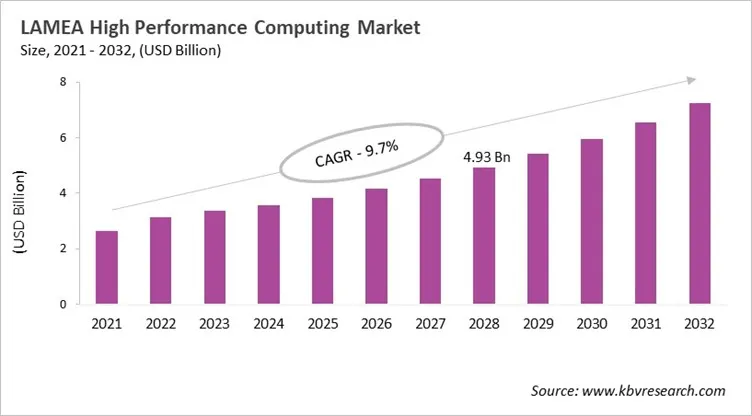
The LAMEA HPC market has changed from being used only in schools and universities to being an important part of digital infrastructure that supports research, industry, and national development. Adoption has sped up as governments include HPC in their plans for digital transformation and innovation, which were limited in the past by gaps in infrastructure and funding. In the past, early use cases focused on climate modeling, seismic analysis, and environmental research. More recent investments in the Middle East, Latin America, and parts of Africa have increased the power of national supercomputers. Cloud-based and hybrid HPC models have made it even easier for businesses, small and medium-sized businesses, and public institutions to use advanced computing without having to spend a lot of money. This change shows that the HPC ecosystem in the region is moving toward being more distributed and application driven.
The LAMEA HPC market is changing in important ways, such as coming together with AI, more people using cloud and hybrid deployments, and aligning with national goals for sustainability and resilience. Governments are using HPC more for AI-driven analytics, smart infrastructure, planning for renewable energy, and research on public health. To deal with data sovereignty and cost efficiency, market leaders focus on localization, working with public institutions, and building regional cloud infrastructure. A key part of the plan is to build capacity through training and ecosystem development. Competition is somewhat consolidated, with global OEMs and cloud providers leading high-end deployments. Regional integrators, on the other hand, stand out by offering localized solutions and services.
Based on Deployment, the market is segmented into On-premise and Cloud. The On-premise market segment dominated the Brazil High Performance Computing Market by Deployment is expected to grow at a CAGR of 7.6 % during the forecast period thereby continuing its dominance until 2032. Also, The Cloud market is anticipated to grow as a CAGR of 8.7 % during the forecast period during (2025 - 2032).
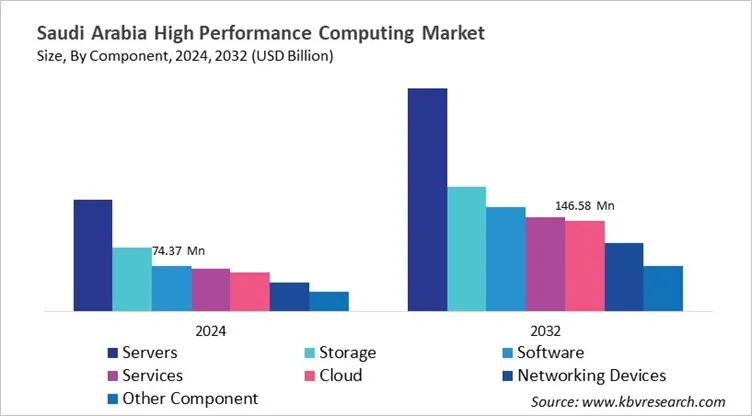
Based on Component, the market is segmented into Servers, Storage, Software, Services, Cloud, Networking Devices and Other Component. With a compound annual growth rate (CAGR) of 9.3% over the projection period, the Servers Market, dominate the Saudi Arabia High Performance Computing Market by Component in 2024 and would be a prominent market until 2032. From 2025 to 2032 The Networking Devices market is expected to witness a CAGR of 11.5% during (2025 - 2032).
Free Valuable Insights: The Worldwide High Performance Computing Market is Projected to reach USD 94.91 Billion by 2032, at a CAGR of 6.9%
Brazil is one of the top users of HPC in Latin America. This is because there is a lot of scientific research that needs it and more businesses want it. The country's HPC ecosystem is based on national institutions like LNCC and INPE, which support research in areas like climate science, bioinformatics, engineering, energy exploration, and space. Advanced computing is very important for AI, data analytics, and complex simulations in government-backed projects and university research programs. GPU-accelerated systems and more people using cloud-based and hybrid HPC models to make systems more scalable and cost-effective are two important trends. Most of the technology comes from global OEMs and cloud providers. Major energy companies use HPC to model and optimize reservoirs. Brazil's HPC market has a lot of room to grow, thanks to the increasing number of workloads that require a lot of computing power. But long-term investment, developing talent, and combining cloud and legacy systems are still big problems that need to be solved.

By Component
By Deployment
By End Use
By Country
Our team of dedicated experts can provide you with attractive expansion opportunities for your business.



 Unique Offerings