The Latin America, Middle East and Africa Equipment Monitoring Market is expected to reach $408.19 million by 2028 and would witness market growth of 7.0% CAGR during the forecast period (2025-2032).
The Brazil market dominated the LAMEA Equipment Monitoring Market by Country in 2024, and would continue to be a dominant market till 2032; thereby, achieving a market value of $104.9 million by 2032. The Argentina market is showcasing a CAGR of 7.6% during (2025 - 2032). Additionally, The UAE market would register a CAGR of 5.8% during (2025 - 2032). The Brazil and Saudi Arabia led the LAMEA Equipment Monitoring Market by Country with a market share of 21.8% and 13.9% in 2024. The Nigeria market is expected to witness a CAGR of 8.6% during throughout the forecast period.
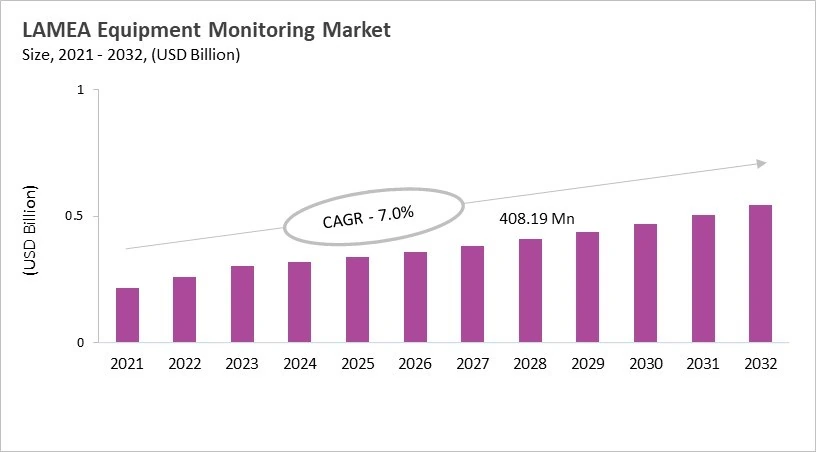
The LAMEA equipment monitoring landscape has changed a lot as Latin America, the Middle East, and Africa have modernized their industries and gone digital. Industries have always relied on reactive and preventive maintenance, but more and more are using sensor-based, real-time monitoring systems that make assets more reliable and operations more efficient. The combination of Industrial IoT, cloud-based platforms, and predictive analytics has made it possible to collect data on equipment all the time, diagnose problems from a distance, and do maintenance based on the condition of the equipment. This has cut down on unplanned downtime and maintenance costs. Government programs that support smart industry, sustainability, and digital infrastructure have sped up adoption even more, especially in the energy, mining, utilities, and manufacturing sectors.
Major players in the market, like global OEMs like Siemens, ABB, Schneider Electric, and Honeywell focus on end-to-end solutions that include hardware, analytics, and lifecycle services. They often work with regional integrators to meet local operational and regulatory needs. Technological depth, predictive capabilities, remote monitoring, and customization for specific industries all help companies stand out from the competition. LAMEA's equipment monitoring ecosystem is changing because of trends like predictive maintenance, centralized monitoring, cloud integration, and alignment with sustainability goals. These trends show a steady move toward data-driven industrial management and better asset lifecycle performance.
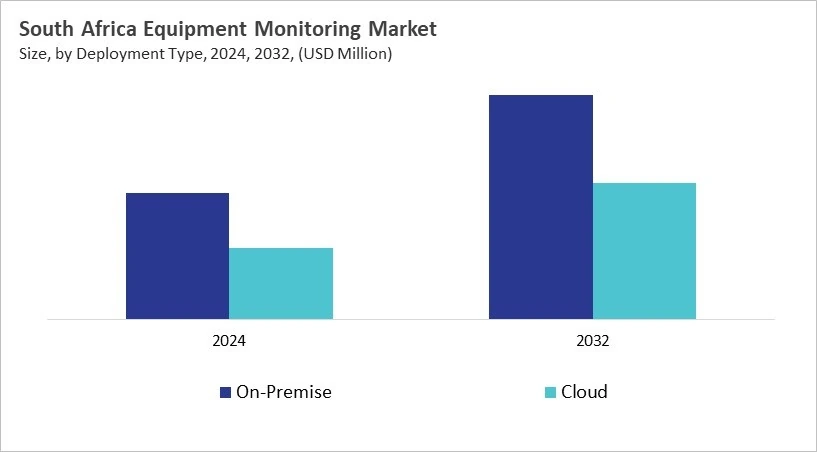
Based on Deployment Type, the market is segmented into On-Premise and Cloud. With a compound annual growth rate (CAGR) of 7.6% over the projection period, the On-Premise Market, dominate the South Africa Equipment Monitoring Market by Deployment Type in 2024 and would be a prominent market until 2032. The Cloud market is expected to witness a CAGR of 8.7% during (2025 - 2032).
Based on Monitoring Type, the market is segmented into Vibration Monitoring, Thermal Monitoring, Lubrication Monitoring, Motor Current Monitoring, Corrosion Monitoring, Noise & Alarm Monitoring and Other Monitoring Type. Among various UAE Equipment Monitoring Market by Monitoring Type; The Vibration Monitoring market achieved a market size of USD $14.8 Million in 2024 and is expected to grow at a CAGR of 5.1 % during the forecast period. The Corrosion Monitoring market is predicted to experience a CAGR of 6.3% throughout the forecast period from (2025 - 2032).
Free Valuable Insights: Equipment Monitoring Market Size Worth USD 5.08 billion by 2032
Brazil is the leader in the Latin American equipment monitoring market because it has a lot of power generation capacity, strong oil and gas production, mining, and industrial manufacturing. Because the country relies on hydropower, offshore oil, and more renewable energy installations, turbines, transmission networks, subsea equipment, and refineries need to be constantly monitored. The Ministry of Mines and Energy and ANEEL oversee this to make sure the grid is reliable and efficient. Key factors driving the market are predictive maintenance and real-time diagnostics for hydro, thermal, wind, and solar facilities. These are made possible by industrial IoT, cloud-based asset management, and digital substation projects. Integrated monitoring solutions are offered by both domestic companies like WEG and international companies like Siemens, ABB, and Schneider Electric. EPC companies help with deployment in energy and infrastructure projects. Brazil's market is growing because of big energy infrastructure projects, offshore oil operations, the use of renewable energy, and the use of new diagnostic and predictive technologies.

By Deployment Type
By Monitoring Type
By End-User
By Country
Our team of dedicated experts can provide you with attractive expansion opportunities for your business.



 Unique Offerings