The Latin America, Middle East and Africa Emission Monitoring Systems Market would witness market growth of 11.5% CAGR during the forecast period (2025-2032).
The Brazil market dominated the LAMEA Emission Monitoring Systems Market by Country in 2024, and would continue to be a dominant market till 2032; thereby, achieving a market value of $221.3 million by 2032. The Argentina market is showcasing a CAGR of 12.3% during (2025 - 2032). Additionally, The UAE market would register a CAGR of 10.3% during (2025 - 2032). The Brazil and UAE led the LAMEA Emission Monitoring Systems Market by Country with a market share of 27.8% and 13.6% in 2024. The Nigeria market is expected to witness a CAGR of 13.2% during throughout the forecast period.
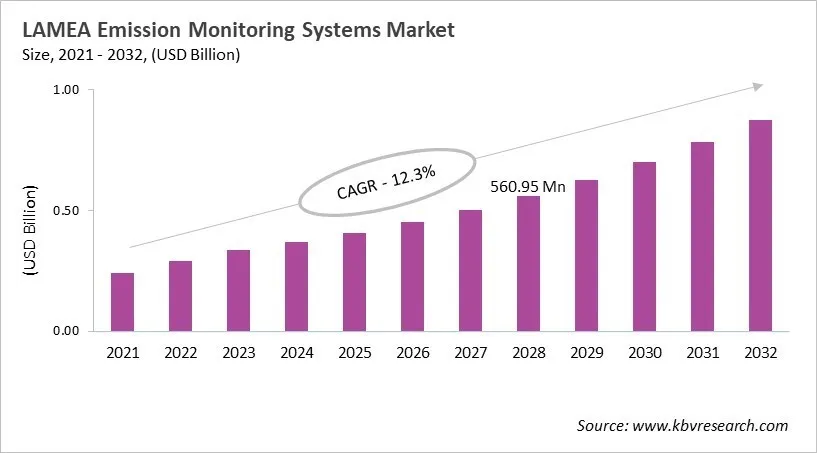
Over the past 20 years, the LAMEA Emission Monitoring Systems (EMS) market has changed a lot because of stricter environmental laws, more industrialization, and climate commitments in Latin America, the Middle East, and Africa. Brazil, Mexico, and Chile are some of the Latin American countries that have strict air quality and emissions standards. Saudi Arabia, the UAE, and Oman are some of the Middle Eastern countries that are using EMS as part of their national sustainability and net-zero plans. South Africa and other countries in Africa are using CEMS and PEMS solutions to meet air quality standards and global environmental goals. OEM innovations from companies like Siemens Energy and ABB are helping the market grow even more. These innovations include predictive monitoring, real-time analyzers, and digital platforms that help companies comply with regulations, cut costs, and improve industrial efficiency.
Current market trends include stricter regulations, digital transformation, and linking with corporate sustainability frameworks. More and more businesses in mining, oil and gas, cement, and power use EMS to keep track of emissions, report on ESG issues, and evaluate performance. To offer high-accuracy, cost-effective, and reliable monitoring solutions that are tailored to local regulatory and industrial conditions, key market leaders focus on new technologies, expanding their services, and forming partnerships with local businesses. The balance of technological sophistication, affordability, durability, and service capabilities shapes competition. In areas where digital environmental governance is a priority, predictive and IoT-enabled systems have a clear edge.
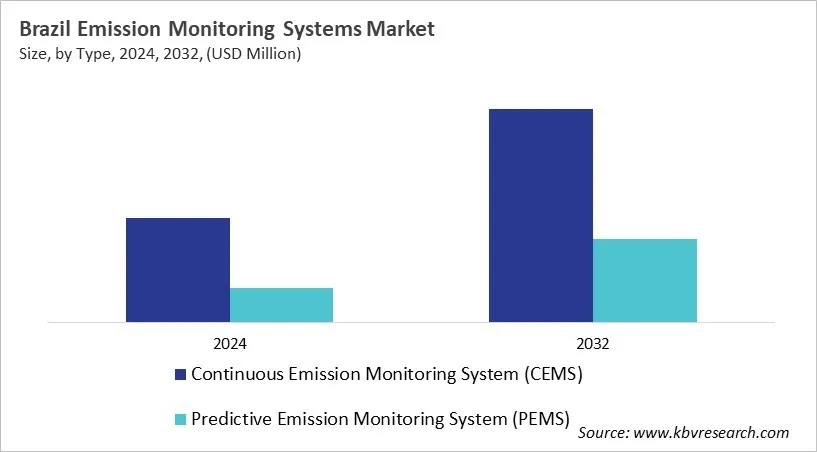
Based on Type, the market is segmented into Continuous Emission Monitoring System (CEMS), and Predictive Emission Monitoring System (PEMS). The Continuous Emission Monitoring System (CEMS) market segment dominated the Brazil Emission Monitoring Systems Market by Type is expected to grow at a CAGR of 9.5 % during the forecast period thereby continuing its dominance until 2032. Also, The Predictive Emission Monitoring System (PEMS) market is anticipated to grow as a CAGR of 11.9 % during the forecast period during (2025 - 2032).
Based on End-Use, the market is segmented into Oil & Gas, Power Generation, Metals & Mining, Chemical & Fertilizer, Pulp & Paper, Pharmaceutical, and Other End-Use. With a compound annual growth rate (CAGR) of 9.3% over the projection period, the Oil & Gas Market, dominate the UAE Emission Monitoring Systems Market by End-Use in 2024 and would be a prominent market until 2032. The Metals & Mining market is expected to witness a CAGR of 9.9% during (2025 - 2032).
Free Valuable Insights: The Worldwide Emission Monitoring Systems Market is Projected to reach USD 7.87 Billion by 2032, at a CAGR of 10.0%
Brazil has one of the most advanced markets for emission monitoring systems in the LAMEA region. This is because of a strong regulatory framework led by IBAMA and state-level agencies that require businesses to report on air quality. Advanced monitoring technologies are used by important industries like oil and gas, mining, steel, and power generation to keep an eye on pollutants like NOx, SOx, CO, and particulate matter. The market is growing because of more government pressure, public demand for cleaner air, and alignment with global sustainability goals. This is happening along with the use of digital, real-time, and predictive monitoring solutions. In the competitive landscape, global technology companies work with local businesses to provide solutions that are ready for compliance, last a long time, and focus on service. Brazil's market growth is due to a combination of strict environmental regulations, new technologies, and a focus on long-term industrial growth.

By Type
By Component
By End Use
By Country
Our team of dedicated experts can provide you with attractive expansion opportunities for your business.



 Unique Offerings