The Latin America, Middle East and Africa Electric Rice Cooker Market would witness market growth of 11.8% CAGR during the forecast period (2025-2032). In the year 2028, the LAMEA market's volume is expected to surge to 1,639.8 Thousand Units, showcasing a growth of 13.3% (2025-2032).
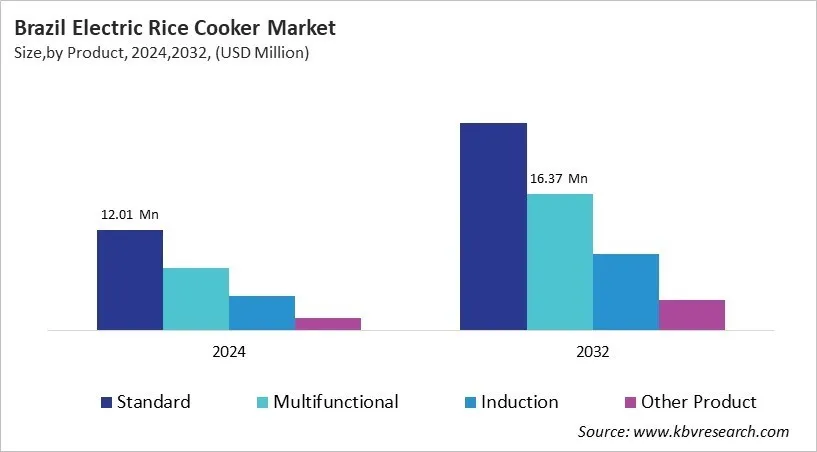
The ‘Others’ category covers product types beyond the standard, multifunctional and induction classifications: this may include smart rice cookers with IoT connectivity, pressure-cooking rice cookers, micro-computer controlled models, or unconventional formats tailored to niche use-cases. These models represent innovation and experimentation in the market. Thus, the Others segment in Brazil market consumed 15.8 Thousand Units in 2024.

The Brazil market dominated the LAMEA Electric Rice Cooker Market by Country in 2024, and would continue to be a dominant market till 2032; thereby, achieving a market value of $54.1 Million by 2032. The Argentina market is showcasing a CAGR of 12.3% during (2025 - 2032). Additionally, The UAE market would register a CAGR of 10.7% during (2025 - 2032). The Brazil and South Africa led the LAMEA Electric Rice Cooker Market by Country with a market share of 26.2% and 15.1% in 2024.
The market for electric rice cookers in the LAMEA region has grown slowly over time, from a small part of the market to a larger one. This is due to urbanization, rising disposable incomes, and changes in family dynamics. Rice has not always been a staple food in many markets, but the rise of modern cooking appliances, dual-income households, and small living spaces has created a need for kitchen solutions that are easy to use and save energy. Manufacturers have responded with locally adapted models—ranging from cost-effective, small-capacity devices to feature-rich, multifunctional cookers with steaming, programmable, and smart connectivity options. The expansion of retail and e-commerce channels has further facilitated market access, enabling brands to cater to diverse consumer segments across Latin America, the Middle East, and Africa.
To get more business, important players in LAMEA are using strategies like localization, expanding their channels, making their products stand out, building cost-effective supply chains, and raising brand awareness. Global brands and OEM/ODM manufacturers are tailoring rice cookers to local voltage standards, rice types, and cooking preferences while leveraging offline and online distribution networks. The market remains price-sensitive, with intense competition in entry-to-mid segments and emerging premium demand for advanced features. Fragmented distribution and relatively low brand loyalty present opportunities for agile manufacturers, while strategic segmentation and marketing initiatives help brands differentiate offerings, protect margins, and drive adoption in a region where the electric rice cooker market is still in its developmental phase.
Based on Application, the market is segmented into Household and Commercial. With a compound annual growth rate (CAGR) of 10.4% over the projection period, the Household Market, dominate the UAE Electric Rice Cooker Market by Application in 2024 and would be a prominent market until 2032. The Commercial market is expected to witness a CAGR of 11.6% during (2025 - 2032).
Based on Product, the market is segmented into Standard, Multifunctional, Induction and Other Product. The Standard market segment dominated the Brazil Electric Rice Cooker Market by Product is expected to grow at a CAGR of 9.8 % during the forecast period thereby continuing its dominance until 2032. Also, The Induction market is anticipated to grow as a CAGR of 11 % during the forecast period during (2025 - 2032).
Free Valuable Insights: The Worldwide Electric Rice Cooker Market is Projected to reach USD 4.07 Billion by 2032, at a CAGR of 9.7%
The electric rice cooker segment in Brazil is witnessing growing relevance as urban households seek convenient, time-saving kitchen solutions, with rice remaining a staple in daily meals. Rising urbanization, smaller family units, dual-income households, higher disposable incomes, and expanded access through modern retail and e-commerce are driving demand, while economic volatility, regional infrastructure gaps, and entrenched stovetop cooking habits remain constraints. Consumers increasingly prefer multifunction rice cookers and localized features, though entry-level models dominate, with premium options occupying a niche. Competition involves both global and local/imported value brands, where success depends on balancing cost, performance, convenience, after-sales service, and strong distribution networks, particularly online. Brands emphasizing premium pricing without clear added value risk limited adoption.

By Application (Volume, Thousand Units, USD Billion, 2021-2032)
By Distribution Channel (Volume, Thousand Units, USD Billion, 2021-2032)
By Product (Volume, Thousand Units, USD Billion, 2021-2032)
By Country (Volume, Thousand Units, USD Billion, 2021-2032)
Our team of dedicated experts can provide you with attractive expansion opportunities for your business.





 Unique Offerings