The Latin America, Middle East and Africa Disclosure Management Market would witness market growth of 18.6% CAGR during the forecast period (2025-2032).
The Brazil market dominated the LAMEA Disclosure Management Market by Country in 2024, and would continue to be a dominant market till 2032; thereby, achieving a market value of $70 million by 2032. The Argentina market is showcasing a CAGR of 19.8% during (2025 - 2032). Additionally, The UAE market would register a CAGR of 17.6% during (2025 - 2032). The Brazil and UAE led the LAMEA Disclosure Management Market by Country with a market share of 27.8% and 16.1% in 2024. The South Africa market is expected to witness a CAGR of 19.7% during throughout the forecast period.
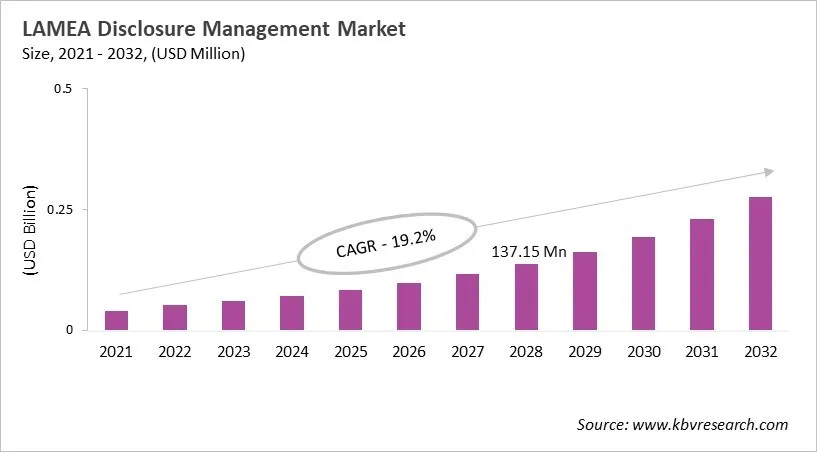
The LAMEA region has seen a big change in how companies report and disclose information. They used to just file simple financial statements, but now they use more complex, multi-dimensional frameworks that include ESG, climate-risk, and governance data. Regulatory momentum, especially in Latin America and some parts of the Middle East, has led to mandatory sustainability disclosures that follow global standards like ISSB and GRI. At the same time, Africa is making progress in digital reporting to meet investor expectations. As a result, companies are using more and more integrated disclosure-management platforms that support data governance, audit trails, multi-entity reporting, multilingual formats, and assurance readiness. This shows how the region is moving from compliance-focused to strategic transparency.
At the same time, three main trends are affecting vendor offerings and business strategies across LAMEA: mandatory sustainability reporting, digital/data integration, and regional-local customization. Market participants put a lot of emphasis on localized platform configurations, cloud-based scalability, integrated governance solutions, and partnerships with regional advisory firms to deal with different regulatory regimes, budget levels, and maturity levels in different markets. Now, competition is based not only on the software's capabilities but also on the strength of its services, regulatory intelligence, and localization. Both global vendors and agile regional players are trying to deal with the growing scrutiny from investors and the growing complexity of disclosure requirements.
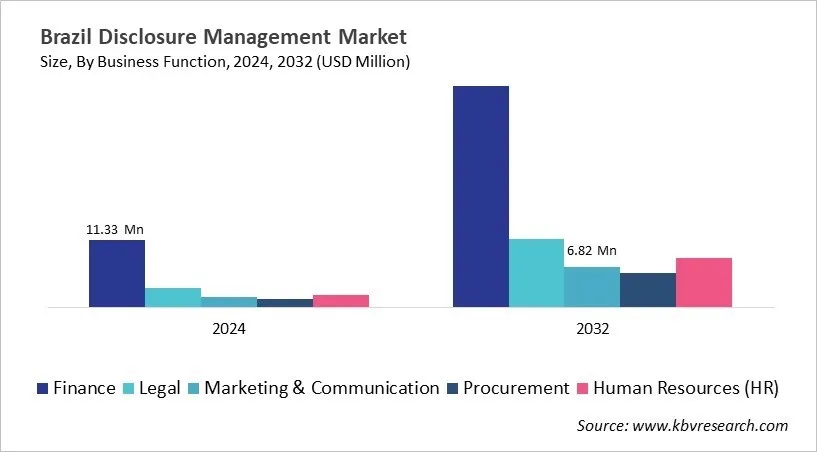
Based on Business Function, the market is segmented into Finance, Legal, Marketing & Communication, Procurement, and Human Resources (HR). Among various Brazil Disclosure Management Market by Business Function; The Finance market achieved a market size of USD $11.3 Million in 2024 and is expected to grow at a CAGR of 16.3 % during the forecast period. The Procurement market is predicted to experience a CAGR of 19.3% throughout the forecast period from (2025 - 2032).
Based on End-use, the market is segmented into BFSI, IT & Telecommunications, Government & Public Sector, Retail & E-commerce, Energy & Utilities, Manufacturing, Healthcare, Media & Entertainment, and Other End-uses. With a compound annual growth rate (CAGR) of 17.4% over the projection period, the BFSI Market, dominate the Argentina Disclosure Management Market by End-use in 2024 and would be a prominent market until 2032. The Manufacturing market is expected to witness a CAGR of 21.9% during (2025 - 2032).
Free Valuable Insights: The Worldwide Disclosure Management Market is Projected to reach USD 4.17 Billion by 2032, at a CAGR of 16.9%
Brazil's disclosure-management market is changing quickly because of its large and mature economy, deep capital markets, and stricter oversight from the Comissão de Valores Mobiliários (CVM). The push from investors for ESG transparency and Brazil's plan to adopt ISSB standards by 2026 are speeding up the move toward reporting that is both integrated and focused on sustainability. Sectors like agriculture, mining, and energy are under more scrutiny for their climate risks and social impacts. This is increasing the need for strong disclosure platforms that include audit trails, data governance, and ESG integration. As reporting becomes more organized and digital, competition grows between global vendors that offer advanced, scalable solutions and local providers that know the rules and can offer lower prices. In general, the market is still changing as Brazilian businesses adjust to stricter rules and higher expectations for transparency.

By Component
By Deployment
By Enterprise Size
By Business Function
By End Use
By Country
Our team of dedicated experts can provide you with attractive expansion opportunities for your business.



 Unique Offerings