The Latin America, Middle East and Africa Construction Equipment Finance Market would witness market growth of 7.1% CAGR during the forecast period (2025-2032).
The Brazil market dominated the LAMEA Construction Equipment Finance Market by Country in 2024, and would continue to be a dominant market till 2032; thereby, achieving a market value of $4,603.1 million by 2032. Argentina market is showcasing a CAGR of 8.5% during (2025 - 2032). Additionally, The UAE market would register a CAGR of 6% during (2025 - 2032). The Brazil and South Africa led the LAMEA Construction Equipment Finance Market by Country with a market share of 25.8% and 14% in 2024.The UAE market is expected to witness a CAGR of 6% during throughout the forecast period.
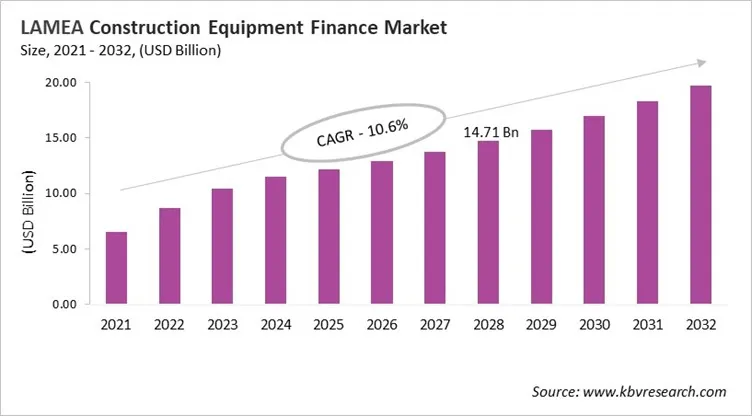
In Latin America, the Middle East, and Africa (LAMEA), the construction equipment finance market has become very important for building new infrastructure, mechanizing, and updating fleets. In Latin America, more money is being spent on roads, ports, and urban development, which has increased the need for heavy machinery. Because of the high upfront costs and cash-flow problems, contractors are turning to financing. OEMs like Caterpillar and Komatsu have grown their financing arms to speed up equipment purchases by offering loans, leases, and vendor-finance models. The need for flexible financing is even stronger because of economic instability, currency risks, and the difficulty of following rules. Financing has changed over time from simple bank loans to more complex options like leasing, hire-purchase, and rental-back models. These structures help contractors keep their cash flow steady while also helping equipment dealers make more sales and keep their customers happy. The same basic ideas apply in the Middle East and Africa, where a lack of domestic capital and a need for better infrastructure drive the use of financing.
The LAMEA equipment finance market is changing because of things like OEM-linked financing, flexible asset-use models, and more digitalization. Manufacturers now offer financing along with equipment and service bundles, which makes it easier to buy and helps with full lifecycle management. Contractors can better handle cash flow problems and usage risks with flexible structures like operating leases, capital leases, customized payment cycles, and residual-value guarantees. Digital tools and telematics help lenders better understand how assets are doing, better underwrite risk, and offer maintenance or fleet management services as part of financing packages. OEMs also use strategic methods like expanding their dealer networks, making financing options more available in different areas, and offering flexible payment terms that fit with project timelines. All these trends make financing an important part of fleet renewal, productivity, and keeping customers for a long time in the LAMEA region.
Based on Industry, the market is segmented into Construction, Mining, Rental, Government and Other Industry. Among various Brazil Construction Equipment Finance Market by Industry; The Construction market achieved a market size of USD $1425.4 Million in 2024 and is expected to grow at a CAGR of 4.8 % during the forecast period. The Government market is predicted to experience a CAGR of 6.4% throughout the forecast period from (2025 - 2032).
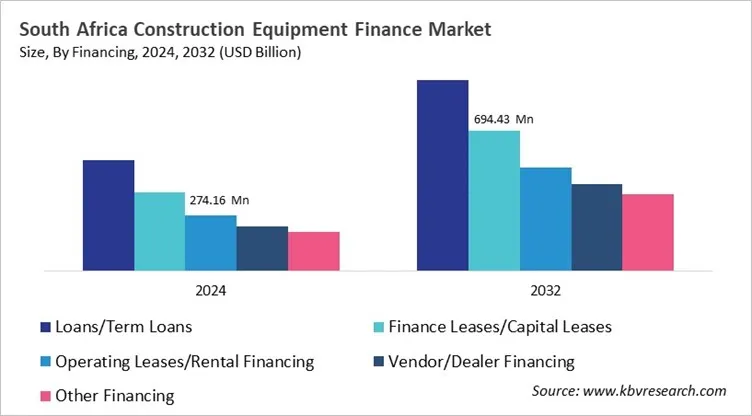
Based on Financing, the market is segmented into Loans/Term Loans, Finance Leases/Capital Leases, Operating Leases/Rental Financing, Vendor/Dealer Financing and Other Financing. The Loans/Term Loans market segment dominated the South Africa Construction Equipment Finance Market by Financing is expected to grow at a CAGR of 7.2 % during the forecast period thereby continuing its dominance until 2032. Also, The Vendor/Dealer Financing market is anticipated to grow as a CAGR of 8.9 % during the forecast period during (2025 - 2032).
Free Valuable Insights: The Worldwide Construction Equipment Finance Market is Projected to reach USD 144.91 Billion by 2032, at a CAGR of 6.1%
Brazil's construction equipment finance market is driven by big infrastructure projects like PAC, a lot of mining, and a lot of demand for urban construction machinery. Because of this, contractors who must pay a lot for their equipment need financing. There are more than 8,000 infrastructure projects going on right now. The cycles of public investment have a big effect on how companies buy equipment, and high interest rates and currency fluctuations make companies more likely to lease or rent instead of buy. OEMs are well represented, with companies like Caterpillar, Komatsu, Volvo CE, Hitachi, JCB, and Chinese companies like XCMG. Many of these companies offer financing solutions that are either captive or partnered. Mining equipment often needs long-term financing, and digitalized machines with telemetry and service bundles make financed packages more appealing. As the demand for efficient, low-emission equipment grows, so does the need for financing because the initial costs are higher. Local manufacturing and assembly make it easier for banks and lessors to lend money to OEMs. This creates a competitive environment where flexible, service-integrated financing models are the most popular.

By Financing
By Equipment
By Industry
By Country
Our team of dedicated experts can provide you with attractive expansion opportunities for your business.



 Unique Offerings