The Latin America, Middle East and Africa Computer Aided Manufacturing Software Market is expected to reach $383.99 million by 2028 and would witness market growth of 10.8% CAGR during the forecast period (2025-2032).
The Brazil market dominated the LAMEA Computer Aided Manufacturing Software Market by Country in 2024, and would continue to be a dominant market till 2032; thereby, achieving a market value of $143.2 million by 2032. The Argentina market is showcasing a CAGR of 11.4% during (2025 - 2032). Additionally, The UAE market would register a CAGR of 9.7% during (2025 - 2032). The Brazil and Saudi Arabia led the LAMEA Computer Aided Manufacturing Software Market by Country with a market share of 26.8% and 17% in 2024. The Nigeria market is expected to witness a CAGR of 12.8% during throughout the forecast period.
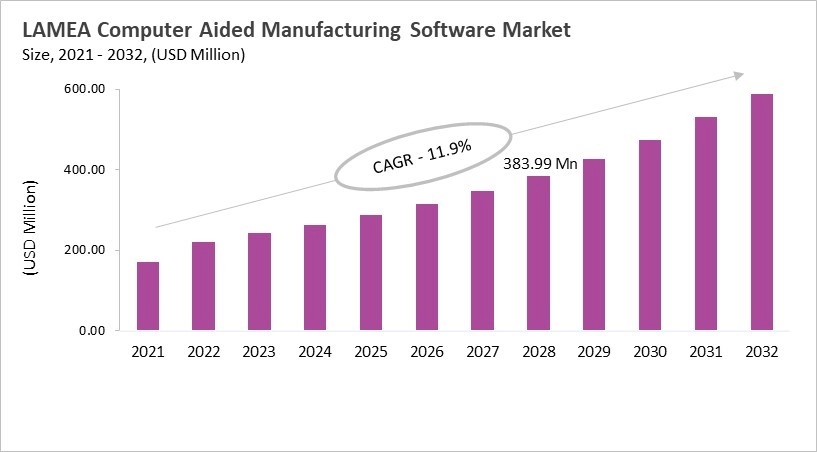
Despite differences in industry across LAMEA, the CAM software market is becoming more and more shaped by a common drive toward automation, competitiveness, and integration into global supply chains. To meet international quality standards and support nearshoring initiatives, metalworking companies in Latin America are using advanced CNC technologies, multi-axis machining, and automated bending. Smart factories and digital workflows are quickly becoming popular in the Middle East, thanks to national programs like Saudi Arabia's Vision 2030. In Africa, on the other hand, there is a "leapfrogging" trend, where modern CNC and automation are replacing older production methods to make higher-value goods. In the region, CAM is seen as a key part of these projects because it provides the programming backbone for more advanced machines and smart factory operations.
Regional strategies and the way competition works make CAM's role even more important. In Latin America, vendors combine CAM with automation projects and advanced CAD/CAM workflows to help companies win global contracts. Middle Eastern suppliers use government incentives to set up digital lighthouse factories, while African OEMs focus on training, support, and solutions that are tailored to specific industries like mining and automotive. A mix of global CAM providers and new regional players drives competition. Success often depends on being able to connect software to specific CNC machines, provide high-quality local service, and offer complete digital manufacturing solutions. As a result, CAM adoption in LAMEA is not just about choosing software; it is also about modernization, skill development, and changes to how things are done.
Based on Software Type, the market is segmented into Integrated, Standalone and Cloud. With a compound annual growth rate (CAGR) of 11.1% over the projection period, the Integrated Market, dominate the South Africa Computer Aided Manufacturing Software Market by Software Type in 2024 and would be a prominent market until 2032. The Cloud market is expected to witness a CAGR of 12.8% during (2025 - 2032).
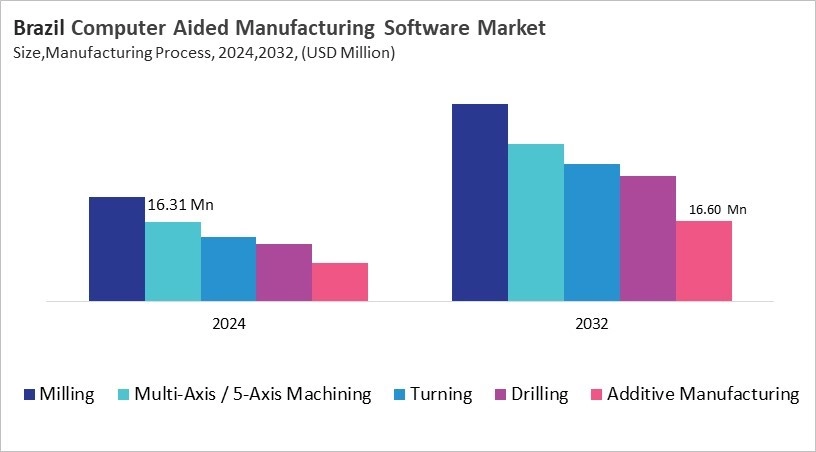
Based on Manufacturing Process, the market is segmented into Milling, Multi-Axis / 5-Axis Machining, Turning, Drilling and Additive Manufacturing. Among various Brazil Computer Aided Manufacturing Software Market by Manufacturing Process; The Milling market achieved a market size of USD $21.3 Million in 2024 and is expected to grow at a CAGR of 8.5 % during the forecast period. The Additive Manufacturing market is predicted to experience a CAGR of 9.8% throughout the forecast period from (2025 - 2032).
Free Valuable Insights: Computer Aided Manufacturing Software Market Size Worth USD 5.49 billion by 2032
Brazil's CAM software market has a direct connection to the country's growing manufacturing sectors, such as automotive, aerospace, oil and gas, agricultural machinery, and medical devices. These sectors are quickly adopting multi-axis, high-speed, and hybrid machining technologies. Government-backed projects in precision machining and additive manufacturing, especially metal 3D printing, are driving growth. This is happening alongside efforts to reindustrialize and the need to be competitive on a global scale despite rising costs and currency fluctuations. CAM is most popular with big manufacturers and advanced job shops, but small and medium-sized businesses are also starting to use bundled solutions with CNC machines. Some market trends are the merging of CAM with digital manufacturing, quality systems, and production processes; the standardization of operations across multiple plants; and the growth of hybrid additive-subtractive workflows. There are global vendors, local resellers, system integrators, and niche regional providers in the competitive landscape. Continued investment in automation, industrial innovation, and infrastructure is expected to strengthen CAM's role in improving productivity, quality, and operational flexibility across key sectors.

By Deployment Mode
By Software Type
By Manufacturing Process
By End-User Industry
By Country
Our team of dedicated experts can provide you with attractive expansion opportunities for your business.



 Unique Offerings