The Latin America, Middle East and Africa Coconut Derivatives Market would witness market growth of 10.7% CAGR during the forecast period (2025-2032).
The Brazil market dominated the LAMEA Coconut Derivatives Market by Country in 2024, and would continue to be a dominant market till 2032; thereby, achieving a market value of $1,276.1 million by 2032. The Argentina market is showcasing a CAGR of 12.2% during (2025 - 2032). Additionally, The UAE market would register a CAGR of 9.6% during (2025 - 2032). The Brazil and South Africa led the LAMEA Coconut Derivatives Market by Country with a market share of 20.8% and 15% in 2024.
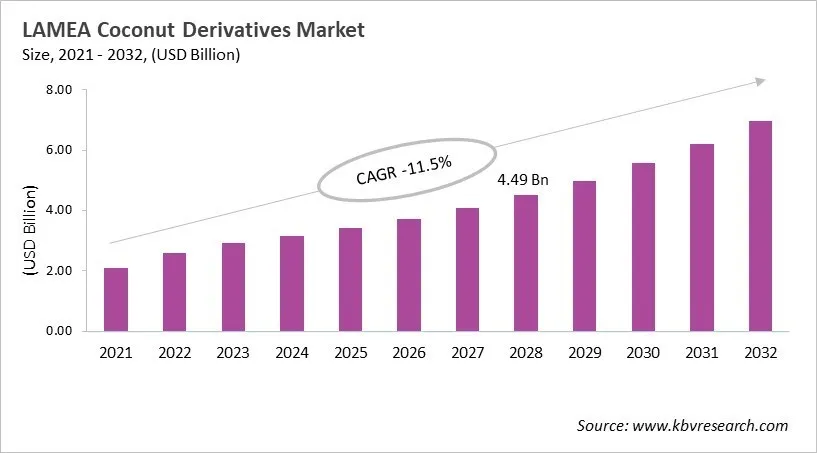
In the last 20 years, the coconut derivatives economy in Latin America, the Middle East, and Africa (LAMEA) has changed from a trade in fresh coconuts, copra, and crude coconut oil to a wide range of products that add value, such as edible oils, drinks, dairy alternatives, flours, sweeteners, and personal care items. Latin American producers, especially Brazil, are still the main suppliers. On the other hand, Middle Eastern and African markets focus on downstream activities like packaging, retail, and foodservice, which are driven by imports. Market players have turned to premiumization, multi-origin sourcing, sustainability certification, and product reformulation to meet the growing demand for coconut water, plant-based milks, and natural personal care products. This is because of changing consumer health trends, government regulations, and climate-related price swings.
Key market strategies show these changes. For example, PepsiCo is setting up large-scale beverage processing in Brazil, and Asian-origin OEMs are expanding into MENA and Southern Africa by offering a wider range of products and using localized distribution models. Sustainability and traceability programs, especially the Sustainable Coconut Charter, are now necessary for reducing risk and getting into new markets. The structure of market competition is mixed. The Gulf and African markets, which rely on imports, are home to global FMCGs, regional specialists, and private labels that source from multiple countries, follow halal and local rules, and adapt their prices and packaging. Being able to handle changes in supply quickly and professionally is becoming more and more important for success in the market.
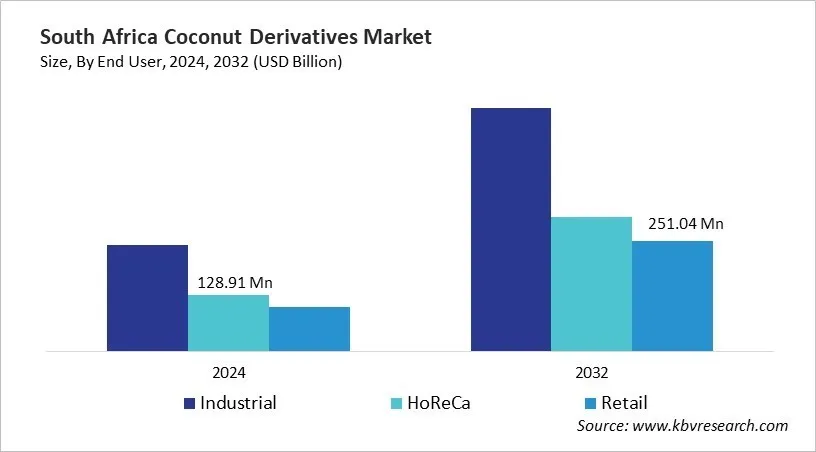
Based on End User, the market is segmented into Industrial, HoReCa, and Retail. With a compound annual growth rate (CAGR) of 11.2% over the projection period, the Industrial Market, dominate the South Africa Coconut Derivatives Market by End User in 2024 and would be a prominent market until 2032.The Retail market is expected to witness a CAGR of 12.3% during (2025 - 2032).
Based on Product Type, the market is segmented into Coconut Oil, Coconut Milk, Coconut Water, Desiccated Coconut, Coconut Sugar, Coconut Flour & Fibre Derivatives, and Other Product Type. The Coconut Oil market segment dominated the Brazil Coconut Derivatives Market by Product Type is expected to grow at a CAGR of 7.3 % during the forecast period thereby continuing its dominance until 2032. Also, The Coconut Sugar market is anticipated to grow as a CAGR of 10.2 % during the forecast period during (2025 - 2032).
Free Valuable Insights: The Worldwide Coconut Derivatives Market is Projected to reach USD 54.08 Billion by 2032, at a CAGR of 9.5%
Brazil is now a lively market for chatbot-based mental health apps because of its large population, growing awareness of mental health, and lack of access to professional care. Chatbots can help with mood tracking, therapeutic exercises, and real-time support. They can also be used in addition to traditional therapy. Smartphone use, internet access, cultural openness to talking about mental health, affordability, and support from the government and schools are all important factors. Trends include conversational AI giving evidence-based techniques, personalized feedback, gamification, wearable integration, hybrid care models, and content that is culturally relevant. The competitive landscape includes local startups that offer culturally relevant, low-cost solutions and global platforms that use advanced AI and clinical validation. Working with universities, hospitals, and corporate wellness programs can help build credibility and reach. This means that standing out depends on how well you adapt to different cultures, how easy it is to get to, and how well it fits into larger health ecosystems.

By End User
By Retail Type
By Packaging
By Product Type
By Country
Our team of dedicated experts can provide you with attractive expansion opportunities for your business.



 Unique Offerings