The Latin America, Middle East and Africa Climate Tech Market is expected to reach $6.17 billion by 2028 and would witness market growth of 22.6% CAGR during the forecast period (2025-2032).
The Brazil market dominated the LAMEA Climate Tech Market by Country in 2024, and would continue to be a dominant market till 2032; thereby, achieving a market value of $2,920.7 million by 2032. The Argentina market is showcasing a CAGR of 23.2% during (2025 - 2032). Additionally, The UAE market would register a CAGR of 21.4% during (2025 - 2032). The Brazil and Saudi Arabia led the LAMEA Climate Tech Market by Country with a market share of 22.8% and 17.9% in 2024. The South Africa market is expected to witness a CAGR of 23.5% during throughout the forecast period.
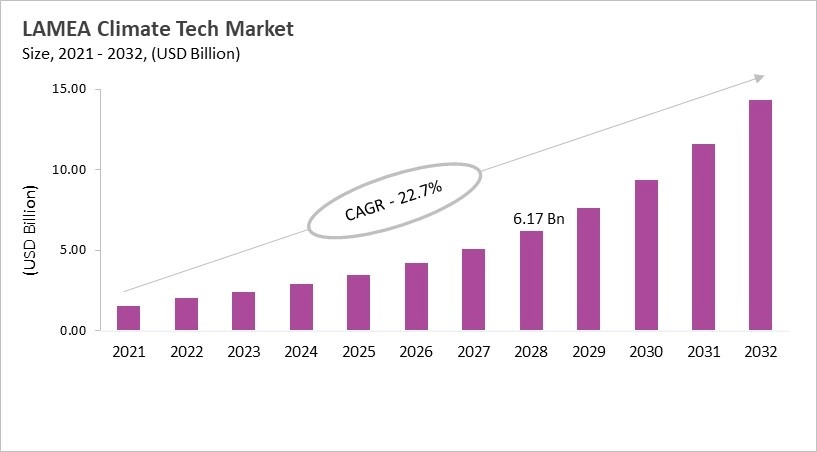
The LAMEA Climate Tech Market has grown as a way for the region to deal with its high risk of climate change and ongoing development problems. More and more, governments in Latin America, the Middle East, and Africa see climate technology as a way to protect the economy, ensure energy security, and promote inclusive growth. They are moving beyond policy-driven emissions commitments to focus on broader adaptation and sustainability goals. The market has changed a lot because of leadership from the public sector, cooperation between countries, and development finance. At first, the focus was on renewable energy, but it has since grown to include decentralized energy systems, climate-smart agriculture, water management, and digital climate solutions. This change shows that climate technology is no longer just a way to meet regulations; it is now a way to bring about long-term changes in society and the economy.
The rise of locally adapted, decentralized solutions, the integration of digital technologies with climate applications, and a growing focus on adaptation and resilience alongside mitigation are all important market trends. Governments and leaders in different regions are making sure that climate tech is used in line with national development plans. They are also creating ecosystems for innovation and using mixed finance models to lower the risk of investments and get private companies to join in. The LAMEA Climate Tech Market is competitive, but it is also collaborative and policy-focused. Global OEMs, regional players, startups, and public institutions all work together within structured frameworks. In general, the market values growth through partnerships, long-term effects, and climate resilience more than short-term business competition.
Based on End User, the market is segmented into Energy & Utilities, Manufacturing Industries, Transportation & Logistics Companies, Commercial & Residential Sectors, Agricultural Enterprises, Government & Regulatory Bodies and Other End User. Among various UAE Climate Tech Market by End User; The Energy & Utilities market achieved a market size of USD $143.6 Million in 2024 and is expected to grow at a CAGR of 20.5 % during the forecast period. The Agricultural Enterprises market is predicted to experience a CAGR of 22.3% throughout the forecast period from (2025 - 2032).
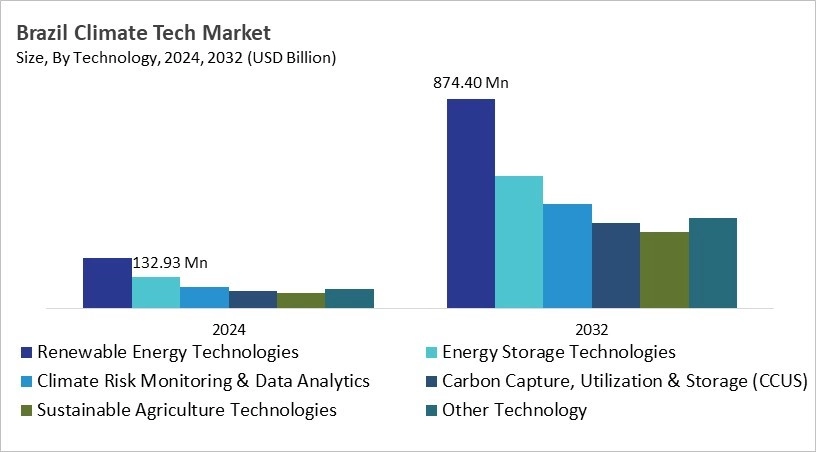
Based on Technology, the market is segmented into Renewable Energy Technologies, Energy Storage Technologies, Climate Risk Monitoring & Data Analytics, Carbon Capture, Utilization & Storage (CCUS), Sustainable Agriculture Technologies and Other Technology. With a compound annual growth rate (CAGR) of 19.9% over the projection period, the Renewable Energy Technologies Market, dominate the Brazil Climate Tech Market by Technology in 2024 and would be a prominent market until 2032. The Climate Risk Monitoring & Data Analytics market is expected to witness a CAGR of 21.8% during (2025 - 2032).
Free Valuable Insights: Climate Tech Market Size Worth USD 166.96 billion by 2032
Brazil's climate technology market is growing because there are a lot of renewable resources, public policy is changing, and the country is committed to moving to clean energy. The National Energy Transition Policy (PNTE) and the new commitments made in the Paris Agreement make it clear how to reach net-zero emissions by 2050. They also encourage long-term investment and the use of new technologies. Hydropower is still the main source of energy, but wind and solar power are growing quickly and attracting technology companies from both the US and other countries. Government agencies and laws are very important for making sure that climate goals are in line with energy and industrial systems. Market trends show that companies are moving into bioenergy, green hydrogen, energy storage, and grid modernization technologies. Brazil is a key and growing climate technology market because of its supportive policies, competitive market dynamics, and renewable energy potential.

By End User
By Technology
By Country
Our team of dedicated experts can provide you with attractive expansion opportunities for your business.



 Unique Offerings