The Latin America, Middle East and Africa Cleaning Robot Market would witness market growth of 24.0% CAGR during the forecast period (2025-2032).
The Brazil market dominated the LAMEA Cleaning Robot Market by Country in 2024, and would continue to be a dominant market till 2032; thereby, achieving a market value of $903 million by 2032. The Argentina market is showcasing a CAGR of 25.3% during (2025 - 2032). Additionally, The UAE market would register a CAGR of 22.1% during (2025 - 2032). The Brazil and Argentina led the LAMEA Cleaning Robot Market by Country with a market share of 27.8% and 10.5% in 2024. The Nigeria market is expected to witness a CAGR of 26.3% during throughout the forecast period.
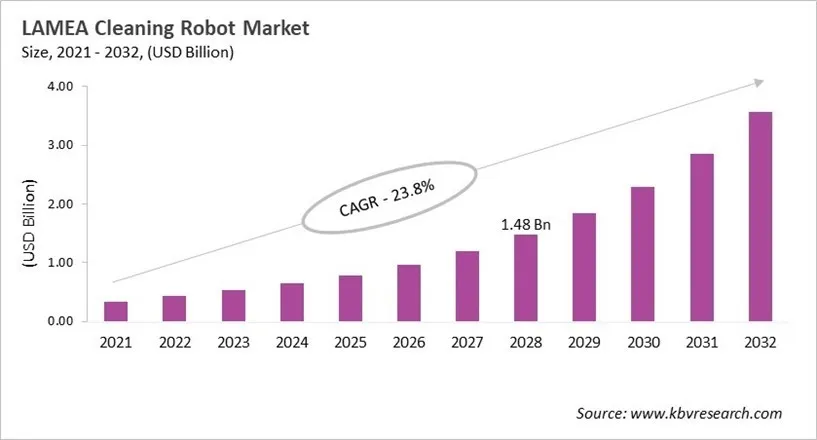
The LAMEA Cleaning Robot Market has changed from being only used by a few people to being widely accepted. This is because consumer robotics have improved, cities have grown, and more homes and businesses are becoming automated. Global OEM innovations helped the initial growth, while government-led digitalization efforts, especially in the Middle East, and rising awareness of hygiene in Latin America and Africa, helped the regional growth. Technological advances like AI-powered navigation, LiDAR mapping, multi-purpose cleaning, and better filtration have turned cleaning robots from fun toys into dependable tools. Adoption has been fastest in cities and areas with a lot of infrastructure, thanks to more retail outlets and lower prices.
Some of the most important trends in the market are more integration with AI and smart home systems, more use of autonomous cleaning robots in big businesses, and a strong focus on designs that are hygienic and have multiple uses. Market leaders have strengthened their presence in LAMEA by forming partnerships for localized distribution, customizing products for specific regions, and building strong networks for after-sales service. Commercial strategies aimed at airports, malls, hotels, and hospitals have sped up adoption even more, especially in the Middle East. Overall, the market's steady growth path is still being shaped by ongoing innovation, government policies that support it, and changing consumer preferences toward convenience and cleanliness.
Based on Product, the market is segmented into In-House and Outdoor. Among various Brazil Cleaning Robot Market by Product; The In-House market achieved a market size of USD $130.7 Million in 2024 and is expected to grow at a CAGR of 22.1 % during the forecast period. The Outdoor market is predicted to experience a CAGR of 23.6% throughout the forecast period from (2025 - 2032).
Based on Charging, the market is segmented into Automatic Charging and Manual Charging. The Automatic Charging market segment dominated the Argentina Cleaning Robot Market by Charging is expected to grow at a CAGR of 25 % during the forecast period thereby continuing its dominance until 2032. Also, The Manual Charging market is anticipated to grow as a CAGR of 26 % during the forecast period during (2025 - 2032).
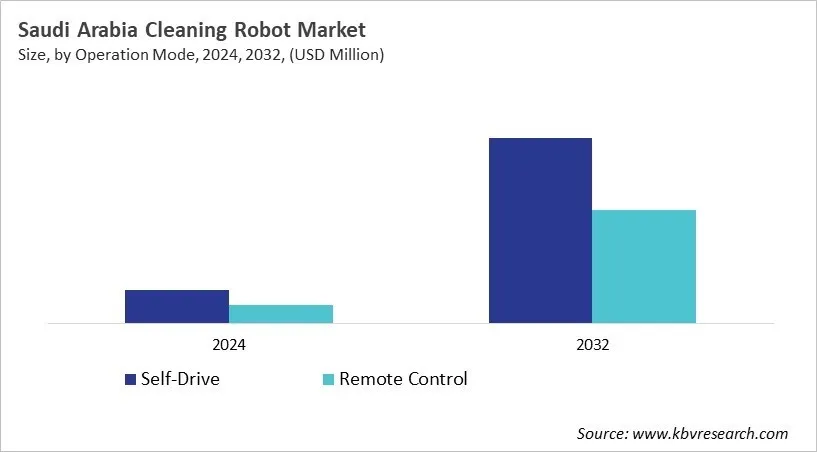
Based on Operation Mode, the market is segmented into Self-Drive and Remote Control. With a compound annual growth rate (CAGR) of 24.3% over the projection period, the Self-Drive Market, dominate the Saudi Arabia Cleaning Robot Market by Operation Mode in 2024 and would be a prominent market until 2032. From 2025 to 2032 The Remote Control market is expected to witness a CAGR of 25.7% during (2025 - 2032).
Free Valuable Insights: The Worldwide Cleaning Robot Market is Projected to reach USD 31.82 Billion by 2032, at a CAGR of 23.0%
The market for cleaning robots in Brazil is growing quickly because more people are moving to cities, incomes are rising, and more people are learning about smart home technologies. Because people in big cities like São Paulo and Rio de Janeiro live busy lives, have small homes, and have a lot of pets, there is a lot of demand for automated cleaning solutions. E-commerce sites and social media are very important for getting the word out about mid-range robots with lots of features, like mapping, app connectivity, and vacuuming and mopping. Rising labor costs, health concerns, and the need to manage indoor allergens all help the market grow. On the other hand, economic changes, import taxes, and currency fluctuations make it harder for lower-income households to adopt the product. There is a lot of competition, with global brands like iRobot, Xiaomi, and Samsung competing with cheap Chinese brands. This makes for a dynamic market where customers have to weigh price, advanced features, and ease of use in their own country.

By Product
By Charging
By Operation Mode
By End-use
By Distribution Channel
By Type
By Country
Our team of dedicated experts can provide you with attractive expansion opportunities for your business.





 Unique Offerings