The Latin America, Middle East and Africa Biohacking Market would witness market growth of 20.6% CAGR during the forecast period (2025-2032).
The Brazil market dominated the LAMEA Biohacking Market by Country in 2024, and would continue to be a dominant market till 2032; thereby, achieving a market value of $1,841.8 million by 2032. The Argentina market is showcasing a CAGR of 21.1% during (2025 - 2032). Additionally, The UAE market would register a CAGR of 19.4% during (2025 - 2032). The Brazil and UAE led the LAMEA Biohacking Market by Country with a market share of 24.8% and 14.1% in 2024. The South Africa market is expected to witness a CAGR of 21.7% during throughout the forecast period.
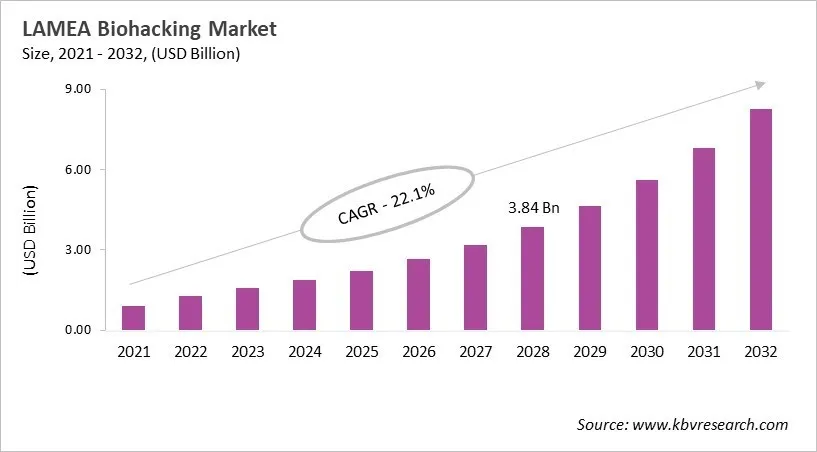
The LAMEA biohacking market is changing quickly because more people are becoming aware of their health, more people are moving to cities, and more people are interested in staying healthy in Latin America, the Middle East, and Africa. What started out as simple wearable devices to track activity and sleep has grown into advanced biometric monitoring, nutrigenomics, cognitive enhancers, and personalized wellness solutions. Government support for digital health, rising disposable incomes, and the spread of global AI-enabled wellness trends are all speeding up the adoption of these technologies. High-performance wellness programs and premium biohacking experiences are also driving up demand among wealthy people in places like the Gulf and major Latin American cities.
Market players are making their presence stronger by forming partnerships in different regions, coming up with new products, and creating integrated wellness ecosystems that bring together devices, analytics, and coaching services. To better meet the cultural and economic needs of different LAMEA markets, companies are focusing on building trust, following the rules, and adapting to local conditions. There are both well-known global brands and regional startups that offer niche, performance-focused solutions. Even though there are problems like changing rules and high costs, the market has a lot of room to grow because more and more people are putting data-driven self-optimization, longevity, and overall health at the top of their lists.
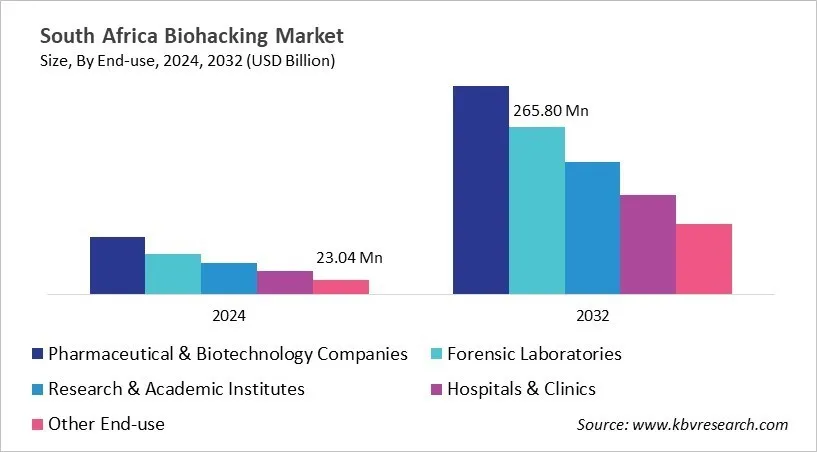
Based on End Use, the market is segmented into Pharmaceutical & Biotechnology Companies, Forensic Laboratories, Research & Academic Institutes, Hospitals & Clinics, and Other End-use. The Pharmaceutical & Biotechnology Companies market segment dominated the South Africa Biohacking Market by End-use is expected to grow at a CAGR of 20 % during the forecast period thereby continuing its dominance until 2032. Also, The Hospitals & Clinics market is anticipated to grow as a CAGR of 22.2 % during the forecast period during (2025 - 2032).
Based on Product, the market is segmented into Wearables, Implants, Smart Drugs, Supplements, Mobile Apps, Gene Modification Kits, and Other Product. Among various Brazil Biohacking Market by Product; The Wearables market achieved a market size of USD $138.1 Million in 2024 and is expected to grow at a CAGR of 17.1 % during the forecast period. The Mobile Apps market is predicted to experience a CAGR of 19.5% throughout the forecast period from (2025 - 2032).
Free Valuable Insights: The Worldwide Biohacking Market is Projected to reach USD 93.34 Billion by 2032, at a CAGR of 18.3%
Brazil's biohacking market is changing quickly because more people are interested in health and wellness, more people are using connected health devices, and more people in cities are looking for ways to improve their health in a way that works for them. Strong healthcare systems in big cities, easier access to affordable wearables, and more activity from local startups and research institutions are all speeding up innovation even more. There is competition between global tech companies and local businesses that set themselves apart by offering Portuguese-language interfaces, aligning with local culture, using data analytics, and creating integrated service ecosystems. More and more people are using self-tracking, wellness tourism, and corporate wellness programs, but there are still problems with rules and ethics that need to be worked out. Overall, Brazil is becoming a major regional hub where global innovation meets local adaptation to meet the needs of health-conscious, tech-savvy consumers.

By Application
By End Use
By Product
By Country
Our team of dedicated experts can provide you with attractive expansion opportunities for your business.



 Unique Offerings