The Latin America, Middle East and Africa Automatic Content Recognition Market is expected to reach $656.7 million by 2028 and would witness market growth of 25.2% CAGR during the forecast period (2025-2032).
The Brazil market dominated the LAMEA Automatic Content Recognition Market by Country in 2024, and would continue to be a dominant market till 2032; thereby, achieving a market value of $370 million by 2032. The Argentina market is showcasing a CAGR of 26.7% during (2025 - 2032). Additionally, The UAE market would register a CAGR of 24% during (2025 - 2032). The Brazil and UAE led the LAMEA Automatic Content Recognition Market by Country with a market share of 24.8% and 14.6% in 2024. The Nigeria market is expected to witness a CAGR of 26.9% during throughout the forecast period.
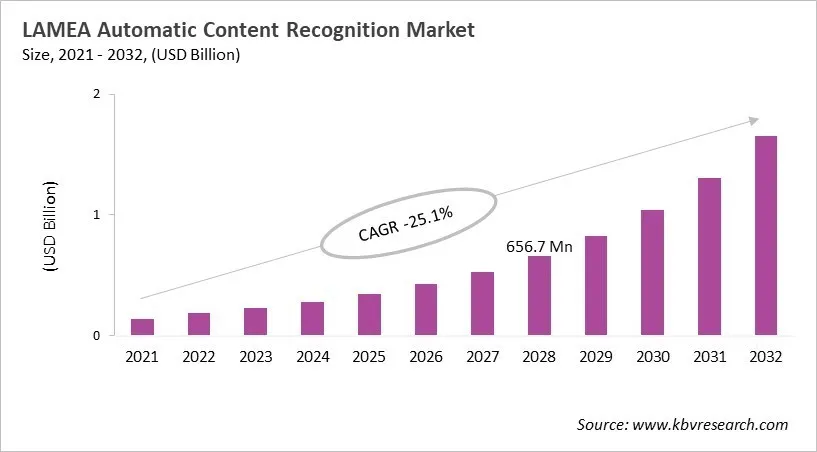
The Automatic Content Recognition (ACR) market in the LAMEA region, which includes Latin America, the Middle East, and Africa, has grown as more people use smart TVs, digital broadcasting, and media platforms that connect to the internet. Using fingerprinting or watermarking techniques, ACR lets connected devices find audio and video content in real time. This helps with content discovery, personalization, and analytics. The technology has become more popular because more people are buying smart TVs, broadband is getting better, and ACR is being built into OEM operating systems. Latin America is the first to adopt it through digital broadcasting projects, the Middle East is using smart city and connected home investments, and Africa is slowly adopting ACR as infrastructure and affordability improve.
Multilingual content recognition, data-driven advertising, and AI-powered analytics for personalization and campaign measurement are some of the most important trends in the LAMEA ACR market. Samsung, LG, Sony, Hisense, and TCL are some of the biggest OEMs that focus on localization, following the rules, and working with local broadcasters to improve recognition accuracy and user relevance. In this area, competition is less about hardware and more about how advanced embedded ACR systems are, how well they can analyze data, and how well they can adapt content to fit different cultures. Overall, ACR is becoming more and more of a key technology that makes it possible to easily navigate content, show targeted ads, and improve digital experiences across LAMEA's diverse and changing media ecosystems.
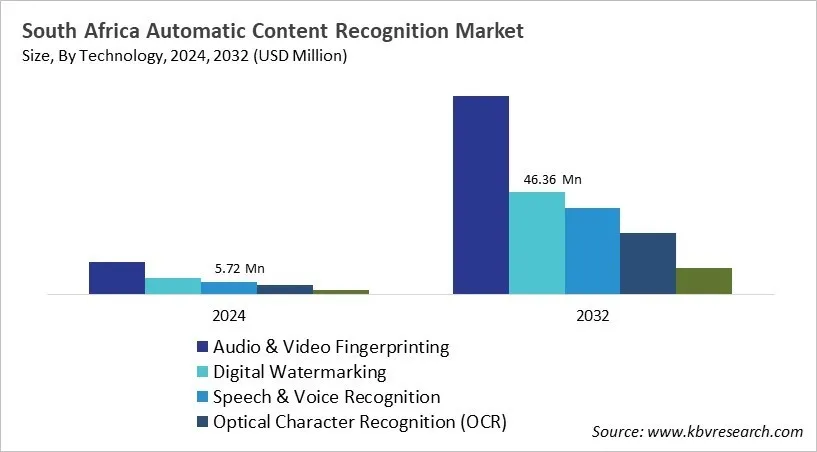
Based on Technology, the market is segmented into Audio & Video Fingerprinting, Digital Watermarking, Speech & Voice Recognition, Optical Character Recognition (OCR) and Other Technology. The Audio & Video Fingerprinting market segment dominated the South Africa Automatic Content Recognition Market by Technology is expected to grow at a CAGR of 25.7 % during the forecast period thereby continuing its dominance until 2032. Also, The Optical Character Recognition (OCR) market is anticipated to grow as a CAGR of 27.6 % during the forecast period during (2025 - 2032).
Based on End-User Industry, the market is segmented into Media & Entertainment, Consumer Electronics OEMs, Advertising & Marketing, Telecom & IT, Automotive, Healthcare and Other End-User Industry. Among various Brazil Automatic Content Recognition Market by End-User Industry; The Media & Entertainment market achieved a market size of USD $25.2 Million in 2024 and is expected to grow at a CAGR of 22 % during the forecast period. The Healthcare market is predicted to experience a CAGR of 24.9% throughout the forecast period from (2025 - 2032).
Free Valuable Insights: The Worldwide Automatic Content Recognition Market is Projected to reach USD 19.32 Billion by 2032, at a CAGR of 23.1%
Brazil is a major media and digital entertainment market in Latin America because it has a lot of people, a lot of TVs, and more people are watching streaming content. The move from linear broadcasting to hybrid and connected TV environments has made Automatic Content Recognition (ACR) more important. ACR lets you accurately identify content across broadcast, streaming, and on-demand platforms. The widespread use of smart TVs from global OEMs like Samsung and LG, along with the digital transformation of Brazil's advertising ecosystem, makes ACR an important tool for measuring audiences across platforms, analyzing content, and targeting ads. OEM-driven ACR solutions work with both linear and streaming content. They improve content recommendations and programmatic advertising while making sure that data use is in line with Brazil's privacy laws. Global OEMs and international technology companies are the main players in the competitive landscape. They focus on device coverage, data accuracy, and integration with analytics and advertising platforms. So, Brazil is an important market for the LAMEA ACR ecosystem as a whole.

By Solution
By Component
By Technology
By End-User Industry
By Country
Our team of dedicated experts can provide you with attractive expansion opportunities for your business.



 Unique Offerings