The Latin America, Middle East and Africa Automated Feeding Systems Market is expected to reach $919.50 million by 2028 and would witness market growth of 18.5% CAGR during the forecast period (2025-2032).
The Brazil market dominated the LAMEA Automated Feeding Systems Market by Country in 2024, and would continue to be a dominant market till 2032; thereby, achieving a market value of $552.3 million by 2032. The Argentina market is showcasing a CAGR of 19.7% during (2025 - 2032). Additionally, The UAE market would register a CAGR of 16.3% during (2025 - 2032). The Brazil and Saudi Arabia led the LAMEA Automated Feeding Systems Market by Country with a market share of 32.2% and 13.4% in 2024. The South Africa market is expected to witness a CAGR of 19.8% during throughout the forecast period.
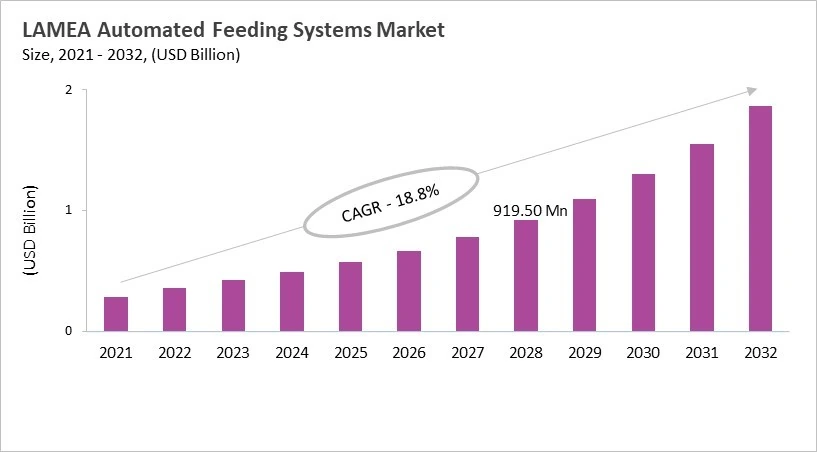
The LAMEA Automated Feeding Systems Market has grown in line with goals for modernizing farming and making sure there is enough food in Latin America, the Middle East, and Africa. Livestock farms used to rely on manual feeding, but they are now using more mechanized and automated solutions because of things like workers moving to other jobs, farms getting bigger, and the need for more efficiency. OEMs like Lely, GEA, and DeLaval have grown in their regions by adding robotic and programmable feeding systems to their barn management platforms. Adoption is highest in markets that export goods and have limited resources, like Brazil and the Middle East, where precision feeding helps with productivity and sustainability.
Digital and smart farming technologies are becoming more popular, resource efficiency is becoming more important, and commercial livestock farms are becoming more modern. Increasingly, automated feeding systems are being linked to herd monitoring and farm management software to make things work better and cut down on waste. Competitive strategies focus on new technologies, networks of dealers in different regions, and modular system design that can be used on farms of different sizes and in different climates. In advanced markets, competition is based on integration and reliability. In emerging African economies, on the other hand, affordability and training support are very important. Digital transformation, sustainability priorities, and the growth of commercial livestock in different LAMEA regions all influence the market.
Based on components, the automated feeding systems market is characterized into hardware, services, and software. Among various UAE Automated Feeding Systems Market by Component; The Hardware market achieved a market size of USD $23.8 Million in 2024 and is expected to grow at a CAGR of 15.9 % during the forecast period. The Services market is predicted to experience a CAGR of 16.8% throughout the forecast period from (2025 - 2032).
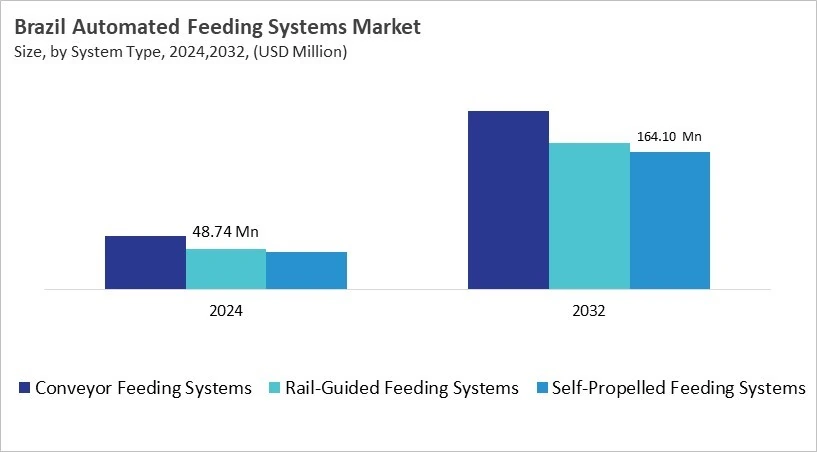
On the basis of system type, the automated feeding systems market is classified into conveyor feeding systems, rail-guided feeding systems, self-propelled feeding systems. The Conveyor Feeding Systems market segment dominated the Brazil Automated Feeding Systems Market by System Type is expected to grow at a CAGR of 16.5 % during the forecast period thereby continuing its dominance until 2032. Also, The Self-Propelled Feeding Systems market is anticipated to grow as a CAGR of 17.9 % during the forecast period during (2025 - 2032).
Free Valuable Insights: Automated Feeding Systems Market Size Worth USD 16.85 billion by 2032
The market for automated feeding systems in Brazil is growing as big producers of beef, poultry, pork, and dairy use technology to make their businesses more efficient and competitive. Automated feeding helps with accurate feed distribution, less waste, and better animal health in operations that require a lot of work. The push for higher productivity and sustainability is a big reason why, and organizations like the Brazilian Agricultural Research Corporation (Embrapa) are promoting new farming technologies. Market trends show that systems that use sensors, IoT, and data analytics to manage feed and herds in real time are becoming more popular. There are both international OEMs and local agritech companies that compete by offering solutions that work well in Brazilian farming conditions. These partnerships make it easier for farms of all sizes to use automation. But there are still problems with high upfront costs, the need for training, and connecting to the internet in rural areas. Despite this, precision livestock farming is still growing in Brazil's livestock industry.

By Component
By System Type
By Livestock
By Country
Our team of dedicated experts can provide you with attractive expansion opportunities for your business.



 Unique Offerings