The Latin America, Middle East and Africa AI Server Market would witness market growth of 40.0% CAGR during the forecast period (2025-2032).
The Brazil market dominated the LAMEA AI Server Market by Country in 2024, and would continue to be a dominant market till 2032; thereby, achieving a market value of $34,853.6 million by 2032. The Argentina market is showcasing a CAGR of 41.9% during (2025 - 2032). Additionally, The UAE market would register a CAGR of 38.6% during (2025 - 2032).
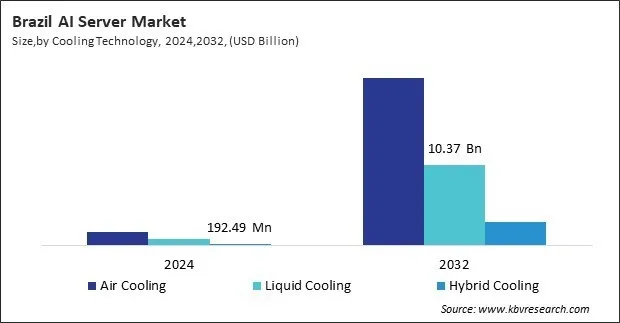
The Latin America, Middle East, and Africa (LAMEA) region has witnessed a significant transformation in its AI server market, driven by a combination of governmental initiatives, technological advancements, and increased demand across various sectors. Countries like Brazil, the United Arab Emirates (UAE), and South Africa have emerged as key players, investing heavily in AI infrastructure to bolster their digital economies. In Brazil, the government's commitment to digital transformation has led to substantial investments in AI infrastructure. The country's focus on enhancing its technological capabilities is evident in its support for AI-driven projects across healthcare, agriculture, and finance sectors.
Similarly, the UAE has launched the UAE Strategy for Artificial Intelligence 2031, aiming to position itself as a global leader in AI by integrating it into various sectors, including transportation, healthcare, and education. This strategy emphasizes the development of AI infrastructure, including the deployment of advanced AI servers to support large-scale data processing and analytics. The evolution of the AI server market in LAMEA is also marked by the increasing involvement of Original Equipment Manufacturers (OEMs) and technology firms. Companies like Dell Technologies and Hewlett Packard Enterprise (HPE) have expanded their operations in the region, offering AI-optimized server solutions tailored to local needs.
Free Valuable Insights: The Worldwide AI Server Market is Projected to reach USD 1.6 Trillion by 2032, at a CAGR of 37.5%
The LAMEA region—comprising Latin America, the Middle East, and Africa—is increasingly becoming a strategic frontier for AI server infrastructure. While still trailing mature markets in North America, Europe, and parts of Asia, LAMEA is witnessing a rapid adoption of AI servers driven by government-led digital transformation agendas, cloud provider expansion, and the rise of sovereign compute infrastructure in energy, healthcare, security, and public services.
The Gulf nations—particularly the United Arab Emirates (UAE) and Saudi Arabia—are leading the Middle East’s push into AI infrastructure:
These developments reflect a strategic shift from cloud consumption to national AI infrastructure ownership, which is heavily server-reliant.
Sub-Saharan African countries are entering the AI server market through international partnerships, startup ecosystems, and academic research initiatives:
The region is also home to startup-led AI labs (e.g., Data Science Nigeria, iCog Labs Ethiopia) that operate micro data centers powered by modular AI servers.
The LAMEA (Latin America, Middle East, and Africa) region presents a unique and increasingly dynamic competitive environment in the AI server market. Characterized by sovereign infrastructure initiatives, expanding cloud presence, and infrastructure modernization across emerging economies, the region is witnessing a multi-directional competitive wave from global tech giants, regional cloud providers, and government-backed innovation programs.
The Middle East, particularly Saudi Arabia and the United Arab Emirates (UAE), is leading the competitive charge through government-led AI infrastructure programs:
The competitive landscape here is dominated by sovereign data control, bilingual (Arabic-English) LLM training, and vendor alignment with national strategies.
Africa is gradually emerging as a future-ready AI server market, led by South Africa, Nigeria, Kenya, and Egypt:
The African competitive environment is community-centric, cost-sensitive, and increasingly decentralized—favoring modular AI server deployments with open-source support.
Based on the Processor Type, the AI server market is segmented into GPU-based, FPGA-based, and ASIC-based servers. The GPU-Based Servers held the major market share among all the processor types in 2024 followed by FPGA-based Servers.
Trend: The LAMEA region is witnessing a significant push towards GPU-based AI servers, driven by collaborations between global tech giants and local enterprises to enhance AI capabilities.
Supporting News:
Trend: FPGA-based servers are gaining traction in the LAMEA region, particularly for applications requiring customizable and energy-efficient AI processing solutions.
Supporting News:
Based on Cooling Technology, the market is segmented into Air Cooling, Liquid Cooling, and Hybrid Cooling.
Trend: Widespread implementation in emerging LAMEA data centers, especially in Latin America, utilizing ambient air and evaporative techniques to manage rack-level heat efficiently and sustainably.
To illustrate:
Trend: Adoption of liquid-cooled and immersion systems is accelerating in data centers across Africa and Latin America, driven by the need to support high-density AI workloads and reduce energy consumption.
To illustrate:
Based on Form Factor, the LAMEA AI Server Market is segmented into Rack-mounted servers, Blade Servers, and Tower servers segment. The Rack mounted server segment garnered the highest revenue share among others in 2024 in LAMEA AI Server Market.
Trend:Rack-mounted servers are widely adopted in the LAMEA region due to their scalability and efficient space utilization, making them ideal for data centers and enterprise environments.
To illustrate:
Trend:Blade servers are gaining traction in the LAMEA region, particularly in environments requiring high-density computing and efficient resource utilization, such as virtualization and cloud computing.
To illustrate:
Trend:Based on the End Use, the LAMEA AI Server Market is segmented into IT & Telecommunication, BFSI, Retail & E-commerce, Healthcare & Pharmaceutical, Automotive and Other End Use. The IT & Telecommunication segment garnered the largest revenue share in LAMEA market followed by BFSI and Retail & E-commerce among all other end use verticals.
The IT & Telecommunication sector leads AI server adoption in the LAMEA region, driven by increased mobile and internet penetration, digital transformation efforts, and smart infrastructure expansion. Countries such as UAE, Nigeria, and Brazil are heavily investing in AI to enhance connectivity and operational efficiency.
Trend:Telecom operators are leveraging AI servers to optimize network traffic, predict service faults, and personalize customer interactions. AI is also aiding energy efficiency in data centers. The region’s AI in Telecom market is forecasted to grow at a CAGR of 43.8% through 2030, reflecting widespread digitization efforts and AI-driven network modernization.
To illustrate:
Major players like Etisalat (UAE), MTN (South Africa), and Oi (Brazil) are integrating AI through partnerships with global vendors such as Ericsson and Huawei. These providers deploy GPU-enabled AI servers to power intelligent call routing, network self-healing, and 5G expansion
In the BFSI segment, financial institutions in LAMEA are turning to AI servers to enhance fraud detection, risk analysis, and customer experience. Digital banking growth and regulatory tech reforms have spurred demand for robust AI compute infrastructure.
Trend:AI is being used to automate loan processing, detect fraudulent transactions in real-time, and deliver hyper-personalized financial products.
To illustrate:
Banks like Emirates NBD, Banco do Brasil, and First Bank of Nigeria deploy AI servers supported by IBM, Oracle, and local cloud vendors. AI workloads are also offloaded to regional data centers powered by Nvidia GPU clusters for secure, real-time analytics.
Based on Processor Type, the market is segmented into GPU-based Servers, FPGA-based Servers, and ASIC-based Servers. Based on Cooling Technology, the market is segmented into Air Cooling, Liquid Cooling, and Hybrid Cooling. Based on Form Factor, the market is segmented into Rack-mounted Servers, Blade Servers, and Tower Servers. Based on End Use, the market is segmented into IT & Telecommunication, BFSI, Retail & E-commerce, Healthcare & Pharmaceutical, Automotive, and Other End Use. Based on countries, the market is segmented into Brazil, Argentina, UAE, Saudi Arabia, South Africa, Nigeria, and Rest of LAMEA.

By Processor Type
By Cooling Technology
By Form Factor
By End Use
By Country
Our team of dedicated experts can provide you with attractive expansion opportunities for your business.



 Unique Offerings