The Latin America, Middle East and Africa AI Annotation Market would witness market growth of 27.6% CAGR during the forecast period (2025-2032).
The Brazil market dominated the LAMEA AI Annotation Market by Country in 2024, and would continue to be a dominant market till 2032; thereby, achieving a market value of $254.5 million by 2032. The Argentina market is showcasing a CAGR of 29% during (2025 - 2032). Additionally, The UAE market would register a CAGR of 26% during (2025 - 2032). The Brazil and UAE led the LAMEA AI Annotation Market by Country with a market share of 33.4% and 10.8% in 2024. The Nigeria market is expected to witness a CAGR of 30.7% during throughout the forecast period.
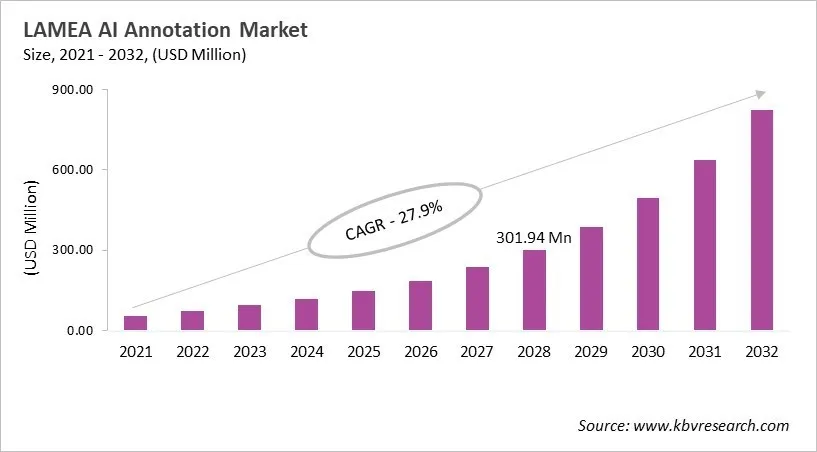
The training-data annotation segment in the LAMEA region has progressed from fundamental outsourcing assistance to a strategic facilitator aligned with regional AI and digital transformation initiatives. In Latin America, government programs are focused on AI strategies, training the workforce, and partnerships between the public and private sectors to boost social inclusion, innovation, and productivity. Parts of Africa and the Middle East are also using annotation operations as both local service-economy opportunities and the basis for national AI projects. Over time, annotation services have evolved from simple tagging to more complex workflows that can handle multilingual text, images, and videos that are relevant to a specific culture, and model training that is specific to a certain region. This has been made possible by improvements in digital infrastructure, workforce skills, and regulatory frameworks. This change shows that annotation services are becoming more focused on localization, more aware of regulations, and more open to including workers. These services will support a wide range of AI applications in agriculture, healthcare, and smart cities.
Multilingual and culturally aware data labeling, compliance with regional AI governance and data protection policies, and the growth of local digital skills to fit into global AI value chains are some of the most important trends affecting the LAMEA annotation market. Market leaders set themselves apart by having annotation teams that speak different languages, following the rules, training the local workforce, and using tools and semi-automated workflows for quality assurance. Competition is defined by a dual dynamic: local providers leverage cost and regional expertise, while global players bring process maturity, tooling, and scale. As annotation becomes more strategic and less about cost, providers are competing more on their ability to localize, follow regulations, have domain expertise, and deliver high-quality work. This makes it harder for new companies to enter the LAMEA ecosystem and keeps clients coming back.
Based on Data Modality, the market is segmented into Image & Video Computer Vision, Text & Natural Language Processing (NLP), LiDAR & Sensor fusion, Tabular, Structured, & Synthetic Data Tagging and Audio & Speech. The Image & Video Computer Vision market segment dominated the South Africa AI Annotation Market by Data Modality is expected to grow at a CAGR of 27.3 % during the forecast period thereby continuing its dominance until 2032. Also, The Tabular, Structured, & Synthetic Data Tagging market is anticipated to grow as a CAGR of 30 % during the forecast period during (2025 - 2032).
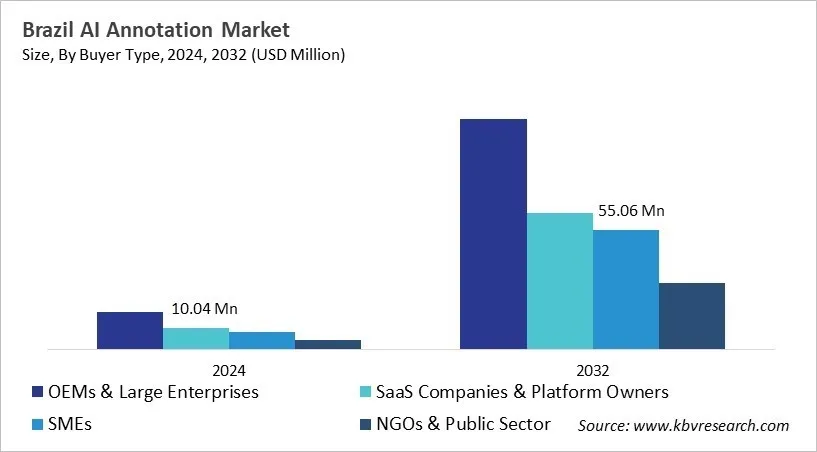
Based on Buyer Type, the market is segmented into OEMs & Large Enterprises, SaaS Companies & Platform Owners, SMEs and NGOs & Public Sector. Among various Brazil AI Annotation Market by Buyer Type; The OEMs & Large Enterprises market achieved a market size of USD $17.4 Million in 2024 and is expected to grow at a CAGR of 25.7 % during the forecast period. The SMEs market is predicted to experience a CAGR of 27.2% throughout the forecast period from (2025 - 2032).
Free Valuable Insights: The Worldwide AI Annotation Market is Projected to reach USD 8.68 Billion by 2032, at a CAGR of 25.7%
The market for Brazilian AI annotation services is growing quickly because Brazil is Latin America's largest economy, and the government has made AI and data governance a national priority. As more and more industries, like agribusiness, healthcare, finance, and public services, go digital, the need for advanced annotation solutions like semantic segmentation, multimodal labeling, and Portuguese-language datasets is growing. Regulatory factors, such as the LGPD and the proposed AI Act, are shaping the market by putting a lot of stress on ethical practices, data privacy, and compliance across borders. Digital infrastructure investments, like data centers, help support large-scale annotation workflows. At the same time, crowdsourced and hybrid human-AI pipelines are becoming more popular because they are more efficient and cost-effective. There are both domestic and international competitors. Domestic competitors include universities, research centers, and OEMs. International competitors must also adapt to local language and governance needs. Overall, Brazil has a lot of potential for growth in the annotation services market. However, it is important to make sure that all rules are followed, that data is safe, and that the work is of high quality.

By Data Modality
By Buyer Type
By Vertical
By Country
Our team of dedicated experts can provide you with attractive expansion opportunities for your business.



 Unique Offerings