The Latin America, Middle East and Africa 3D NAND Flash Memory Market would witness market growth of 24.3% CAGR during the forecast period (2025-2032).
The Brazil market dominated the LAMEA 3D NAND Flash Memory Market by Country in 2024, and would continue to be a dominant market till 2032; thereby, achieving a market value of $1,561.7 million by 2032. The Argentina market is showcasing a CAGR of 25.2% during (2025 - 2032). Additionally, The UAE market would register a CAGR of 23% during (2025 - 2032). The Brazil and UAE led the LAMEA 3D NAND Flash Memory Market by Country with a market share of 20.2% and 13.6% in 2024.The South Africa market is expected to witness a CAGR of 25.4% during throughout the forecast period.
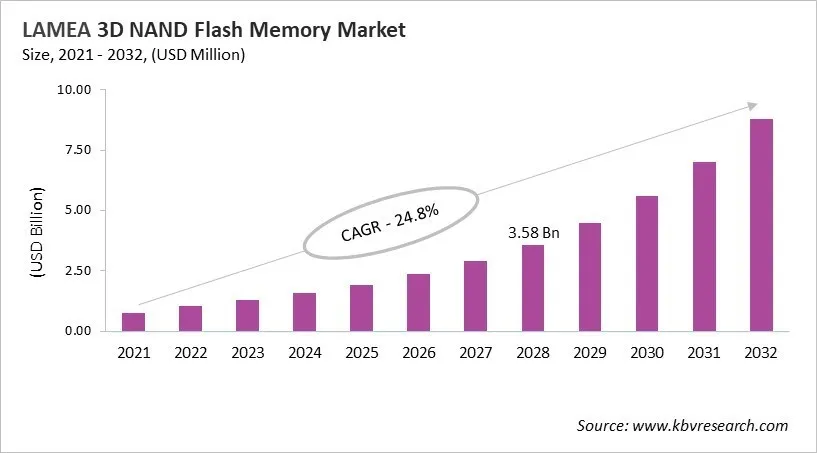
The LAMEA 3D NAND flash memory market has grown along with the region's rapid digital transformation, which is being driven by more mobile connectivity, cloud adoption, and public digital infrastructure projects. Historically, Latin America, the Middle East, and Africa were end markets rather than manufacturing hubs. However, as planar technologies reached their limits, the demand for high-density, reliable storage has made 3D NAND more important. Government-led programs in e-governance, digital inclusion, and national data infrastructure have made it much easier for data centers, telecommunications networks, and enterprise IT systems to adopt new technologies. OEMs have responded by making 3D NAND solutions that are energy-efficient, long-lasting, and affordable, and that work with the infrastructure and environmental conditions in each region.
Strong demand from data centers, cloud platforms, and mobile-driven digital ecosystems, especially in Africa and parts of Latin America, is helping the market grow even more. Energy efficiency and sustainability have become important factors in making decisions. This has led to OEM innovations in advanced 3D NAND architectures that address regional power and cost issues. Top suppliers are working on strategies that include making products more local, working with regional integrators and governments, and building strong global supply chains. As a result, competition in the LAMEA market focuses on reliability, scalability, and total cost of ownership. This makes 3D NAND flash memory a key technology for the region's integration into the global digital economy.
Based on Type, the market is segmented into Triple-Level Cell, Multi-Level Cell, and Single-Level Cell & Others. The Triple-Level Cell market segment dominated the UAE 3D NAND Flash Memory Market by Type is expected to grow at a CAGR of 22.5 % during the forecast period thereby continuing its dominance until 2032. Also, The Multi-Level Cell market is anticipated to grow as a CAGR of 23.6 % during the forecast period during (2025 - 2032).
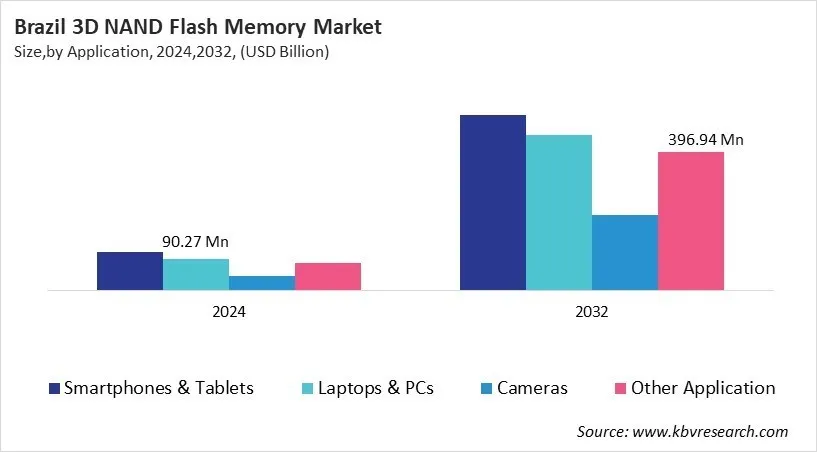
Based on Application, the market is segmented into Smartphones & Tablets, Laptops & PCs, Cameras, and Other Application. With a compound annual growth rate (CAGR) of 21.4% over the projection period, the Smartphones & Tablets Market, dominate the Brazil 3D NAND Flash Memory Market by Application in 2024 and would be a prominent market until 2032. The Cameras market is expected to witness a CAGR of 23.5% during (2025 - 2032).
Free Valuable Insights: The Worldwide 3D NAND Flash Memory Market is Projected to reach USD 101.63 Billion by 2032, at a CAGR of 22.2%
Brazil is a key player in the LAMEA 3D NAND flash memory market because it is the region's biggest consumer of technology and electronics. This is due to a strong ecosystem for electronics assembly and system integration, even though wafer-level manufacturing is not available. The high demand for imported NAND flash comes from its widespread use in smartphones, consumer electronics, enterprise storage, and public-sector IT infrastructure. Policies that encourage digital transformation, local electronics manufacturing, and strategic technologies indirectly boost NAND flash consumption. The market is also growing because more people are using smartphones, the cloud, and data centers, and e-government programs are helping. Global memory OEMs that sell their products through regional channels are the most competitive. Local companies, on the other hand, focus on assembly, integration, and distribution.

By Type
By Application
By End Use
By Country
Our team of dedicated experts can provide you with attractive expansion opportunities for your business.



 Unique Offerings