“Global IT Security Market to reach a market value of USD 734.02 Billion by 2032 growing at a CAGR of 12.5%”
The Global IT Security Market size is expected to reach $734.02 billion by 2032, rising at a market growth of 12.5% CAGR during the forecast period.
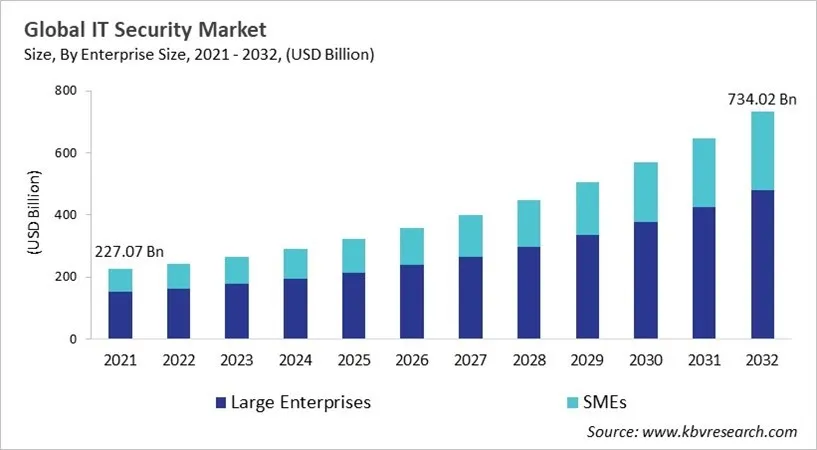
Recently, the IT security market has developed into a vast multibillion-dollar ecosystem underpinning major industries. Early security efforts emphasized antivirus tools and firewalls, but the explosion of cloud computing, digital connectivity, and mobile technologies exposed the drawbacks of perimeter-based defense. International bodies like ENISA and NIST, and governments, introduced frameworks to bolster resilience, while tech-giants such as IBM, Cisco, Microsoft, and Palo Alto Networks have expanded their cybersecurity portfolios. Nowadays, cybersecurity integrates quantum-safe encryption, automation, and artificial intelligence, emphasizing rapid response, systemic resilience, and governance across interconnected digital ecosystems, and not just on preventing breaches. The IT security market is predicted to grow with the prevalence of the Zero Trust model and a greater focus on continuous verification, collaboration, and resilience.
The IT security market is anticipated to expand supported by trends including AI-based defense, supply-chain risk management, and cloud native protection. Both defenders and attackers are harnessing ML and AI to automate detection, exploitation, and response, encouraging vendors to embed smart analytics into their platforms. Key players such IBM, Cisco, and Microsoft are transforming to integrated AI-powered security platforms and managed services that help with 24/7 protection. The IT security market seems to be highly competitive with multinational leaders and agile innovators from regions like Singapore, India and Israel. Regional variations in digital maturity and regulation drive growth of IT security market. The North America and Europe are focusing on compliance, while Asia Pacific and developing markets are driving through national cybersecurity, and rapid digital expansion.
The major strategies followed by the market participants are Partnerships as the key developmental strategy to keep pace with the changing demands of end users. For instance, In October 2025, IBM came into partnership with Anthropic to integrate Claude AI into IBM’s enterprise software portfolio. The collaboration aims to enhance productivity and software development efficiency while embedding robust security, governance, and compliance controls across the development lifecycle for enterprise clients. Moreover, In October, 2025, Fortinet expanded its partnership with Armis to enhance global cybersecurity resilience. By integrating Armis Centrix with the Fortinet Security Fabric, Fortinet delivers unified visibility, automated enforcement, and proactive defense, helping organizations eliminate blind spots and strengthen protection across their digital attack surfaces.
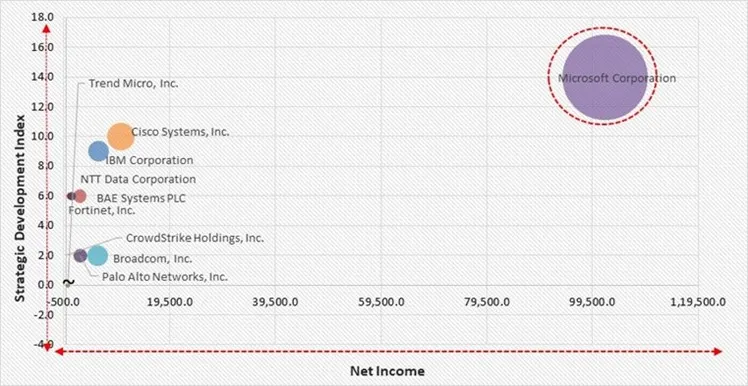
Based on the Analysis presented in the KBV Cardinal matrix; Microsoft Corporation is the forerunners in the IT Security Market. In June, 2024, Microsoft Corporation and CrowdStrike announced a collaboration to align threat actor naming taxonomies, improving clarity, speed, and accuracy in cyber threat intelligence. This joint reference guide enhances coordination, confidence, and response efficiency across cybersecurity platforms within the global IT security market. Companies such as Cisco Systems, Inc. and IBM Corporation are some of the key innovators in IT Security Market.
The COVID-19 pandemic sped up the growth and strategic importance of the IT security market by a lot as companies quickly switched to remote and hybrid work. Companies put more money into making sure that their endpoints, cloud environments, VPNs, and collaboration tools were safe. They also started using new frameworks like zero trust, MFA, and SASE. As cyber threats like phishing and ransomware grew, governments and businesses became more aware of the problem. This led to stronger national cyber defenses and modernization efforts. The rise in cloud use increased the need for AI-powered, cloud-native security solutions like IAM, XDR, and endpoint protection. This led to strong revenue growth for major vendors. Cybersecurity went from being a reactive support function to a key part of business strategy and digital resilience. This solidified its long-term growth in the market. Thus, the COVID-19 pandemic had a positive impact on the market.

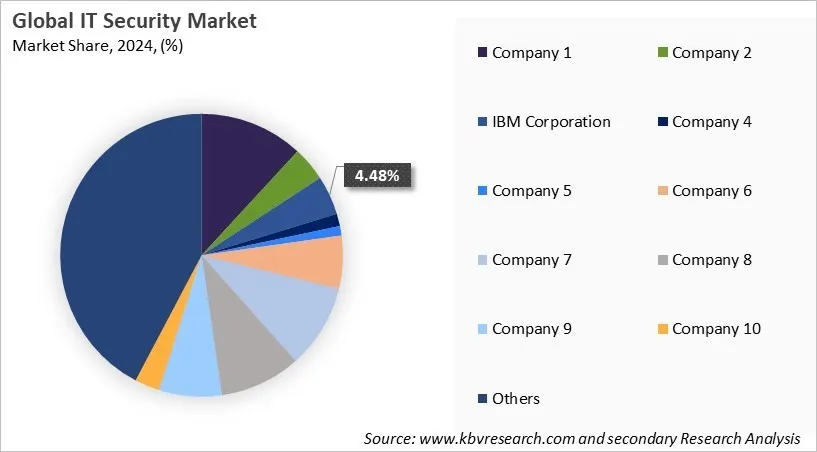
The leading players in the market are competing with diverse innovative offerings to remain competitive in the market. The above illustration shows the percentage of revenue shared by some of the leading companies in the market. The leading players of the market are adopting various strategies in order to cater demand coming from the different industries. The key developmental strategies in the market are Acquisitions, and Partnerships & Collaborations.
Free Valuable Insights: IT Security Market size to reach USD 734.02 Billion by 2032
Based on Enterprise Size, the market is segmented into Large Enterprises, and SMEs. The SMEs segment attained 33% revenue share in the IT security market in 2024. SMEs—organisations with fewer employees, simpler IT infrastructures and more constrained budgets—form a distinct and growing market segment. Their cybersecurity needs tend to focus on foundational protection: endpoint security, firewall/UTM, access control and basic monitoring. While smaller in total expenditure compared to large enterprises, SMEs are increasingly adopting security solutions as regulation tightens, supply-chain demand spreads and cyber-risk awareness rises.
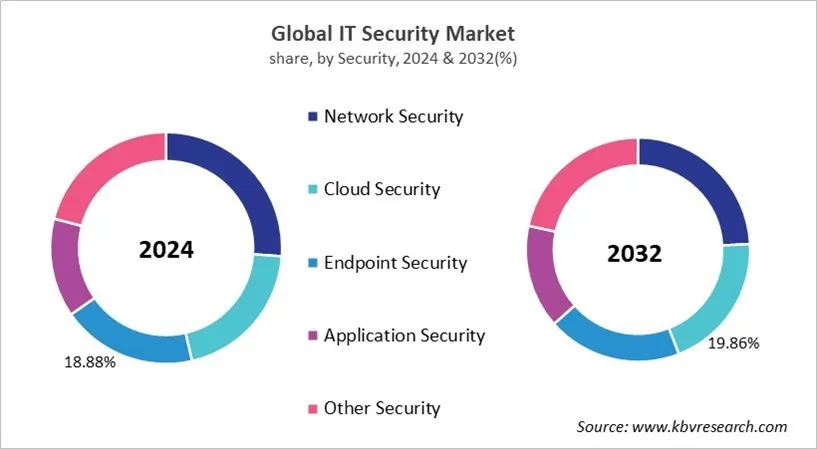
Based on Security, the market is segmented into Network Security, Cloud Security, Endpoint Security, Application Security, and Other Security. The cloud security segment witnessed 20% revenue share in the IT security market in 2024. The cloud security segment focuses on securing public, private, and hybrid cloud environments, including workloads, containers, and SaaS applications. With the rise of remote operations and multi-cloud adoption, cloud security solutions—such as configuration management, identity governance, and workload protection—are essential. OEMs like Microsoft and AWS promote shared-responsibility frameworks and automated threat detection for cloud resilience.
Region-wise, the IT security market is analyzed across North America, Europe, Asia Pacific, and LAMEA. The North America segment recorded 36% revenue share in the IT security market in 2024. The IT security market is predicted to experience prominent growth in the North America and Europe regions. This is due to high digital adoption, strict data protection regulations, and the presence of major technology providers. Further, the demand for cybersecurity has surged due to advanced cloud adoption, increasing ransomware incidents, and government initiatives like the US Cybersecurity and Infrastructure Security (CISA) programs and the Executive Order on Improving the Nation’s Cybersecurity. The region’s large investment in zero-trust frameworks, managed security services, and AI-driven threat detection is supporting market expansion. Moreover, in Europe, the IT security market is growing, backed by the General Data Protection Regulation (GDPR) and the EU Cyber Resilience Act, which has established a strong compliance-oriented security culture. Also, the European Union Agency for Cybersecurity is promoting regional collaboration, while nations like the UK, Germany, and France are resulting in digital sovereignty initiatives.
In the Asia Pacific and LAMEA regions, the IT security market is anticipated to grow at a significant rate. This is because of the rising cloud infrastructure, accelerated digital transformation, and growing cyberattacks targeting in developing nations. In the Asia Pacific, countries such as Singapore, Japan, India, and China are investing heavily in national cybersecurity frameworks, regional capacity building, and private-public partnerships. The region’s expanding fintech industry and e-commerce also support demand for endpoint protection and identity management solutions. In addition, in LAMEA, cybersecurity growth is supported by infrastructure investments and government modernization programs, especially in the Gulf Cooperation Council (GCC) countries and Brazil.
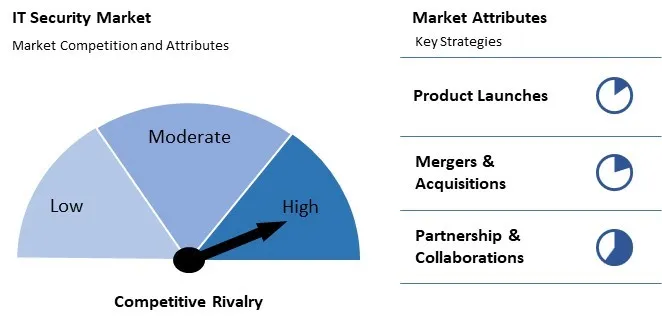
The IT security market is very competitive because technology is always changing, and cyber threats are getting worse. Providers stand out by being innovative, offering a wide range of protection options, and having strong threat intelligence capabilities. The market is changing quickly in areas like AI-driven defense, cloud security, and zero-trust. This is making competitors work harder to be more flexible and respond faster. As regulations get stricter and attack surfaces get bigger, participants try to find a balance between strong protection and ease of use. This makes the landscape change all the time, so it's important to keep getting better to stay relevant.
| Report Attribute | Details |
|---|---|
| Market size value in 2025 | USD 322.23 Billion |
| Market size forecast in 2032 | USD 734.02 Billion |
| Base Year | 2024 |
| Historical Period | 2021 to 2023 |
| Forecast Period | 2025 to 2032 |
| Revenue Growth Rate | CAGR of 12.5% from 2025 to 2032 |
| Number of Pages | 770 |
| Number of Tables | 744 |
| Report coverage | Market Trends, Revenue Estimation and Forecast, Segmentation Analysis, Regional and Country Breakdown, Competitive Landscape, Market Share Analysis, Porter’s 5 Forces Analysis, Company Profiling, Companies Strategic Developments, SWOT Analysis, Winning Imperatives |
| Segments covered | Enterprise Size, Type, Security, Vertical, Region |
| Country scope |
|
| Companies Included | Microsoft Corporation, Broadcom, Inc., IBM Corporation, BAE Systems PLC, NTT Data Corporation, Cisco Systems, Inc., Palo Alto Networks, Inc., Fortinet, Inc., CrowdStrike Holdings, Inc., and Trend Micro, Inc. |
By Enterprise Size
By Type
By Security
By Vertical
By Geography
This Market size is expected to reach USD 734.02 Billion by 2032.
The IT Security market is projected to grow at a CAGR of 12.5% between 2025 and 2032.
An escalating threat landscape and growing critical infrastructure risks, alongside regulatory, compliance, and government-mandated cybersecurity initiatives, are driving heightened focus on robust security measures.
Microsoft Corporation, Broadcom, Inc., IBM Corporation, BAE Systems PLC, NTT Data Corporation, Cisco Systems, Inc., Palo Alto Networks, Inc., Fortinet, Inc., CrowdStrike Holdings, Inc., and Trend Micro, Inc.
The Network Security segment led the maximum revenue in the Global IT Security Market by Security in 2024, thereby, achieving a market value of $177.7 billion by 2032.
The North America region dominated the Global IT Security Market by Region in 2024, and would continue to be a dominant market till 2032; thereby, achieving a market value of $249.5 billion by 2032.
Our team of dedicated experts can provide you with attractive expansion opportunities for your business.











 Unique Offerings