“Global Integrated Vehicle Health Management Market to reach a market value of USD 44.35 Billion by 2032 growing at a CAGR of 11.6%”
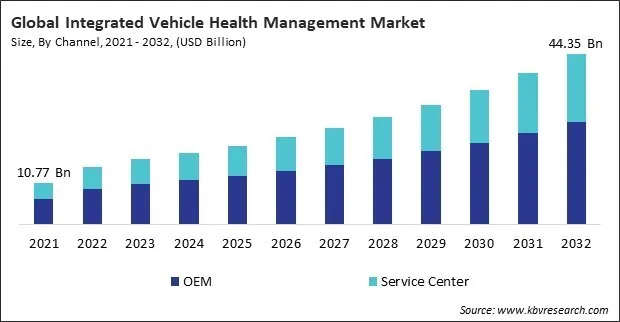
The Global Integrated Vehicle Health Management Market size is expected to reach $44.35 billion by 2032, rising at a market growth of 11.6% CAGR during the forecast period.
These systems are designed to deliver real-time diagnostics and prognostics, ensuring the vehicle's performance is continuously monitored from the moment it leaves the factory. OEMs often embed sophisticated software and sensors into vehicles, which not only enhance safety and reliability but also allow for seamless integration with other in-vehicle technologies. This approach is increasingly favored by manufacturers aiming to improve customer satisfaction, reduce warranty costs, and support predictive maintenance strategies.

The growing demand for predictive maintenance solutions in both the automotive and aerospace sectors is one of the most influential forces driving the (IVHM) market. Traditional maintenance approaches, such as reactive or scheduled maintenance, often result in unnecessary costs, operational downtimes, and the risk of catastrophic failure. In conclusion, the expanding application of predictive maintenance across transportation sectors is a powerful catalyst for IVHM adoption, significantly improving operational reliability, cost efficiency, and asset longevity.
Additionally, as vehicles become increasingly sophisticated with the integration of electronic, mechanical, and software-based systems, the need for comprehensive health monitoring platforms has become imperative. The IVHM market is benefiting from this trend as traditional diagnostic tools and manual checks are no longer sufficient to ensure the safe and efficient operation of modern vehicles. In conclusion, the rising integration of complex systems in modern vehicles underscores the necessity for advanced health management solutions like IVHM, making it an indispensable tool for operational stability and risk reduction.
The deployment of 5G in the aviation sector involves significant capital investment, which poses a major restraint to its adoption, especially among budget-constrained airlines and smaller airport authorities. Unlike previous generations of wireless technologies, 5G requires a denser network of base stations, antennas, and backhaul infrastructure to deliver its promised speed and ultra-low latency. Therefore, the substantial capital requirements and infrastructure complexities associated with 5G deployment act as a major deterrent, slowing down its widespread adoption in the aviation sector.
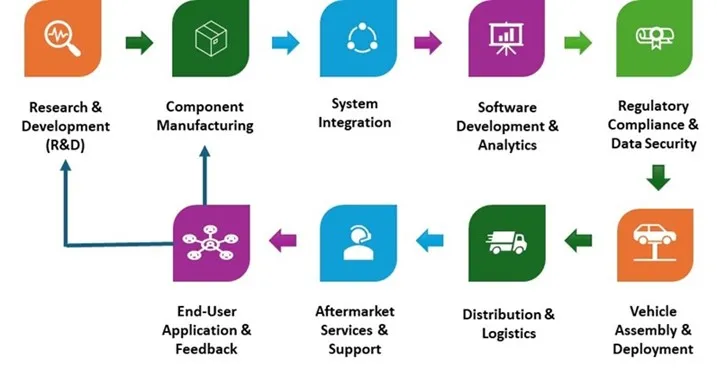
The value chain of the Integrated Vehicle Management market begins with Research & Development (R&D), where new technologies and innovations are conceptualized. It moves to Component Manufacturing, where individual hardware elements are produced. System Integration then ensures these components work cohesively. Following this, Software Development & Analytics add intelligence and control functionalities. Regulatory Compliance & Data Security ensures systems meet legal and safety standards. The process continues with Vehicle Assembly & Deployment, after which Distribution & Logistics manage the transportation of products. Aftermarket Services & Support maintain product performance, while End-User Application & Feedback guide improvements, looping insights back into R&D and manufacturing.
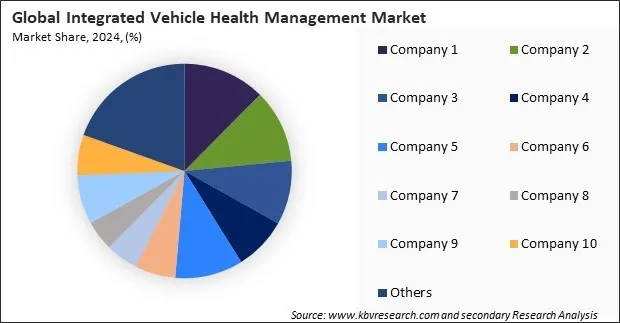
The leading players in the market are competing with diverse innovative offerings to remain competitive in the market. The above illustration shows the percentage of revenue shared by some of the leading companies in the market. The leading players of the market are adopting various strategies in order to cater demand coming from the different industries. The key developmental strategies in the market are Acquisitions, and Partnerships & Collaborations.
During the COVID-19 pandemic, global automotive manufacturing came to a standstill due to widespread lockdowns and restrictions. Major vehicle manufacturers halted production for several months, which directly affected the demand for integrated vehicle health management systems. With assembly lines idle and fewer new vehicles entering the market, the installation of IVHM systems significantly declined. The supply chains that supported the production of IVHM components were also heavily disrupted. Thus, the COVID-19 pandemic had a negative impact on the market.
Based on channel, the market is characterized into OEM and service center. The service center segment procured 38% revenue share in the market in 2024. The service center segment involves aftermarket installations and maintenance of integrated vehicle health management systems. These centers typically cater to vehicles already in use, providing retrofitting solutions or conducting diagnostics through specialized tools.
| Category | Details |
|---|---|
| Use Case Title | Confidential |
| Date | 2025 |
| Entities Involved | Confidential |
| Objective | Enable affordable, scalable IVHM insights through plug-and-play OBD-II diagnostic platforms at service centers—targeting aging vehicles and Tier-2/3 city coverage. |
| Context and Background | In markets with a high volume of aging and out-of-warranty vehicles, especially in emerging economies, the need for cost-effective and accessible vehicle health management is critical. Many such vehicles lack factory-installed diagnostics. This gap is now being filled by service centers leveraging aftermarket telematics and data analytics to provide predictive maintenance solutions, emissions compliance, and enhanced customer engagement. |
| Description | Castrol Auto Service, in collaboration with Mahindra First Choice, introduced a plug-and-play IVHM solution designed for aftermarket deployment. Vehicles are connected via OBD-II dongles that collect real-time performance data. This data is sent to a cloud analytics engine, where AI models assess fault probabilities and maintenance needs. Service advisors use dashboard tools to interpret the results, while customers receive proactive alerts via WhatsApp about upcoming maintenance or detected issues. The system also supports driver behavior profiling and helps generate resale certification reports based on historical vehicle health. |
| Key Capabilities Deployed |
|
| Regions Covered |
|
| Benefits |
|
| Source | Confidential |
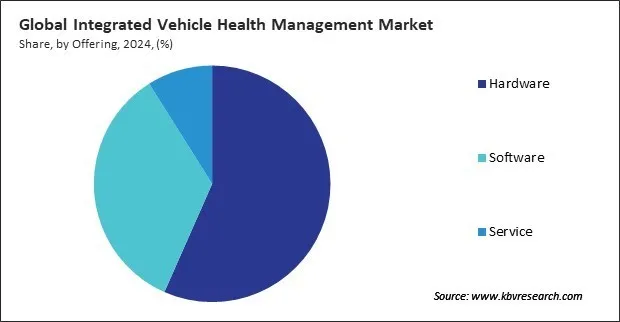
On the basis of offering, the market is classified into hardware, software, and service. The software segment recorded 34% revenue share in the market in 2024. Software in integrated vehicle health management refers to the analytical and monitoring platforms that interpret data collected from the vehicle's hardware. This includes diagnostic tools, predictive analytics, machine learning models, and user interfaces that enable actionable insights.
Based on end use, the market is segmented into commercial & defense aviation, automotive, marine, and others. The automotive segment acquired 38% revenue share in the market in 2024. The automotive segment represents a significant portion of the market, as manufacturers increasingly embed integrated health systems into modern vehicles. These systems track various mechanical and electronic parameters to inform drivers of issues, improve fuel efficiency, and support features like remote diagnostics and over-the-air updates.
By application, the integrated vehicle health management market is divided into diagnostics and prognostics. The prognostics segment garnered 28% revenue share in the integrated vehicle health management market in 2024. The prognostics segment is centered on the prediction of future failures or performance degradation before they occur. This application utilizes advanced data analytics, historical trends, and machine learning algorithms to assess the remaining useful life of various vehicle components.
Free Valuable Insights: Global Integrated Vehicle Health Management Market size to reach USD 44.35 Billion by 2032
Region-wise, the integrated vehicle health management market is analyzed across North America, Europe, Asia Pacific, and LAMEA. The North America segment recorded 34% revenue share in the integrated vehicle health management market in 2024. North America represents a mature and technologically advanced market for integrated vehicle health management. The region benefits from a well-established automotive and aerospace industry, along with a strong presence of key market players and advanced infrastructure.
| Report Attribute | Details |
|---|---|
| Market size value in 2024 | USD 18.75 Billion |
| Market size forecast in 2032 | USD 44.35 Billion |
| Base Year | 2024 |
| Historical Period | 2021 to 2023 |
| Forecast Period | 2025 to 2032 |
| Revenue Growth Rate | CAGR of 11.6% from 2025 to 2032 |
| Number of Pages | 404 |
| Number of Tables | 438 |
| Report coverage | Market Trends, Revenue Estimation and Forecast, Segmentation Analysis, Regional and Country Breakdown, Market Share Analysis, Porter’s 5 Forces Analysis, Company Profiling, Companies Strategic Developments, SWOT Analysis, Winning Imperatives |
| Segments covered | Channel, Offering, End Use, Application, Region |
| Country scope |
|
| Companies Included | Robert Bosch GmbH, Continental AG, ZF Friedrichshafen AG, Cummins, Inc., Denso Corporation, Visteon Corporation, Vector Informatik GmbH, Garrett Motion, Inc., OnStar Corporation (General Motors Co.), and HARMAN International Industries, Inc. (Samsung Electronics Co., Ltd.) |
By Channel
By Offering
By End Use
By Application
By Geography
This Market size is expected to reach $44.35 billion by 2032.
Increasing Demand for Predictive Maintenance in Automotive and Aerospace Industries are driving the Market in coming years, however, High Capital Expenditure and Infrastructure Constraints restraints the growth of the Market.
Robert Bosch GmbH, Continental AG, ZF Friedrichshafen AG, Cummins, Inc., Denso Corporation, Visteon Corporation, Vector Informatik GmbH, Garrett Motion, Inc., OnStar Corporation (General Motors Co.), and HARMAN International Industries, Inc. (Samsung Electronics Co., Ltd.)
The expected CAGR of this Market is 11.6% from 2023 to 2032.
The OEM segment captured the maximum revenue in the Market by Channel in 2024, thereby, achieving a market value of $26.70 billion by 2032.
The North America region dominated the Market by Region in 2024, thereby, achieving a market value of $14.37 billion by 2032.
Our team of dedicated experts can provide you with attractive expansion opportunities for your business.







 Unique Offerings