“Global Integrated Bridge Systems Market to reach a market value of USD 10.53 Billion by 2032 growing at a CAGR of 3.7%”
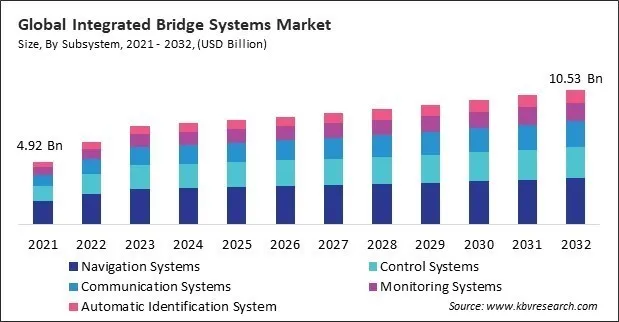
The Global Integrated Bridge Systems Market size is expected to reach $10.53 billion by 2032, rising at a market growth of 3.7% CAGR during the forecast period.
Navigation systems are the most important part of the Integrated Bridge Systems (IBS) design. They provide real-time information on the vessel's position, direction, and situation that helps it operate safely and efficiently. Navigation is an important subsystem that brings together parts like radar, Electronic Chart Display and Information Systems (ECDIS), Global Navigation Satellite Systems (GNSS/GPS), gyrocompasses, speed logs, autopilot, and echo sounders into a single interface.
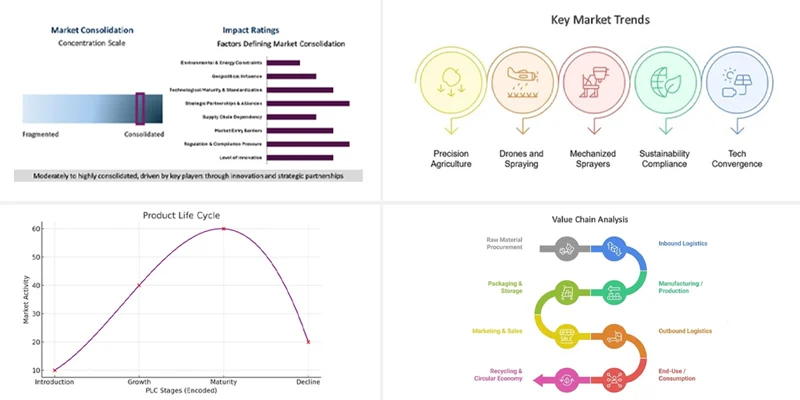

The steady rise in global marine traffic has been one of the biggest reasons why the need for Integrated Bridge Systems (IBS) has grown. The maritime sector is the most important part of worldwide trade. Almost 80% of the world's goods trade by volume and more than 70% by value goes by sea. The amount of goods moved across continents has grown a lot as globalization has gotten stronger and international trade has become more complicated. This has directly led to a need for ships that are safer, smarter, and more efficient. IBS plays a key part in this. As a result, the steady rise in global maritime trade and the requirement for vessels to operate in a way that is technologically sophisticated, efficient, and compliant are major factors driving the use of Integrated Bridge Systems.
Furthermore, as shipping channels throughout the world get busier, safety at sea has become a top priority for shipowners, naval architects, and regulatory organizations. Accidents at sea, such ship accidents, grounding, and oil spills, may have terrible effects on the economy and the environment. Integrated Bridge Systems (IBS) greatly reduce these dangers by bringing together several important navigation features into one easy-to-use interface. In conclusion, the effort throughout the industry to make shipping safer and lower the chance of accidents and collisions at sea is a strong factor behind the use and improvement of Integrated Bridge Systems.
One of the biggest reasons how Integrated Bridge Systems (IBS) aren't used more widely is that they take a lot of money to buy, install, and keep up. IBS has a lot of benefits for safety and efficiency, but these benefits come at a cost that not all ship operators can pay, especially those that work in emerging nations or have small fleets. Depending on the kind, size, and role of the vessel, a contemporary IBS arrangement might cost millions of dollars. since of this, the Integrated Bridge Systems market can't grow very quickly since it needs a lot of money up front and has continuous costs for operations and training. This is especially true for stakeholders who are sensitive to costs.
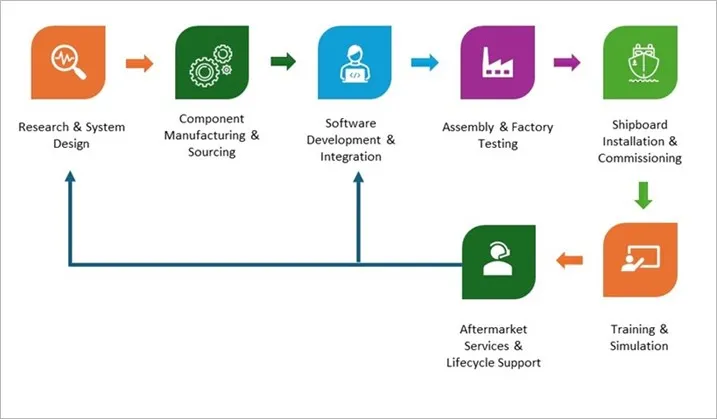
The value chain of the Integrated Bridge Systems (IBS) Market begins with Research & System Design, focusing on conceptualizing advanced navigation solutions. This is followed by Component Manufacturing & Sourcing, where critical hardware parts are produced or procured. Software Development & Integration then embeds essential navigation and control software. Afterward, Assembly & Factory Testing ensures system functionality and compliance. The systems are then moved to Shipboard Installation & Commissioning, enabling real-world operation. Training & Simulation equip crew members to use the system effectively, and Aftermarket Services & Lifecycle Support ensure long-term reliability and provide feedback that loops back into system design.
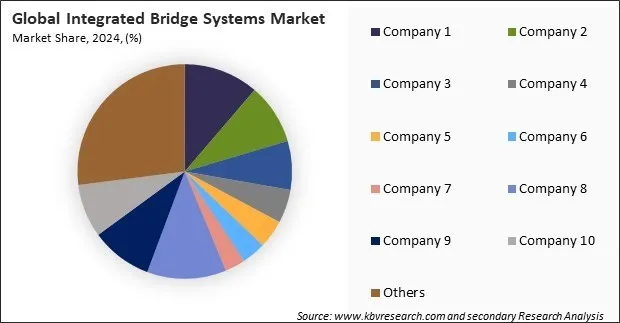
The leading players in the market are competing with diverse innovative offerings to remain competitive in the market. The above illustration shows the percentage of revenue shared by some of the leading companies in the market. The leading players of the market are adopting various strategies in order to cater demand coming from the different industries. The key developmental strategies in the market are Acquisitions, and Partnerships & Collaborations.
The COVID-19 pandemic caused major problems with worldwide supply chains and production in the marine sector, notably for integrated bridge systems. Key component suppliers, notably in China and Europe, had to deal with protracted lockdowns and a lack of workers, which slowed down the manufacture and supply of important navigation, communication, and control systems. These supply-side problems made it harder for shipbuilders to install IBS units on time, which caused delays in other parts of the project. At the height of the epidemic, shipbuilding slowed down a lot because ports and shipyards cut back on or stopped working. Uncertainty in global commerce, less need for cargo transport, and limited shipyard personnel all led to delays or cancellations of new vessel orders. So, the COVID-19 epidemic hurt the market.
Based on subsystem, the integrated bridge systems market is characterized into navigation systems, control systems, communication systems, monitoring systems, and automatic identification system. The control systems segment procured 24% revenue share in the integrated bridge systems market in 2024. Control systems let you control important ship operations from one place, making it easier to do complicated activities like moving and propelling the ship. These systems link directly to engines, rudders, thrusters, and stabilizers, so you can operate them all from one place. Control systems work with navigation and monitoring parts to make automated changes to speed and direction. This makes the system more responsive and saves fuel.
| Category | Details |
|---|---|
| Use Case Title | Confidential |
| Date | 2025 |
| Entities Involved | Confidential |
| Objective | Provide centralized and secure vessel control architecture for high-speed interception and maritime law enforcement. |
| Context and Background | Naval operations require real-time decision-making, fast maneuvering, and high-integrity command systems for surveillance and combat readiness. |
| Description | As part of a modernization effort in 2025, the Indian Coast Guard adopted a cutting-edge bridge control system delivered by Raytheon Anschütz for its fast interceptor boats. These vessels required high-speed responsiveness and operational agility, which the new system provided through joystick steering, thruster-propulsion integration, and mission-mode switching. The control interface featured real-time overrides, fail-safes, and integrated tactical data fusion, allowing operators to transition from navigation to enforcement with minimal latency. The architecture enabled multi-crew handoffs and supported continuous patrols, while also reducing training demands thanks to an intuitive, centralized control station. The solution significantly boosted mission readiness and efficiency in coastal enforcement operations. |
| Key Capabilities Deployed |
|
| Regions Covered |
|
| Benefits |
|
| Source | Confidential |
On the basis of component, the integrated bridge systems market is classified into hardware, software, and services. The software segment recorded 22% revenue share in the integrated bridge systems market in 2024. The software essentially makes the bridge systems work together, allowing for real-time data processing, system integration, user interface controls, and decision assistance. This part has navigation software (such ECDIS programs), automation control suites, trip planning apps, diagnostic tools, and data analytics platforms.
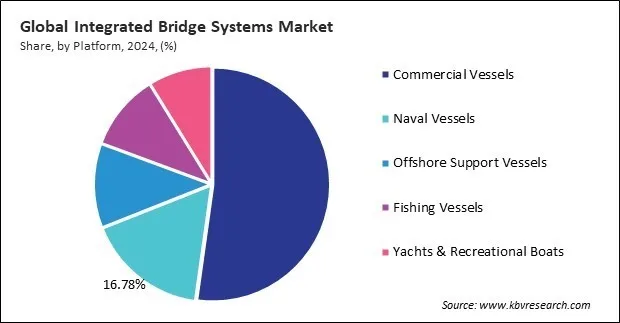
By platform, the integrated bridge systems market is divided into commercial vessels, naval vessels, offshore support vessels, fishing vessels, and yachts & recreational boats. The naval vessels segment garnered 17% revenue share in the integrated bridge systems market in 2024. Naval ships, such as frigates, destroyers, patrol boats, and submarines, use integrated bridge systems that are built for defensive and tactical operations. These systems need to have better encryption, redundancy, and ability to work in battle. It is important to be able to connect with armament systems, sonar, battle management software, and secure communication channels.
Free Valuable Insights: Global Integrated Bridge Systems Market size to reach USD 10.53 Billion by 2032
Region-wise, the integrated bridge systems market is analyzed across North America, Europe, Asia Pacific, and LAMEA. The Asia Pacific segment recorded 39% revenue share in the integrated bridge systems market in 2024. Asia Pacific leads the integrated bridge systems market, driven by the region's large and growing maritime economy. Countries like China, Japan, South Korea, and India are expanding their commercial and naval fleets, boosting demand for advanced navigation and control technologies. The region benefits from a robust shipbuilding industry, particularly in China and South Korea, where integrated systems are in high demand for newbuilds and retrofits.
| Report Attribute | Details |
|---|---|
| Market size value in 2024 | USD 7.92 Billion |
| Market size forecast in 2032 | USD 10.53 Billion |
| Base Year | 2024 |
| Historical Period | 2021 to 2023 |
| Forecast Period | 2025 to 2032 |
| Revenue Growth Rate | CAGR of 3.7% from 2025 to 2032 |
| Number of Pages | 367 |
| Number of Tables | 404 |
| Report coverage | Market Trends, Revenue Estimation and Forecast, Segmentation Analysis, Regional and Country Breakdown, Market Share Analysis, Porter’s 5 Forces Analysis, Company Profiling, Companies Strategic Developments, SWOT Analysis, Winning Imperatives |
| Segments covered | Subsystem, Component, Platform, Region |
| Country scope |
|
| Companies Included | RTX Corporation, Northrop Grumman Corporation, L3Harris Technologies, Inc., HENSOLDT AG, Alphatron Marine B.V., Consilium Marine & Safety AB, Marine Technologies LLC, Kongsberg Group, Furuno Electric Co., Ltd., and Wartsila Corporation |
By Subsystem
By Component
By Platform
By Geography
This Market size is expected to reach $10.53 billion by 2032.
Rising Global Maritime Trade And Seaborne Transportation are driving the Market in coming years, however, High Initial Capital Investment And Maintenance Costs restraints the growth of the Market.
RTX Corporation, Northrop Grumman Corporation, L3Harris Technologies, Inc., HENSOLDT AG, Alphatron Marine B.V., Consilium Marine & Safety AB, Marine Technologies LLC, Kongsberg Group, Furuno Electric Co., Ltd., and Wartsila Corporation
The expected CAGR of this Market is 3.7% from 2023 to 2032.
The Hardware segment led the maximum revenue in the Market by Component in 2024, thereby, achieving a market value of $6.8 billion by 2032.
The Asia Pacific region dominated the Market by Region in 2024, and would continue to be a dominant market till 2032; thereby, achieving a market value of $4.2 billion by 2032.
Our team of dedicated experts can provide you with attractive expansion opportunities for your business.







 Unique Offerings