“Global Industrial Radiography Equipment Market to reach a market value of USD 2.90 Billion by 2032 growing at a CAGR of 7.3%”
The Global Industrial Radiography Equipment Market size is expected to reach USD 2.90 billion by 2032, rising at a market growth of 7.3% CAGR during the forecast period.
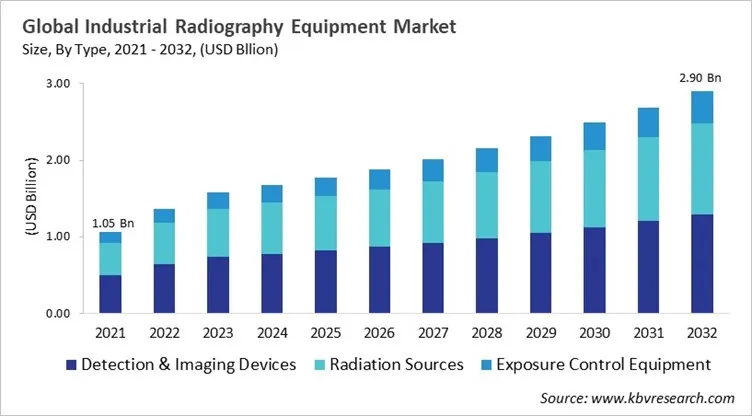
Industrial radiography has emerged as an advanced digital inspection technology that evolved from early isotope applications in the 19th and 20th centuries. The radiography field has significantly switched to computed and digital radiography, which enables storage flexibility, faster image acquisition, higher resolution, and deployment with Industry 4.0 frameworks. Advanced systems include wireless transmission modules, AI-driven analytics, and portable flat panel detectors. These features enable screenings in automotive, power generation, oil & gas, and aerospace sectors. International as well as national regulatory bodies are focused on security norms and considering radiation protection and training standards with the aim of supporting operator and environmental protection.
The market is witnessing substantial growth mainly supported by deployment of machine learning, predictive analytics and machine learning into inspection systems, rising integration of portable & wireless and growing acceptance of digital radiography. Leading OEMs like Nikon/Rigaku, Fujifilm, Comet, Dürr, Olympus/Evident, and GE are framing strategies focusing on continued product innovation and expanding reach in developing markets such as India and China. Further, market players are investing in integrating radiography equipment within wide digital ecosystems. Companies are working on AI-enabled solutions, robust service networks, technological leadership and regulatory compliances to gain a significant share in the industrial radiography equipment market.
The major strategies followed by the market participants are Product Launches as the key developmental strategy to keep pace with the changing demands of end users. For instance, Two news of any two random companies apart from leaders and key innovators. In July, 2025, Carestream Health, Inc. unveiled a bendable digital radiography detector designed for non-destructive testing in industrial settings. This flexible detector enhances imaging access in hard-to-reach areas, improving inspection efficiency and accuracy. It represents a significant advancement in industrial radiography equipment, addressing challenges in the aerospace and manufacturing sectors. Additionally, In June, 2025, Nikon Corporation unveiled an advanced Limited Angle CT technology enabling detailed 3D inspection even in challenging industrial environments. By minimizing scanning angles, throughput is enhanced, data acquisition times are reduced, and image quality is improved, offering significant advantages for sectors that require non-destructive testing and high-precision inspection.
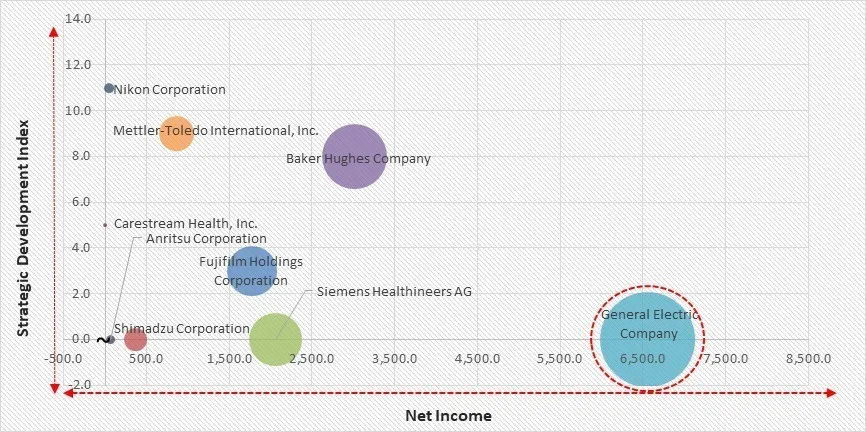
Based on the Analysis presented in the KBV Cardinal matrix; General Electric Company is the forerunner in the Industrial Radiography Equipment Market. Companies such as Baker Hughes Company, Siemens Healthineers AG, and Fujifilm Holdings Corporation are some of the key innovators in Industrial Radiography Equipment Market. In March, 2021, Fujifilm Holdings Corporation unveiled the FDR nano, a compact mobile digital radiology system designed for fast, high-quality imaging. While primarily used in healthcare, its portable X-ray capabilities suggest potential crossover applications in industrial radiography, particularly where mobility and precision imaging are required in non-destructive testing environments.
The COVID-19 pandemic had a big impact on the market for industrial radiography equipment. It caused delays in the supply chain, stopped projects, and lowered demand in industries like oil and gas, aerospace, automotive, and construction. Lockdowns and travel bans caused inspections to be put off, capital investments to be put off, and customer relationships to suffer. Manufacturers had to deal with parts shortages, longer lead times, and less technical support because of global shutdowns. Safety rules made NDT activities on-site even more limited, which caused tenders and contracts to be delayed. These problems caused a big drop in OEM sales, equipment purchases, and after-market revenues. Smaller companies had a hard time keeping their operations stable. Thus, the COVID -19 pandemic had a Negative impact on the industrial radiography equipment market.

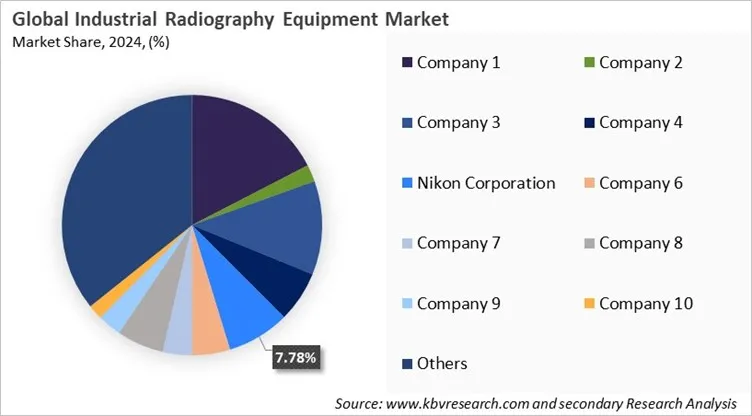
The leading players in the market are competing with diverse innovative offerings to remain competitive in the market. The above illustration shows the percentage of revenue shared by some of the leading companies in the market. The leading players of the market are adopting various strategies to cater demand coming from the different industries. The key developmental strategies in the market are Acquisitions, and Partnerships & Collaborations.
Free Valuable Insights: Global Industrial Radiography Equipment Market size to reach USD 2.90 Billion by 2032
Based on Industry, the Industrial Radiography Equipment Market is segmented into Automotive, Aerospace, Oil & Gas, Manufacturing, Power Generation, and Others. The Automotive segment acquired 28% revenue share in the market in 2024. The automotive industry represents a major end-use segment within the industrial radiography equipment market. Radiographic testing plays a critical role in ensuring the structural integrity and safety of automotive components, including engine parts, welds, castings, and electronic assemblies.
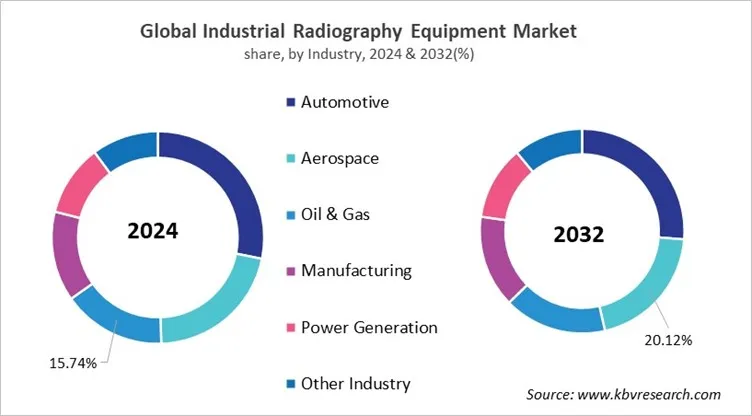
Region-wise, the Industrial Radiography Equipment Market is analyzed across North America, Europe, Asia Pacific, and LAMEA. The North America segment recorded a 36% revenue share in the market in 2024. In the Noth America region, the industrial radiography equipment market is expanding due to presence of automotive, oil & gas, and aerospace sector, strict safety regulations and enhanced industrial infrastructure. The rising demand for non-destructive testing and sturdy investments in R&D is resulting in growing adoption of advanced radiography technologies. Moreover, Europe also presents prominent market opportunities because of developed power generation and automotive industries. Further, increasing investment in safety and quality assurance infrastructure is supporting expansion in the European region.
Rapid industrialization and growing infrastructure are key factors driving the growth of the industrial radiography equipment market in the Asia Pacific and LAMEA region. The Asia Pacific region is witnessing increasing acceptance amid the expanding shipbuilding, energy, and construction sector along with the rising awareness about quality standards. The region is expected to capture the highest growth due to the supportive government initiatives to increase industrial safety. Additionally, LAMEA region showcases substantial growth opportunities supported by infrastructure modernization in Latin America, oil & gas exploration in the Middle East region and energy activities in Africa.
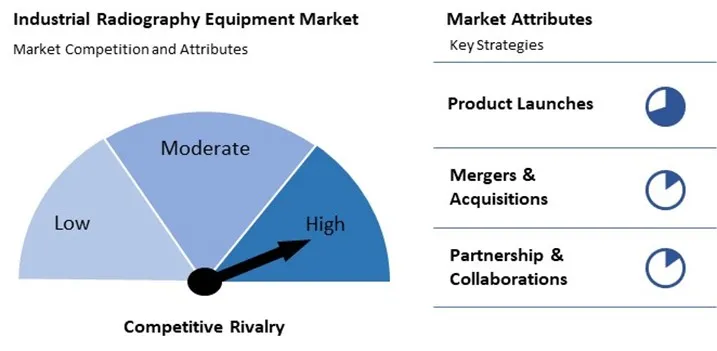
The market competition is intense, driven by rapid technological advancements, evolving consumer demands, and increasing regulatory requirements. Numerous players are focusing on innovation, offering differentiated products and services to capture greater market share. Price sensitivity among buyers further intensifies rivalry, leading to competitive pricing strategies and subscription-based models. Emerging startups add pressure by introducing agile and cost-effective solutions, while established participants invest heavily in research, partnerships, and customer experience enhancements. The presence of multiple alternatives increases switching tendencies, compelling businesses to emphasize value-added features, scalability, and integration capabilities to sustain growth and maintain long-term customer loyalty.
| Report Attribute | Details |
|---|---|
| Market size value in 2024 | USD 1.67 Billion |
| Market size forecast in 2032 | USD 2.90 Billion |
| Base Year | 2024 |
| Historical Period | 2021 to 2023 |
| Forecast Period | 2025 to 2032 |
| Revenue Growth Rate | CAGR of 7.3% from 2025 to 2032 |
| Number of Pages | 402 |
| Number of Tables | 294 |
| Report coverage | Market Trends, Revenue Estimation and Forecast, Segmentation Analysis, Regional and Country Breakdown, Competitive Landscape, Market Share Analysis, Porter’s 5 Forces Analysis, Company Profiling, Companies Strategic Developments, SWOT Analysis, Winning Imperatives |
| Segments covered | Type, Industry, Region |
| Country scope |
|
| Companies Included | Baker Hughes Company, General Electric Company, Fujifilm Holdings Corporation, Shimadzu Corporation, Nikon Corporation, Mettler-Toledo International, Inc., Anritsu Corporation, Carestream Health, Inc. (Onex Corporation), Siemens Healthineers AG (Siemens AG) and Pacific NDT |
By Type
By Industry
By Geography
This Market size is expected to reach USD 2.90 billion by 2032.
The Industrial Radiography Equipment market is projected to grow at a CAGR of 7.3% between 2025 and 2032.
Increasing demand for non-destructive testing (NDT) across industries, coupled with the shift toward digital radiography and automation, is propelling market growth.
Baker Hughes Company, General Electric Company, Fujifilm Holdings Corporation, Shimadzu Corporation, Nikon Corporation, Mettler-Toledo International, Inc., Anritsu Corporation, Carestream Health, Inc. (Onex Corporation), Siemens Healthineers AG (Siemens AG) and Pacific NDT
The Detection & Imaging Devices segment is leading the Global Industrial Radiography Equipment Market by Type in 2024; thereby, achieving a market value of $1.29 billion by 2032.
The North America region dominated the Global Industrial Radiography Equipment Market by Region in 2024, and would continue to be a dominant market till 2032; thereby, achieving a market value of $1.01 billion by 2032.
Our team of dedicated experts can provide you with attractive expansion opportunities for your business.








 Unique Offerings