“Global Industrial Edge Market to reach a market value of USD 55.07 Billion by 2032 growing at a CAGR of 13.1%”
The Global Industrial Edge Market size is expected to reach $55.07 billion by 2032, rising at a market growth of 13.1% CAGR during the forecast period.
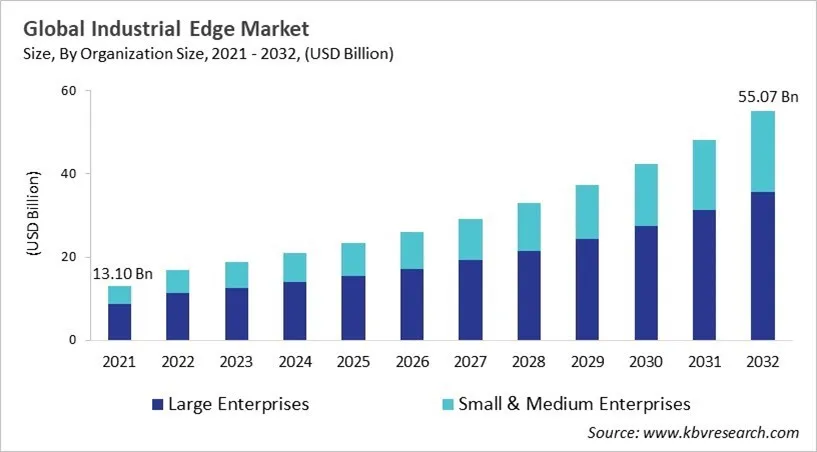
The global industrial edge market has transformed from conventional controlled industrial computerization to a organized, low latency system that processes data proximate to machines. This is propelled by the combination of the Information technology (IT) and Operational Technology (OT), the growth of the IIoT, and drawbacks of the cloud-based models, industries are rapidly relying on the edge technology and pathways of the real-time analysis. Companies like ABB, Siemens, and Dell emphasise that industrial edge computing decreases latency, reduce bandwidth costs, facilitate data-governance requirements and enables fast, fixed decision-making on the ground level. This transformation harmonizes industry 4.0 and smart manufacturing, this is supported by interoperable ecosystems and hybrid edge–cloud architectures.
Industrial automation giants, cloud-edge providers, and new software companies are all trying to offer scalable, secure, and standardized edge solutions. This is what makes the competitive landscape. Top OEMs are focusing on partnerships with other companies in the ecosystem, modular platforms, AI-enabled edge applications, and managing the entire lifecycle of products across multiple industrial sites. Interoperability projects, edge software that works with different marketplaces, and reference architectures make it easier for customers to adopt new technologies by making integration less complicated. As AI, private 5G, and containerization become more advanced, competition gets tougher. This is good for vendors who can offer flexible, secure, and easy-to-deploy industrial edge solutions that speed up digital transformation and improve operations.
The major strategies followed by the market participants are Partnerships as the key developmental strategy to keep pace with the changing demands of end users. For instance, In April, 2024, IBM Corporation announced the partnership with Fortinet, a cybersecurity company to launch of Fortinet Virtual FortiGate Security Appliance (vFSA) on IBM Cloud. This solution enhances cloud network security with features like automated installations and FortiFlex licensing. Designed to safeguard hybrid and multi-cloud environments, vFSA places a strong emphasis on monitoring IoT devices in manufacturing. It also caters to various industries, including financial services, retail, and manufacturing. Moreover, In April, 2024, Cisco Systems, Inc. announced the partnership with Upstream Security, a cloud-based platform for connected cars and IoT ecosystems, to enhance vehicle cybersecurity and compliance with regulations like UNECE R155. Upstream’s technology integrates with Cisco's IoT Control Center to secure connected mobility services by providing advanced threat detection and response capabilities without hardware installation.
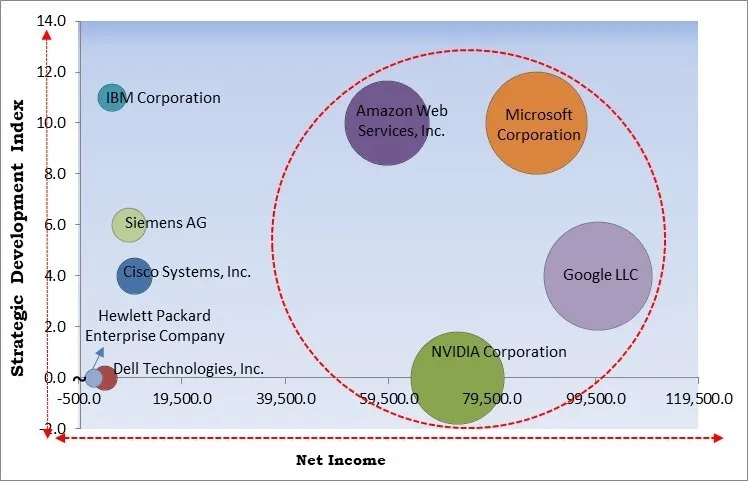
Based on the Analysis presented in the KBV Cardinal matrix; Google LLC, Microsoft Corporation, NVIDIA Corporation, and Amazon Web Services, Inc. are the forerunners in the Industrial Edge Market. In March, 2025, Microsoft Corporation teamed up with CyberArk, a software company to enhance industrial IoT security by aligning with NIST’s guidelines. This solution incorporates Microsoft’s Azure IoT and Defender for IoT, along with CyberArk’s privileged access management, ensuring secure device management and real-time monitoring. The collaboration aims to address security challenges in edge environments and improve operational continuity for manufacturers. Companies such as Cisco Systems, Inc., Siemens AG, and IBM Corporation are some of the key innovators in Industrial Edge Market.
The COVID-19 outbreak had a big impact on the industrial edge market. Lockdowns and operational restrictions stopped production, caused labor shortages, and slowed down the rollout of edge solutions in industries like automotive, oil and gas, and heavy manufacturing. Severe problems in the supply chain, such as semiconductor shortages and logistical bottlenecks, made it even harder to get important hardware and made lead times longer. Companies put safety and essential operations ahead of new technology investments, which led to a drop in capital spending on automation and digital transformation. These things caused projects to be put off, less buying to happen, and a short-term drop in market demand. The pandemic later showed how important it is to have resilient, distributed computing, but the immediate effect on the industrial edge market was mostly bad. Thus, the COVID-19 pandemic had a negative impact on the market.

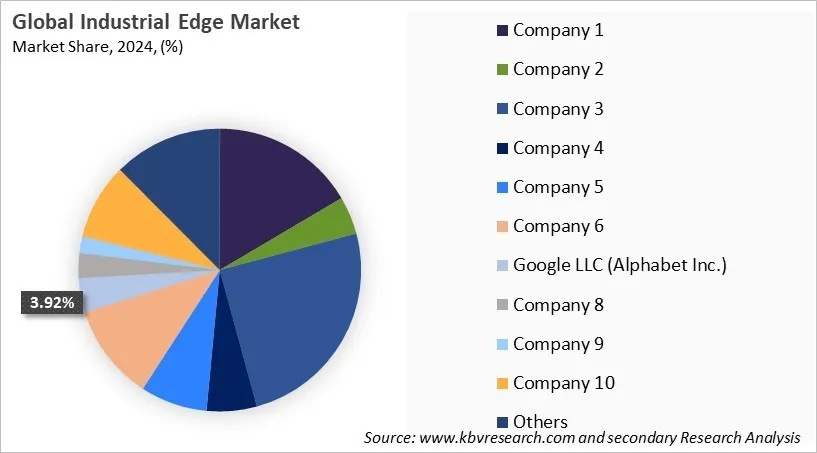
The leading players in the market are competing with diverse innovative offerings to remain competitive in the market. The above illustration shows the percentage of revenue shared by some of the leading companies in the market. The leading players of the market are adopting various strategies in order to cater demand coming from the different industries. The key developmental strategies in the market are Acquisitions, and Partnerships & Collaborations.
Free Valuable Insights: Industrial Edge Market size to reach USD 55.07 Billion by 2032
Based on Organization Size, the market is segmented into Large Enterprises, and Small & Medium Enterprises. The small & medium enterprises segment attained 33% revenue share in the industrial edge market in 2024. The small and medium enterprises (SMEs) segment is experiencing growing participation in the industrial edge market as digital transformation becomes more accessible and cost-effective. SMEs are leveraging edge computing to achieve greater automation, operational agility, and energy efficiency without relying extensively on centralized cloud infrastructure. The proliferation of affordable edge devices and modular software solutions has allowed smaller organizations to implement scalable systems suited to their specific operational needs.
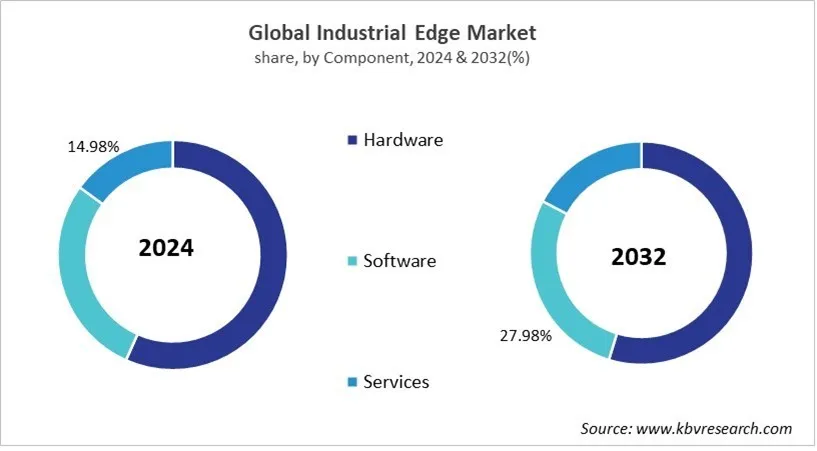
Based on Component, the market is segmented into Hardware, Software, and Services. The software segment recorded 28% revenue share in the industrial edge market in 2024. The software segment plays a transformative role in enabling intelligence and flexibility within industrial edge ecosystems. It comprises edge operating systems, middleware, analytics applications, and orchestration tools that empower industries to analyze data, automate processes, and make real-time decisions at the edge. This segment is gaining traction due to the increasing demand for scalable and interoperable platforms that can seamlessly integrate with both legacy and modern industrial systems.
Region-wise, the industrial edge market is analyzed across North America, Europe, Asia Pacific, and LAMEA. The North America segment recorded 37% revenue share in the industrial edge market in 2024. North America and Europe are the most advanced markets for industrial edge adoption. This is because of early digital transformation efforts, a lot of IIoT use, and a lot of money spent on automation in the manufacturing, energy, automotive, and process industries. In these areas, industrial edge deployments are closely linked to updating old OT systems, improving data governance, and making it possible for advanced applications like real-time quality control, predictive maintenance, and decentralized AI to work. The presence of major OEMs, well-established IT-OT convergence ecosystems, and strong regulatory frameworks for data management and cybersecurity all help growth happen even faster. Both areas also benefit from large-scale private 5G rollouts and partnerships with industrial clouds, which help support hybrid edge-cloud architectures that can grow.
Asia Pacific is becoming the fastest-growing region because of rapid industrialization, the growth of manufacturing hubs in China, India, South Korea, and Southeast Asia, and strong government support for smart factories and the adoption of Industry 4.0. Decentralized computing and real-time analytics are very appealing in this area because of its high-volume production environments and growing need for automation. LAMEA (Latin America, the Middle East, and Africa) is still in the early stages of adoption, but it is gaining speed as industries modernize to boost productivity, cut down on downtime, and deal with operational issues like bandwidth limits or working from remote locations. In both Asia Pacific and LAMEA, investments in IIoT, AI-driven automation, and edge-enabled industrial platforms are growing steadily. This is supported by more partnerships between global OEMs and regional industrial players.
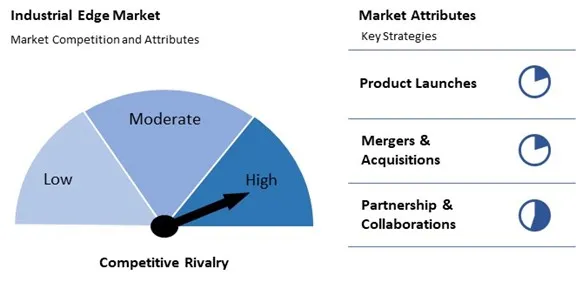
Providers in the Industrial Edge Market are working harder to offer faster processing, better security, and easy integration with existing operational systems. This is making the market more competitive. Advanced edge architectures, flexible deployment models, and specialized solutions that fit different types of industrial environments are what set market players apart. Competition is fueled by new ideas in real-time analytics, interoperability, and device management. As industries speed up their digital transformation, competitors are putting more and more emphasis on reliability, low latency, and scalability in order to take advantage of new opportunities and solidify their position in this fast-changing environment.
| Report Attribute | Details |
|---|---|
| Market size value in 2025 | USD 23.27 Billion |
| Market size forecast in 2032 | USD 55.07 Billion |
| Base Year | 2024 |
| Historical Period | 2021 to 2023 |
| Forecast Period | 2025 to 2032 |
| Revenue Growth Rate | CAGR of 13.1% from 2025 to 2032 |
| Number of Pages | 767 |
| Number of Tables | 604 |
| Report coverage | Market Trends, Revenue Estimation and Forecast, Segmentation Analysis, Regional and Country Breakdown, Competitive Landscape, Market Share Analysis, Porter’s 5 Forces Analysis, Company Profiling, Companies Strategic Developments, SWOT Analysis, Winning Imperatives |
| Segments covered | Organization Size, Component, Deployment Mode, End-use, Application, Region |
| Country scope |
|
| Companies Included | Amazon Web Services, Inc., IBM Corporation, Cisco Systems, Inc., Dell Technologies, Inc., Hewlett Packard Enterprise Company, Microsoft Corporation, Google LLC, Intel Corporation, NVIDIA Corporation, and Siemens AG |
By Organization Size
By Component
By Deployment Mode
By End-use
By Application
By Geography
The market size is projected to reach USD 55.07 billion by 2032.
The industrial edge market is projected to grow at a CAGR of 13.1% between 2025 and 2032.
Real-time data processing and latency reduction, combined with rising IT-OT convergence and increasingly complex automation systems, are driving stronger adoption momentum.
Amazon Web Services, Inc., IBM Corporation, Cisco Systems, Inc., Dell Technologies, Inc., Hewlett Packard Enterprise Company, Microsoft Corporation, Google LLC, Intel Corporation, NVIDIA Corporation, and Siemens AG
The Hardware segment captured the maximum revenue in the Global Industrial Edge Market by Component in 2024, thereby, achieving a market value of $30.1 billion by 2032.
The North America region dominated the Global Industrial Edge Market by Region in 2024, and would continue to be a dominant market till 2032; thereby, achieving a market value of $19.8 billion by 2032.
Our team of dedicated experts can provide you with attractive expansion opportunities for your business.











 Unique Offerings