“Global HMI Sensors In Wearables Market to reach a market value of USD 9.16 Billion by 2032 growing at a CAGR of 13.6%”
The Global HMI Sensors In Wearables Market size is estimated at $3.75 billion in 2025 and is expected to reach $9.16 billion by 2032, rising at a market growth of 13.6% CAGR during the forecast period (2025-2032). The projected growth of the market is driven by rising adoption of smartwatches, fitness trackers, and health-monitoring devices. Increasing consumer demand for intuitive user interfaces, advancements in sensor miniaturization, and integration of AI-based gesture and touch recognition technologies support strong expansion through 2032.
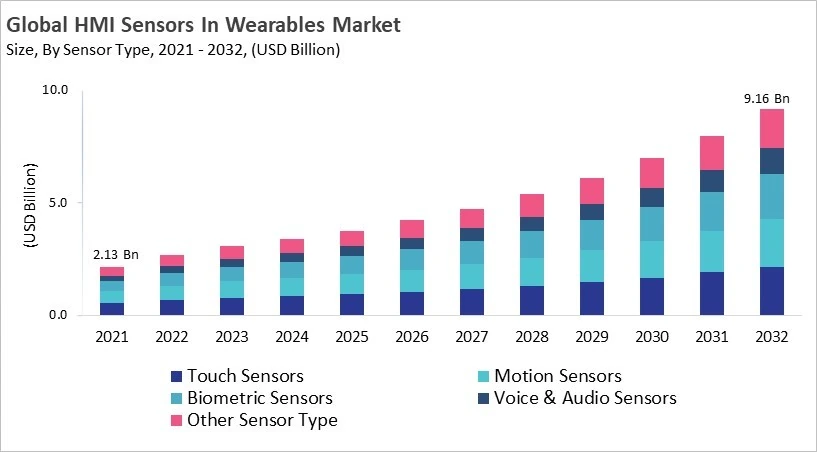
Wearable devices have developed from basic activity trackers to smart, interactive systems supported by advanced HMI sensors. Advancements in sensor microelectronics, miniaturization, embedded processing, and wireless connectivity have enabled wearables to continuously capture physiological, motion, touch, and environmental data. Modern devices integrate various sensors like gyroscopes, contextual awareness, accelerometers, and gesture recognition. Sensor fusion has evolved as a foundational capability, enhancing accuracy and allowing more adaptive user interactions across fitness bands, smartwatches, AR headsets, hearables, and smart rings. These enhancements have developed wearable applications beyond fitness into enterprise productivity, healthcare, defense, and industrial safety, where predictive insights and continued monitoring are largely valued.
Recent trends in HMI sensors in wearables market prioritize AI integration, multimodal sensing, and cross-sector expansion. Machine learning and artificial intelligence play an essential role in enabling wearables to detect anomalies, interpreting raw sensor data, personalize user feedback, and predict health or fatigue trends. Partnerships between specialized sensor providers and OEMs surge differentiation and innovation, propelled by open software ecosystems and energy-efficient sensor modules. The market competition in HMI sensors in wearables market is largely driven by AI-enhanced signal processing, advances in sensor fusion, and regulatory readiness, positioning wearables as a core component that bridges the gap between human biological signals and digital systems across clinical, consumer, and industrial domains.
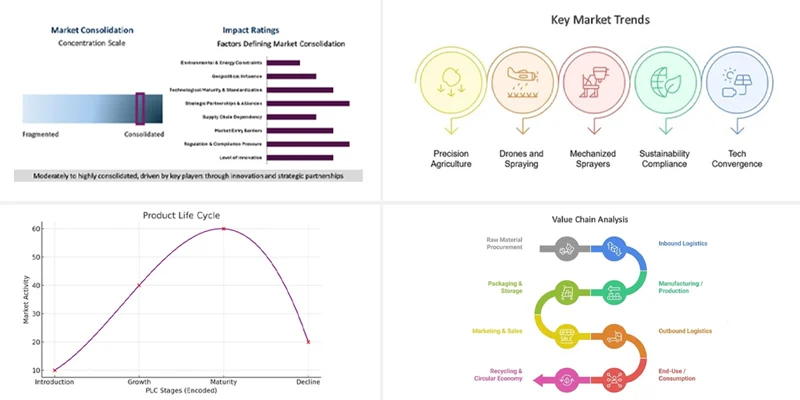

The COVID-19 outbreak negatively affected the HMI sensors in wearables market due to severe global supply chain disruptions and temporary shutdowns of manufacturing facilities. Shortages of semiconductor components delayed production and product launches. Reduced consumer spending during economic uncertainty lowered demand for smartwatches and fitness trackers. Companies postponed investments in R&D and shifted focus toward operational stability. Travel restrictions slowed collaboration and product testing. Retail store closures further limited sales and distribution. Although e-commerce offered partial support, it could not fully offset the decline, leading to a temporary market slowdown. Thus, the COVID-19 pandemic had a negative impact on the market.
On the basis of device type, the HMI Sensors In Wearables Market is classified into smartwatches & fitness bands, hearables / earbuds, smart glasses / AR glasses, head-mounted displays (HMDs), smart rings / wristbands, smart clothing, and other device type. The hearables / earbuds segment represents 17% of the global revenue share in the HMI Sensors in Wearables Market. Growing demand for wireless audio solutions and voice-enabled interaction has significantly contributed to this segment’s expansion. Integration of voice recognition, touch controls, and motion sensors enhances hand-free communication and smart assistance.
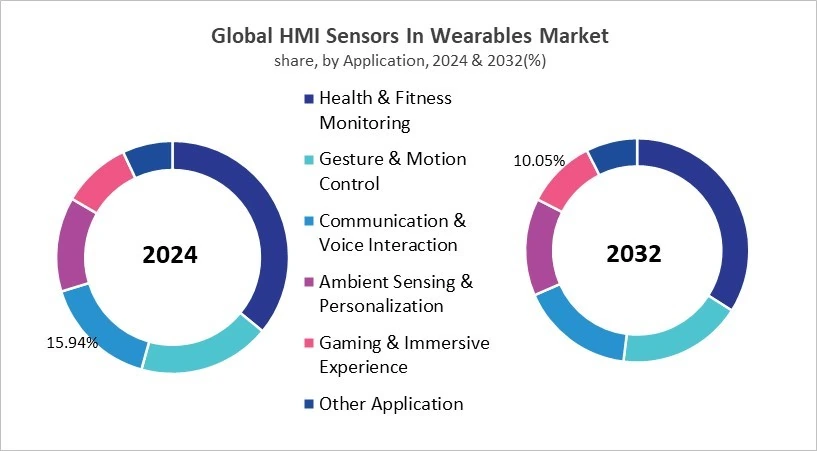
On the basis of application, the HMI Sensors In Wearables Market is classified into health & fitness monitoring, gesture & motion control, communication & voice interaction, ambient sensing & personalization, gaming & immersive experience, and other application. The gesture & motion control segment holds 18% of the global revenue share in the HMI Sensors in Wearables Market. Motion-based interaction enabled by accelerometers and gyroscopes enhances device responsiveness and user engagement. These sensors are extensively used in fitness tracking, gaming, and industrial wearable applications.
Free Valuable Insights: HMI Sensors In Wearables Market Size to reach $9.16 by 2032
Region-wise, the HMI Sensors In Wearables Market is analyzed across North America, Europe, Asia Pacific, and LAMEA. The North America segment recorded 35% revenue share in the HMI Sensors In Wearables Market in 2024. The HMI sensors in wearables market is estimated to experience significant expansion in the North America and Europe regions. The market is propelled by strong consumer demand, advanced technology adoption, and well-established healthcare and digital ecosystems. Regional growth is further supported by investments in healthtech innovation, high demand for real-time biometric and gesture-based interactions in devices like fitness bands and smartwatches, and early adoption of connected and smart wearables. Furthermore, Europe's HMI sensors in wearable market are predicted to capture prominent growth. The market is driven by high digital health awareness, robust healthcare infrastructure, and strict safety/regulatory standards that accelerate the adoption of sensor-rich wearables for wellness applications and preventive care. Also, European economies showcase rapid expansion through the integration of HMI sensors into both clinical and consumer devices.
In the Asia Pacific and LAMEA region, the HMI sensors in wearables market is anticipated to have noticeable growth. This is owing to increasing disposable incomes, rapid urbanization, and expanding consumer electronics manufacturing, especially in India, Japan, China, and South Korea. Rising health consciousness, large tech-savvy population are elements driving strong adoption of sensor-driven wearables across health monitoring, fitness, and industrial segments. This growth is propelled by competitive pricing and regional OEM innovation. Moreover, LAMEA HMI sensors in wearables market is witnessing lucrative growth opportunities. This is owing to increasing awareness of wearable technology benefits, surging digital health initiatives, and government investments in healthcare modernization.
| Report Attribute | Details |
|---|---|
| Market size value in 2025 | USD 3.75 Billion |
| Market size forecast in 2032 | USD 9.16 Billion |
| Base Year | 2024 |
| Historical period | 2021 to 2023 |
| Forecast Period | 2025 to 2032 |
| Revenue Growth Rate | CAGR of 13.6% from 2025 to 2032 |
| Number of Pages | 668 |
| Tables | 543 |
| Report Coverage | Market Trends, Revenue Estimation and Forecast, Segmentation Analysis, Regional and Country Breakdown, Porter’s 5 Forces Analysis, Company Profiling, Companies Strategic Developments, SWOT Analysis, Winning Imperatives |
| Segments Covered | Sensor Type, Application, End Use, Device Type, Region |
| Country Scope |
|
| Companies Included | Samsung Electronics Co., Ltd. (Samsung Group), Apple, Inc., Honeywell International, Inc., Rockwell Automation, Inc., General Electric Company, Schneider Electric SE, Siemens AG, Omron Corporation, Emerson Electric Co. and Mitsubishi Electric Corporation |
By Sensor Type
By Application
By End Use
By Device Type
By Geography
Our team of dedicated experts can provide you with attractive expansion opportunities for your business.







 Unique Offerings