“Global High Performance Computing Market to reach a market value of USD 94.91 Billion by 2032 growing at a CAGR of 6.9%”
The Global High Performance Computing Market size is estimated at $59.57 billion in 2025 and is expected to reach $94.91 billion by 2032, rising at a market growth of 6.9% CAGR during the forecast period (2025-2032). The market is expected to grow because more and more people in research, healthcare, finance, and manufacturing need advanced simulation, AI training, and big data analytics. The growth of the market will continue because of the growth of cloud-based HPC, government investments in supercomputing, and the growing use of digital twins.
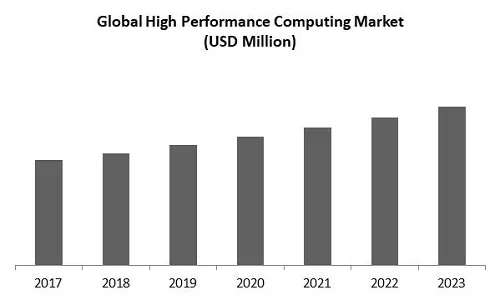
High performance computing has developed from a government-led scientific capability into a foundational technology supporting industry, modern research, and national competitiveness. Industries like pharmaceuticals, automotive, manufacturing, and energy largely rely on high performance computing for modelling, simulation, and data-intensive analysis. Advances in commercial processors and networking facilitated clustered systems, thereby expanding high-performance adoption into industry and academia. High performance computing has become an integrated ecosystem that covers cloud-based services, on-premises systems, and specialized accelerators, aligned with government digital and AI strategies.
The high performance computing market is driven by convergence with artificial intelligence, growing focus on accessibility and efficiency, and the uptake of exascale computing. GPU-accelerated and accelerator-centric designs allow unified support for AI workloads and simulation, while publicly funded exascale initiatives focus on energy efficiency, performance, and scalability. Cloud-based and hybrid high performance models are lowering adoption barriers and allowing flexible scaling, complemented by co-design strategies that align software and hardware with real-world workloads. The high-performance computing market seems to be highly competitive, led by providers like IBM, HPE, AMD, NVIDIA, Fujitsu, Lenovo, and Intel, with differentiation driven by software ecosystems, architectural innovation, and strong government and research partnerships.
The major strategies followed by the market participants are Product Launches as the key developmental strategy to keep pace with the changing demands of end users. For instance, In November, 2024, Advanced Micro Devices, Inc. unveiled the Instinct MI300X accelerator, designed for AI and HPC workloads, competing with NVIDIA’s GPUs. Featuring advanced memory and processing capabilities, it enhances performance for data centers and supercomputing applications. This launch strengthens AMD’s position in the AI-driven semiconductor market, challenging industry leaders like NVIDIA. Additionally, In 2024, November, Hewlett Packard Enterprise Company unveiled new supercomputing solutions designed for AI and high-performance computing (HPC). These innovations enhance processing power, scalability, and efficiency for complex workloads. With advanced capabilities, HPE seeks to support AI-driven research, scientific computing, and enterprise applications, strengthening its position in the AI and HPC markets.
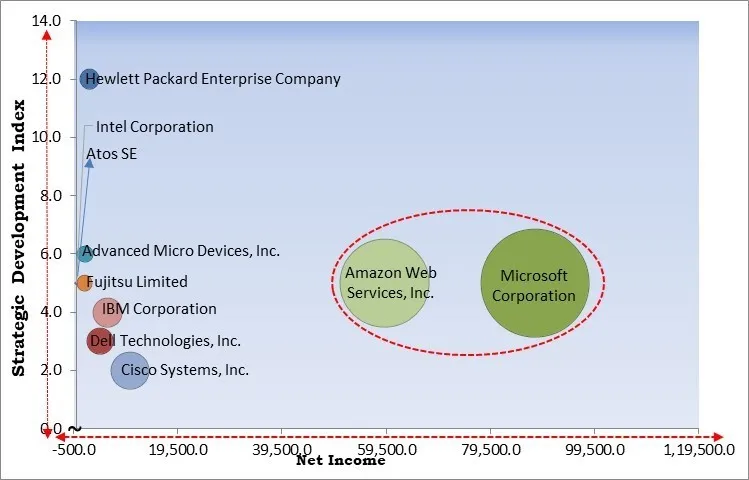
Based on the Analysis presented in the KBV Cardinal matrix; Microsoft Corporation and Amazon Web Services, Inc. are the forerunners in the High-Performance Computing Market. Companies such as Cisco Systems, Inc., IBM Corporation, and Dell Technologies, Inc. are some of the key innovators in High Performance Computing Market. In October, 2024, Microsoft Corporation unveiled the ND H200 v5 series, its latest Azure Virtual Machines optimized for AI supercomputing. Featuring NVIDIA H200 Tensor Core GPUs, these VMs enhance AI workloads with improved performance, scalability, and efficiency, supporting deep learning, large-scale training, and inference for advanced AI models in the cloud.
The COVID-19 pandemic hurt the High-Performance Computing (HPC) market because it messed up supply chains and made it take longer to make and deliver important hardware parts. Lockdowns and slowdowns in manufacturing caused deployments to be pushed back and project timelines to be lengthened. Many companies put off or cut back on their HPC investments because of uncertainty in the economy. This was especially true in the manufacturing, automotive, and energy sectors. Due to campus closures and a lack of funding, research institutions and universities had limited access to HPC systems on their own campuses. Delays in collaborative research projects slowed down their use. Problems with the workforce and challenges with remote work made installation and system optimization even harder. In general, these things held back the growth of the HPC market during the pandemic. Thus, the COVID-19 pandemic had a Negative impact on the market.

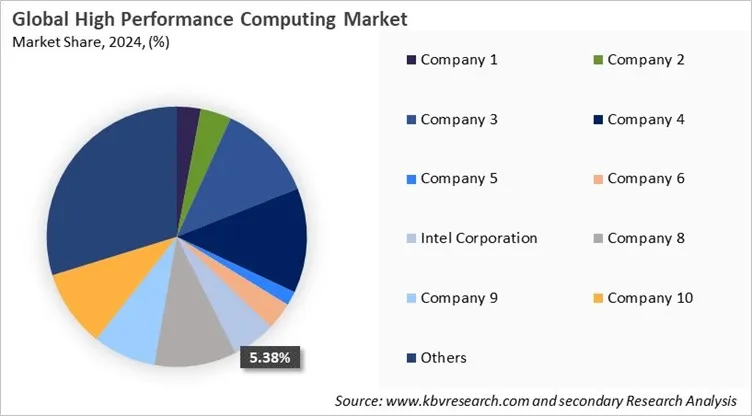
The leading players in the market are competing with diverse innovative offerings to remain competitive in the market. The above illustration shows the percentage of revenue shared by some of the leading companies in the market. The leading players of the market are adopting various strategies to cater demand coming from the different industries. The key developmental strategies in the market are Acquisitions, and Partnerships & Collaborations.
Free Valuable Insights: High Performance Computing Market size to reach USD 94.91 Billion by 2032
Based on Deployment, the High-Performance Computing Market is segmented into On-premises, and Cloud. The Cloud segment acquired 41% revenue share in the market in 2024. The Cloud segment of the High-Performance Computing Market involves the use of third-party cloud providers to deliver scalable, on-demand HPC resources over the internet. This deployment model allows organizations to access advanced computational power without the need for large capital expenditures on physical infrastructure.
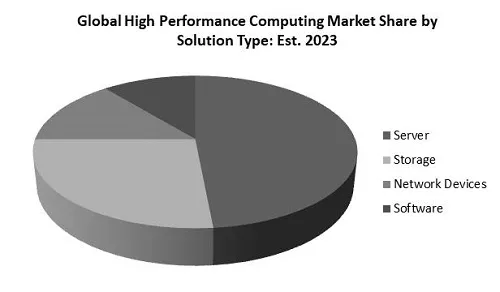
Based on Component, the High Performance Computing Market is segmented into Servers, Storage, Software, Services, Cloud, Networking Devices, and Other Component. The Storage segment attained 17% revenue share in the market in 2024. The Storage component encompasses high-speed storage solutions essential for handling the enormous volumes of data generated by HPC applications. This includes solid-state drives, parallel file systems, and storage arrays designed to support fast read/write speeds and low-latency access. Investment in storage focuses on data security, redundancy, and scalability to accommodate growing computational workloads.
Region-wise, the High-Performance Computing Market is analyzed across North America, Europe, Asia Pacific, and LAMEA. The North America segment recorded 40% revenue share in the market in 2024. The high-performance computing market is anticipated to grow at a significant rate in North America and Europe. The market is majorly driven by the United States’ extensive supercomputing infrastructure, widespread adoption of AI-enabled HPC solutions, and strong federal funding for defense, scientific research, energy, and advanced manufacturing across various industries. The region further benefits from its robust ecosystem of research institutions, technology providers, and cloud service leadership, which together support growth in analytics, simulation, and hybrid HPC deployments. Moreover, Europe high performance computing market is also experiencing expansion propelled by coordinated investments through initiatives such as EuroHPC Joint Undertaking, and strong HPC use in industrial engineering, academic research, and climate science. Further, growth in Europe is supported by collaborative public-private programs and regulatory focus on green computing and data privacy.
In the Asia Pacific and LAMEA region, the high-performance computing market is predicted to capture prominent growth. This is because of heavy government investment, enterprise adoption for AI, digital infrastructure buildouts, and research workloads. This region largely captures great demand for high performance computing and demonstrates a robust growth rate as countries emphasize sovereign computer power and rapid digital transformation. Additionally, the LAMEA high performance computing market is expected to witness substantial expansion during the forecast period. This expansion is supported by increased investment in digitalization, energy sector analytics, educational research HPC clusters, and smart city initiatives by the government. Also, the region’s growth is backed by rising awareness of HPC’s value and expanding cloud-based and hybrid HPC accessibility across developing nations.
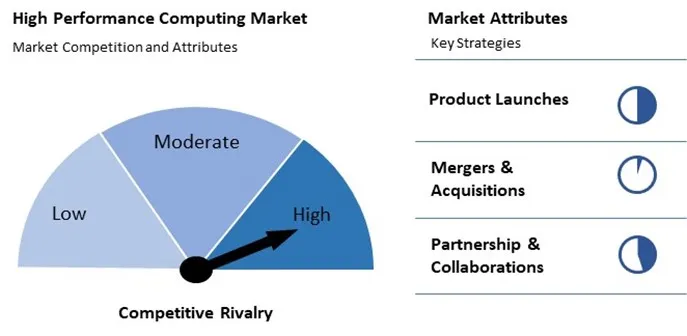
The High-Performance Computing (HPC) market is highly competitive, driven by rapid technological innovation and strong demand from research, government, and enterprise sectors. Key players compete on attributes such as processing speed, scalability, energy efficiency, and total cost of ownership. Competition is further intensified by advancements in AI, cloud-based HPC, and heterogeneous architecture using GPUs and accelerators. Strategic partnerships, continuous R&D, and customized solutions are crucial attributes for sustaining market leadership.
| Report Attribute | Details |
|---|---|
| Market size value in 2025 | USD 59.57 Billion |
| Market size forecast in 2032 | USD 94.91 Billion |
| Base Year | 2024 |
| Historical Period | 2021 to 2023 |
| Forecast Period | 2025 to 2032 |
| Revenue Growth Rate | CAGR of 6.9% from 2025 to 2032 |
| Number of Pages | 600 |
| Number of Tables | 448 |
| Report coverage | Market Trends, Revenue Estimation and Forecast, Segmentation Analysis, Regional and Country Breakdown, Competitive Landscape, Market Share Analysis, Porter’s 5 Forces Analysis, Company Profiling, Companies Strategic Developments, SWOT Analysis, Winning Imperatives |
| Segments covered | Deployment, Component, End Use, Region |
| Country scope |
|
| Companies Included | Atos SE, Advanced Micro Devices, Inc., Hewlett Packard Enterprise Company, Dell Technologies, Inc., Cisco Systems, Inc., Fujitsu Limited, Intel Corporation, IBM Corporation, Microsoft Corporation and Amazon Web Services, Inc. (Amazon.com, Inc.) |
By Component
By Deployment
By End Use
By Geography
The market size is projected to reach USD 94.91 Billion by 2032.
The high performance computing market is projected to grow at a CAGR of 6.9% between 2025 and 2032.
The rise of AI and machine learning workloads, combined with exponential data volume and complexity growth, is accelerating market demand.
Atos SE, Advanced Micro Devices, Inc., Hewlett Packard Enterprise Company, Dell Technologies, Inc., Cisco Systems, Inc., Fujitsu Limited, Intel Corporation, IBM Corporation, Microsoft Corporation and Amazon Web Services, Inc. (Amazon.com, Inc.)
The Government & Defense segment is generating maximum revenue share in the Global High Performance Computing Market by End Use in 2024, growing at a CAGR of 5.6 % during the forecast period.
The North America region dominated the Global High Performance Computing Market by Region in 2024, and would continue to be a dominant market till 2032; thereby, achieving a market value of $37.03 billion by 2032.
Our team of dedicated experts can provide you with attractive expansion opportunities for your business.







 Unique Offerings