The Global Healthcare Cyber Security Market size is expected to reach $28.4 billion by 2027, rising at a market growth of 16.3% CAGR during the forecast period. Cyber security technologies and solutions are constantly getting advanced because of the ever-changing threat landscape, where threats are becoming more sophisticated and damaging. In the present connected health environment, cyber security has become a necessity for healthcare organizations as it is a crucial strategic asset that is being deployed by all companies.
In the last couple of years, the healthcare sector has deployed a healthcare information technology (healthcare IT) infrastructure to access, forward, and receive electronic health data. As medical records have a big volume of data that can be utilized for identity theft and fraud (like social security numbers, claims data, or addresses), personal health information has a superior value on the black market as compared to other industries.
The growth of healthcare cyber security would witness bright prospects due to the surge in the number of cyberattacks in the healthcare sector, increase in the number of threats, and growing concerns regarding privacy and security. The growing cases of data breaches and cyberattacks around the world have increased the concerns, hence boosting the demand for cyber security solutions in the global market. For example, the Secretary of U.S. Department of Health and Human Services (HHS) Breach of Unsecured Protected Health Information reported 592 breaches of unsecured protected health data impacting above 500 individuals in the past two years that are presently being investigated by the Office for Civil Rights.
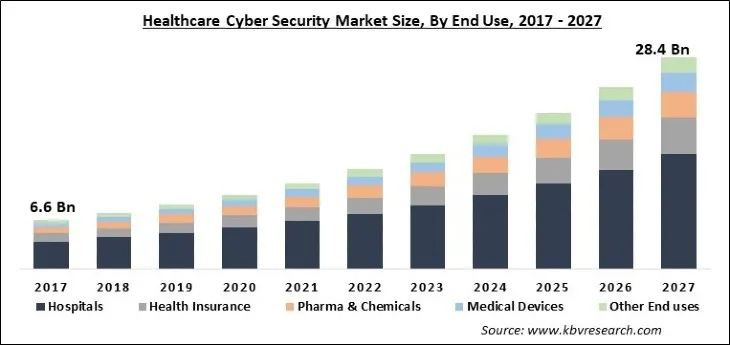
The outbreak of the COVID-19 pandemic fueled the deployment of cyber security services and solutions due to the rise in the number of threats of data breaches and increase cases of cyberattacks in the healthcare system. The demand for cyber security solutions would be driven by the increasing phishing cases in the healthcare industry during the global pandemic.
The requirement and adoption of cyber security are anticipated to be boosted by the rise in penetration of the internet and the adoption of digital platforms by the healthcare sector. Moreover, the high adoption rate of advanced cyber security solutions would contribute to the growth & demand of healthcare cyber security solutions during the forecasting period. In addition, the rise in investments in healthcare cyber security by several healthcare companies and government initiatives would create new growth avenues for the overall healthcare cyber security market during the forecasting period.
The emergence of favorable government norms and acts to safeguard patient information from the rising number of data breaches is motivating healthcare vendors to adopt sophisticated cyber security solutions to secure their healthcare information. For example, The Government of the US passed “The Health Insurance Portability and Accountability Act (HIPPA)” to motivate healthcare institutions to maintain safety and confidentially for their healthcare information.
Healthcare institutions need robust and reliable authentication capabilities to ensure that only real workers access internal networks or particular applications. Companies are aggressively shifting to multi-factor authentication to prevent the threats of password-based authentication. Multi-factor authentication is majorly carried out by including another component to the conventional user-name and password. This may be the hardware and software token, a biometric check, or a device authentication step.
The management of cybersecurity solutions needs many proficient employees and staff. However, the absence of proficient experts and staff has been a significant barrier to the adoption of healthcare cyber security solutions in the market. Moreover, the cybersecurity software and solutions must be regularly updated due to technological developments. In addition, data security is expected to become difficult as the software required for a clean security system and the amplification of cloud services, big data, and artificial intelligence.
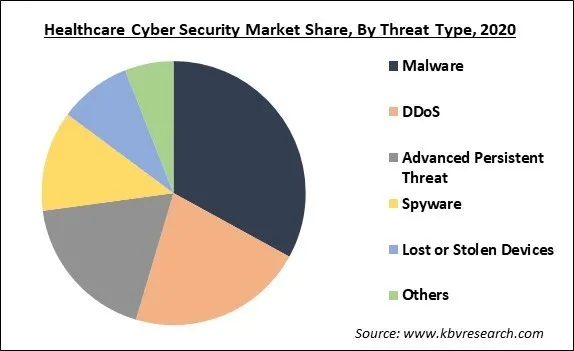
Based on Threat Type, the market is segmented into Malware, DDoS, Advanced Persistent Threat, Spyware, Lost or Stolen Devices and Others. In 2020, the malware segment acquired the highest revenue share of the healthcare cyber security market. In addition, the healthcare sector is currently facing various types of cybersecurity-related issues. It involves malware that compromises system integrity and patient privacy, distributed denial of service (DDoS) attacks that hamper the capability of vendors to offer effective patient care.
Based on End Use, the market is segmented into Hospitals, Health Insurance, Pharma & Chemicals, Medical Devices and Other End uses. The Hospitals market dominated the Global Healthcare Cyber Security Market by End Use 2020, and would continue to be a dominant market till 2027. The Pharma & Chemicals market is expected to witness highest CAGR during the forecast period.
Based on Solution, the market is segmented into Antivirus and Antimalware, Intrusion Detection System/ Intrusion Prevention System, Security Information and Event Management, Identity and Access Management, Risk and Compliance Management, DDoS Mitigation and Other Solutions. Factor such as massive utilization of these solutions is responsible for the growth of this segment. Moreover, the growth of the segment is driven by the increasing number of malware attacks in the healthcare sector which is hampering the networks and affecting patient care.
| Report Attribute | Details |
|---|---|
| Market size value in 2020 | USD 10 Billion |
| Market size forecast in 2027 | USD 28.4 Billion |
| Base Year | 2020 |
| Historical Period | 2017 to 2019 |
| Forecast Period | 2021 to 2027 |
| Revenue Growth Rate | CAGR of 16.3% from 2021 to 2027 |
| Number of Pages | 298 |
| Number of Tables | 443 |
| Report coverage | Market Trends, Revenue Estimation and Forecast, Segmentation Analysis, Regional and Country Breakdown, Competitive Landscape, Companies Strategic Developments, Company Profiling |
| Segments covered | Threat Type, End Use, Solution, Region |
| Country scope | US, Canada, Mexico, Germany, UK, France, Russia, Spain, Italy, China, Japan, India, South Korea, Singapore, Malaysia, Brazil, Argentina, UAE, Saudi Arabia, South Africa, Nigeria |
| Growth Drivers |
|
| Restraints |
|
Based on Regions, the market is segmented into North America, Europe, Asia Pacific, and Latin America, Middle East & Africa. North America emerged as the leading region in the overall healthcare cyber security market by acquiring the maximum revenue share. Factors such as the existence of major market players and the potential application of cyber security in healthcare companies would act as catalysts for the growth of the regional market. Moreover, the growth of the regional market would witness lucrative opportunities with the rise in investments in cyber security and technological advancements happening in the region.
Free Valuable Insights: Global Healthcare Cyber Security Market size to reach USD 28.4 Billion by 2027
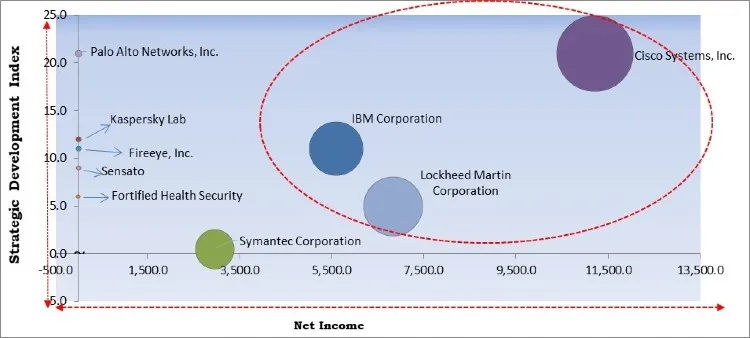
The major strategies followed by the market participants are Product Launches. Based on the Analysis presented in the Cardinal matrix; Cisco Systems, Inc., IBM Corporation, Lockheed Martin Corporation, are the forerunners in the Healthcare Cyber Security Market. Companies such as Symantec Corporation, Fortified Health Security, Palo Alto Networks, Inc., Sensato AND Kaspersky Lab are some of the key innovators in the market.
The market research report covers the analysis of key stake holders of the market. Key companies profiled in the report include Cisco Systems, Inc., FireEye, Inc., IBM Corporation, Kaspersky Lab, Lockheed Martin Corporation, Fortified Health Security, Palo Alto Networks, Inc., Sensato, and Symantec Corporation (Broadcom, Inc.).
By Threat Type
By End Use
By Solution
By Geography

The global healthcare cyber security market size is expected to reach $28.4 billion by 2027.
High requirement for a robust authentication mechanism are driving the market in coming years, however, absence of trained professionals have limited the growth of the market.
Cisco Systems, Inc., FireEye, Inc., IBM Corporation, Kaspersky Lab, Lockheed Martin Corporation, Fortified Health Security, Palo Alto Networks, Inc., Sensato, and Symantec Corporation (Broadcom, Inc.).
The expected CAGR of the healthcare cyber security market is 16.3% from 2021 to 2027.
Yes, Due to covid-19 the requirement and adoption of cyber security are anticipated to be boosted by the rise in penetration of the internet and the adoption of digital platforms by the healthcare sector.
The hospital segment acquired the maximum revenue share of the healthcare cyber security market in 2020. Hospitals are highly prone to cyberattacks as it saves a massive amount of patient data.
Our team of dedicated experts can provide you with attractive expansion opportunities for your business.





 Unique Offerings