“Global Haptic Technology Market to reach a market value of USD 10.36 Billion by 2032 growing at a CAGR of 12.3%”
The Global Haptic Technology Market size is expected to reach USD 10.36 billion by 2032, rising at a market growth of 12.3% CAGR during the forecast period.
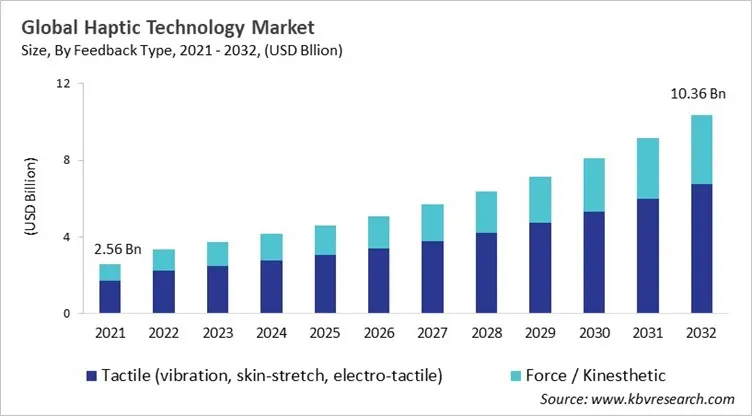
Haptic technology has developed from early research in robotics into a central element of modern human-machine interaction. Initially used in industrial, defense, and simulation systems, its scope expanded with the presence of gaming, consumer electronics, and VR. Advances in actuators, control electronics, and MEMS allow the deployment of tactile feedback into devices such as wearables, controllers, and smartphones, shifting user interaction through nuanced vibrations and texture rendering. Major OEMs like Samsung, Google, and Apple mainstreamed haptics through innovations in piezoelectric actuators and linear resonant. The growth of AR/VR, teleoperation, and automotive touch interfaces further widened haptic applications, while research into flexible and transparent materials encourage the use of energy-efficient, thinner, and more realistic tactile systems.
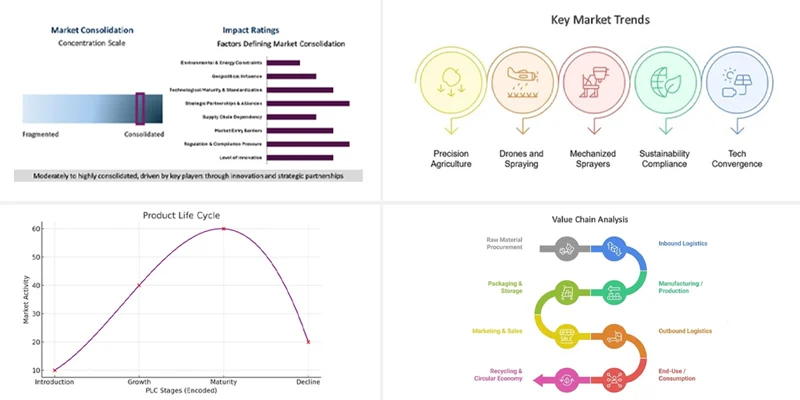
The haptic technology market is a dynamic, moderately fragmented industry driven by the demand for multi-sensory, immersive experiences. The haptic technology market is transforming from basic vibration-based systems to software-based, high-fidelity, multi-modal feedback solutions within automotive, healthcare, robotics, remote collaborations, and consumer electronics. Key market players pursue a mix of IP licensing, acquisitions, vertical integration with OEMs, and ecosystem participation to strengthen their market position. The developing trends like transparent actuators, AI-based tactile rendering, miniaturization, and flexible wearable haptics are reshaping the haptic technology market.
The major strategies followed by the market participants are Product Launches as the key developmental strategy to keep pace with the changing demands of end users. For instance, In March, 2025, Texas Instruments, Inc. unveiled the world’s smallest MCU (1.38 mm²), expanding its MSPM0 portfolio. The wafer-chip package offers full analog and digital interfaces in minimal space—ideal for ultra-compact devices such as wearables. This helps designers embed sensing, control, and potentially haptic modules in smaller form factors. Additionally, In February, 2025, Microchip Technology Incorporated unveiled its maXTouch M1 family (introducing ATMXT3072M1 and ATMXT2496M1) to support large, curved, and free-form automotive displays. These controllers deliver enhanced touch sensitivity (via Smart Mutual acquisition) and integrate ultra-low latency haptic control features, shifting haptic waveform generation from the host CPU to the touch controller.
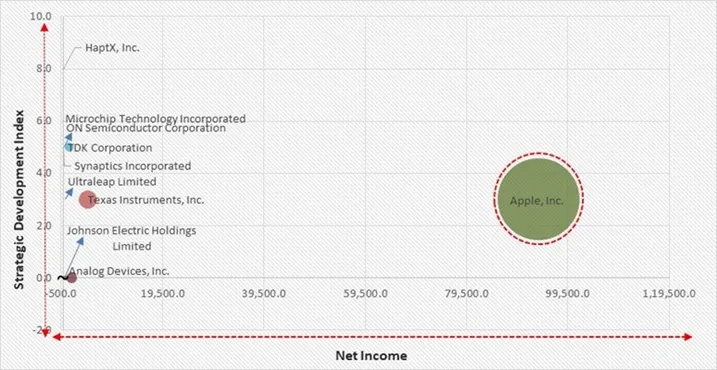
Based on the Analysis presented in the KBV Cardinal matrix; Apple, Inc. is the forerunner in the Haptic Technology Market. In June, 2025, Apple, Inc. unveiled the world's first haptic movie trailer for 'F1 The Movie,' starring Brad Pitt and directed by Joseph Kosinski. Exclusively available on iPhones with iOS 18.4 or later, the trailer uses vibration feedback to immerse viewers in the film's high-speed action scenes. Companies such as Texas Instruments, Inc., Analog Devices, Inc., and TDK Corporation are some of the key innovators in Haptic Technology Market.
The COVID-19 pandemic had a big effect on the haptic technology market. It caused problems with the supply chain, shortages of raw materials, and delays in production. Less production of consumer electronics, car parts, and industrial equipment led to fewer shipments and lost sales. Demand fell even more as people spent less on electronics that weren't necessary. Trade shows, product launches, and research and development (R&D) activities were all put off, which slowed down new ideas. New fields like education, healthcare, and entertainment also had problems. Overall, the pandemic put a stop to market growth and technological progress in important areas for a short time. Thus, the COVID-19 pandemic had a negative impact on the market.

Free Valuable Insights: Haptic Technology Market size to reach USD 10.36 Billion by 2032
Based on feedback type, the haptic technology market is characterized into tactile (vibration, skin-stretch, electro-tactile) and force / kinesthetic. The force / kinesthetic segment attained 33% revenue share in the haptic technology market in 2024. This type of feedback focuses on simulating resistance, weight, and motion, enabling users to physically feel force or pressure in response to virtual or mechanical actions. It plays a crucial role in robotic-assisted surgeries, remote-controlled machinery, and professional training simulators, where realistic force sensations are essential for precision and safety. Kinesthetic systems are also gaining traction in advanced gaming peripherals and virtual reality equipment, offering users a deeper sense of immersion through dynamic physical interaction.
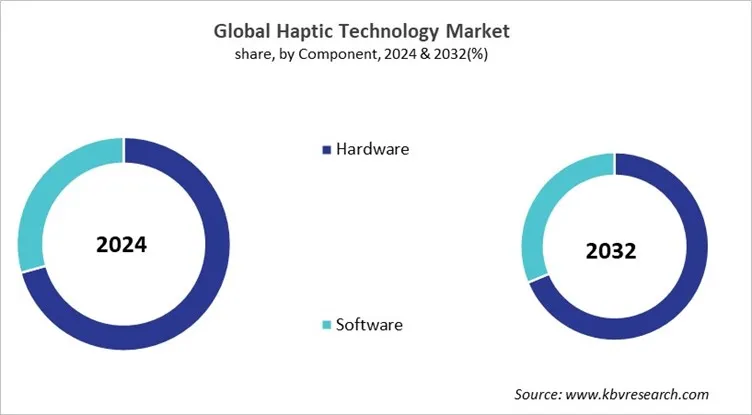
By component, the haptic technology market is divided into hardware and software. The software segment recorded 29% revenue share in the Haptic Technology Market in 2024. The software segment holds a substantial portion of the haptic technology market, owing to its critical role in managing, customizing, and optimizing tactile experiences. Haptic software enables developers to design precise vibration patterns, control feedback intensity, and synchronize tactile responses with visual or auditory cues. The increasing adoption of virtual reality, gaming, and simulation-based training environments has elevated the importance of software-driven haptics that deliver dynamic, real-time sensory feedback.
Region-wise, the haptic technology market is analyzed across North America, Europe, Asia Pacific, and LAMEA. The Asia Pacific segment gained 42% revenue share in the haptic technology market in 2024. The haptic technology market is predicted to experience prominent growth in North America and Europe. The market is expanding, with Canada and the US leading in innovation as well as adoption. The region gets advantage from robust consumer electronics, automotive, healthcare, and gaming industries where haptics are largely integrated into vehicles touch interfaces, medical simulators, and VR/AR systems. High disposable income, a strong R&D ecosystem, and early adoption of immersive interface technologies surge the demand. North America is witnessing significant expansion with the extension of applications into advanced automotive controls, remote healthcare, and tele-operations. Furthermore, Europe haptic technology market is expanding due to widespread adoption of haptic systems in driver feedback systems, automotive infotainment, healthcare devices (like rehabilitation equipment and surgical simulators), premium consumer electronics, and industrial automation. Nations like France, Germany, and the UK are leading regions’ growth, supported by strong engineering capabilities and rising integration of haptics into everyday interfaces.
In the Asia Pacific and LAMEA, the haptic technology market is expected to experience expansion in the forecast period. The market is driven by strong consumer electronics manufacturing in nations like Japan, South Korea, and China, the region benefits from large production of wearables, gaming consoles, and smartphones, along with the increasing adoption of AR/VR systems, smart-device interfaces, and automotive applications. The Asia Pacific region is growing with a large tech savvy population, rapid digitalization, and a cost-efficient manufacturing base. Moreover, the LAMEA region’s market is driven by increasing interest in immersive gaming and AR experiences, growing consumer electronics, and digital transformation across healthcare and automotive industries. LAMEA is predicted to gain market share as haptic-enabled devices become more accessible and affordable across developing nations.
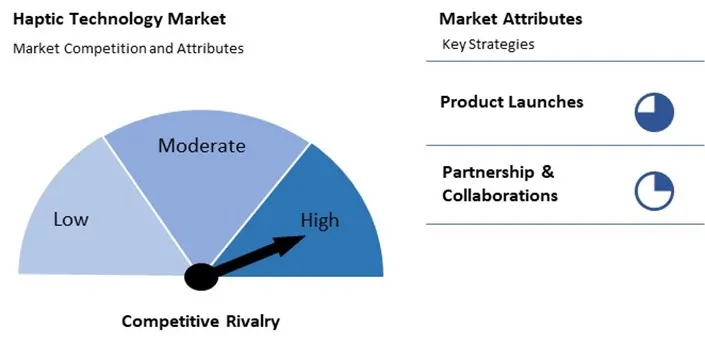
Market competition in the haptic technology market is intense and innovation-driven, fueled by rapid advancements in virtual reality, gaming, automotive, and consumer electronics. Companies compete on technological precision, tactile feedback quality, integration capability, and user experience enhancement. The market features continuous R&D efforts, rising patent activities, and the integration of haptics with AI and IoT. Price pressure, performance differentiation, and application diversity heighten rivalry, pushing firms to innovate in both hardware and software components to gain market advantage.
| Report Attribute | Details |
|---|---|
| Market size value in 2025 | USD 4.59 Billion |
| Market size forecast in 2032 | USD 10.36 Billion |
| Base Year | 2024 |
| Historical Period | 2021 to 2023 |
| Forecast Period | 2025 to 2032 |
| Revenue Growth Rate | CAGR of 12.3% from 2025 to 2032 |
| Number of Pages | 633 |
| Number of Tables | 473 |
| Report coverage | Market Trends, Revenue Estimation and Forecast, Segmentation Analysis, Regional and Country Breakdown, Competitive Landscape, Porter’s 5 Forces Analysis, Company Profiling, Companies Strategic Developments, SWOT Analysis, Winning Imperatives |
| Segments covered | Feedback Type, Actuator Technology, Component, Application, Region |
| Country scope |
|
| Companies Included | Ultraleap Limited (Leap Motion, Inc.), TDK Corporation, Microchip Technology Incorporated, Texas Instruments, Inc., Johnson Electric Holdings Limited, ON Semiconductor Corporation, Synaptics Incorporated, Analog Devices, Inc., HaptX, Inc. and Apple, Inc. |
By Feedback Type
By Actuator Technology
By Component
By Application
By Geography
The market size is projected to reach USD 10.36 billion by 2032.
The haptic technology market is projected to grow at a CAGR of 12.3% between 2025 and 2032.
Strong presence of advanced consumer electronics and gaming ecosystems is fueling the expanding adoption of haptics in automotive interfaces and safety systems.
Ultraleap Limited (Leap Motion, Inc.), TDK Corporation, Microchip Technology Incorporated, Texas Instruments, Inc., Johnson Electric Holdings Limited, ON Semiconductor Corporation, Synaptics Incorporated, Analog Devices, Inc., HaptX, Inc. and Apple, Inc.
The Hardware segment is generating the maximum revenue share in the Global Haptic Technology Market by Component in 2024; thereby, achieving a market value of $7.12 billion by 2032.
The Asia Pacific region dominated the Global Haptic Technology Market by Region in 2024, and would continue to be a dominant market till 2032; thereby, achieving a market value of $4.43 billion by 2032.
Our team of dedicated experts can provide you with attractive expansion opportunities for your business.







 Unique Offerings