“Global Glass Interposers Market to reach a market value of USD 303.45 Million by 2032 growing at a CAGR of 12.1%”
The Global Glass Interposers Market size is expected to reach $303.45 million by 2032, rising at a market growth of 12.1% CAGR during the forecast period.
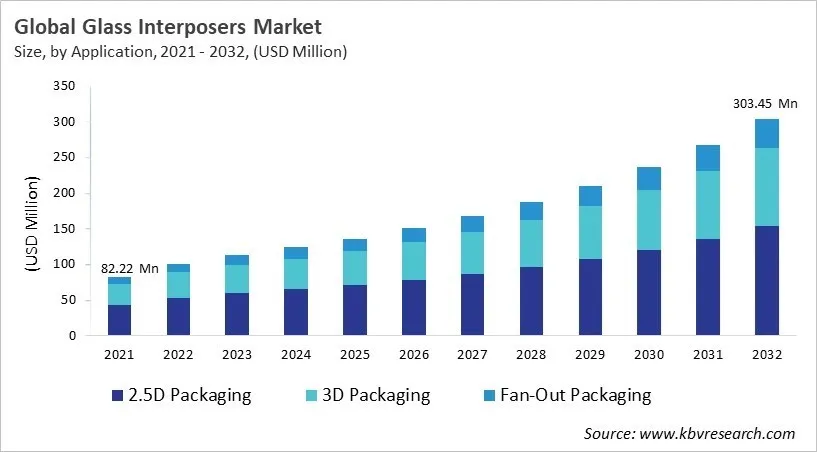
Glass interposers evolved as a game-changer for 2.5D semiconductor packing, due to its superior thermal capabilities, enhanced mechanical robustness, and signal integrity. Market giants such as Intel and Samsung Electronics are speeding their R&D, patent registration, and market deployment initiatives, with applications across the industries such as AI, telecommunication, automotive, and high-performance computers (HPC). Furthermore, Samsung is trying to achieve a transition from silicon to glass interposers by 2028 with the help of parallel-path innovation plan. The company is also collaborating with Chemtronics, Corning, and Philoptics. Similarly, Intel dominates in patent holdings, covering domains like photonic integration, hybrid bonding, and thermally conductive via shields, with the association of players like Huawei, SJ Semi, Absolics.
Furthermore, strategic partnerships, material and tooling collaborations, and the growing use of technology in areas like automotive and telecom are all driving the commercialization of the industry. As per the Semiconductor Industry Association (SIA), global semiconductor sales were $179.7 billion during the second quarter of 2025, an increase of 7.8% compared to Q1. This growth is driving the growth of the glass interposers market. In addition, glass interposers work best in mmWave applications and high-heat environments, enabling their use in ADAS and base stations. Moreover, silicon interposers are still the most popular, but a small group of companies—Intel, Samsung, Corning, Toppan, Absolics, and SJ Semi—are becoming leaders in technology and ecosystem control through patents and early production capacity. Glass interposers are ready for quick adoption because of aggressive global R&D, growing IP portfolios, and ecosystem lock-in strategies. This means that next-generation semiconductor packaging standards are about to change.
The breakout of COVID-19 substantially impacted the global glass interposers industry because of its ramifications in terms of supply chains, deferment of R&D operations, as well as disruption of production activity in main semiconductor centers like Taiwan, South Korea, as well as America. Lockdowns as well as production halts provided a scarcity of core material like ultra-flat glass substrates, stifling the advancement of developmental prototypes. The glass interposer industry was setback temporarily due to disruption of global supplies as well as time lost in semiconductor production due to the outbreak of COVID-19.

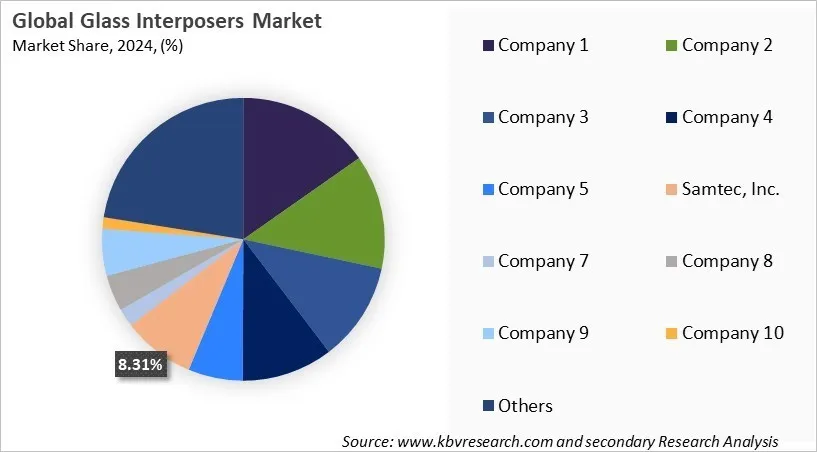
The leading players in the market are competing with diverse innovative offerings to remain competitive in the market. The above illustration shows the percentage of revenue shared by some of the leading companies in the market. The leading players of the market are adopting various strategies in order to cater demand coming from the different industries. The key developmental strategies in the market are Acquisitions, and Partnerships & Collaborations.
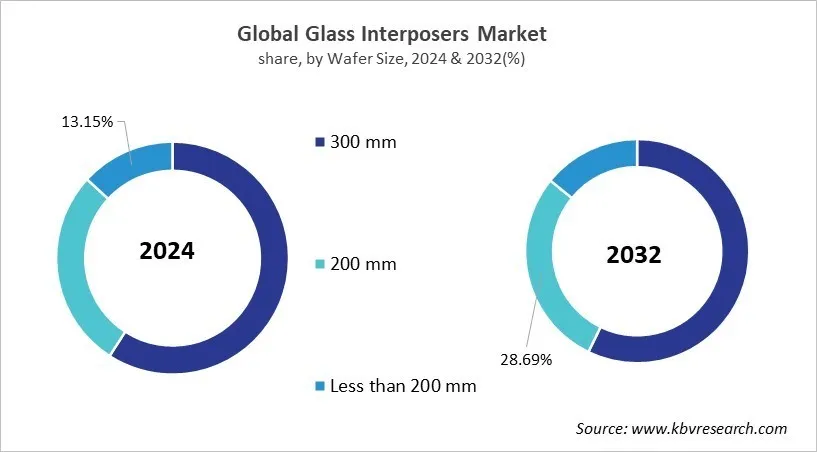
Based on Wafer Size, the market is segmented into 300 mm, 200 mm, and Less than 200 mm. The 200 mm segment attained a 27.7% revenue share in the market in 2024. It is a preferred choice for mid-tier applications that don’t require the scale of 300 mm wafers but still demand reliable functionality. Industries like automotive electronics, IoT devices, and industrial automation benefit from the affordability and compatibility of this wafer size.
Based on Application, the market is segmented into 2.5D Packaging, 3D Packaging, and Fan-Out Packaging. The 3D Packaging segment recorded 35.1% revenue share in the market in 2024. It is used in high-end processors, memory modules, and applications where miniaturization and performance are essential. The approach enhances system speed and power efficiency, which is vital in compact and mobile platforms.
Free Valuable Insights: Global Glass Interposers Market size to reach USD 303.45 Million by 2032
Region-wise, the market is segmented into North America, Europe, Asia-Pacific, LAMEA. The Asia Pacific segment Registered 47.9% revenue share in the market in 2024, owing to its strong semiconductor manufacturing base, high-volume consumer electronics production, and widespread infrastructure development. The glass interposers market is growing quickly in North America and Europe thanks to strong research and development, early commercialization, and a focus on high-performance computing (HPC), AI, and photonics. Intel and Corning lead the way in the U.S., which is a major center for innovation. Europe, on the other hand, uses its knowledge of automotive electronics to make 5G base stations and ADAS modules. The regional supply chain is getting stronger thanks to collaborative ecosystems with suppliers of glass substrates and tools.
Samsung, TSMC, and regional OSATs are making big investments in South Korea, Japan, Taiwan, and China, making the Asia Pacific region the biggest growth center. Partnerships with material suppliers and the ability to quickly make prototypes are speeding up the process of bringing products to market, especially for AI and HPC packaging. LAMEA is slowly gaining ground, with opportunities in telecom, 5G infrastructure, and automotive electronics, especially in the Middle East and South Africa, thanks to technology transfer from big companies around the world.
| Report Attribute | Details |
|---|---|
| Market size value in 2024 | USD 123.72 Million |
| Market size forecast in 2032 | USD 303.45 Million |
| Base Year | 2024 |
| Historical Period | 2021 to 2023 |
| Forecast Period | 2025 to 2032 |
| Revenue Growth Rate | CAGR of 12.1% from 2025 to 2032 |
| Number of Pages | 464 |
| Number of Tables | 473 |
| Report coverage | Market Trends, Revenue Estimation and Forecast, Segmentation Analysis, Regional and Country Breakdown, Market Share Analysis, Porter’s 5 Forces Analysis, Company Profiling, Companies Strategic Developments, SWOT Analysis, Winning Imperatives |
| Segments covered | Product, Application, Closure Type, Material, Region |
| Country scope |
|
| Companies Included | Corning Incorporated, AGC Inc., Schott AG (Carl-Zeiss-Stiftung), Dai Nippon Printing Co., Ltd., Tecnisco, LTD. (Disco Corporation), Samtec, Inc., RENA Technologies GmbH, PLANOPTIK AG, 3DGS Inc., and Workshop of Photonics |
By Wafer Size
By Application
By Substrate Technology
By End Use Industry
By Geography
This Market size is expected to reach $303.45 Million by 2032.
Increasing Demand for High-Performance Electronics are driving the Market in coming years, however, High Manufacturing Cost and Complex Fabrication Process restraints the growth of the Market.
Corning Incorporated, AGC Inc., Schott AG (Carl-Zeiss-Stiftung), Dai Nippon Printing Co., Ltd., Tecnisco, LTD. (Disco Corporation), Samtec, Inc., RENA Technologies GmbH, PLANOPTIK AG, 3DGS Inc., and Workshop of Photonics
The expected CAGR of this Market is 12.1% from 2023 to 2032.
The 300 mm segment captured the maximum revenue in the Market by Wafer Size in 2024, thereby, achieving a market value of $173.5 million by 2032.
The Asia Pacific region dominated the Market by Region in 2024, thereby, achieving a market value of $148.1 million by 2032.
Our team of dedicated experts can provide you with attractive expansion opportunities for your business.












 Unique Offerings