“Global Focused Ion Beam Market to reach a market value of USD 2.43 Billion by 2032 growing at a CAGR of 6.9%”
The Global Focused Ion Beam Market size is expected to reach $2.43 billion by 2032, rising at a market growth of 6.9% CAGR during the forecast period.
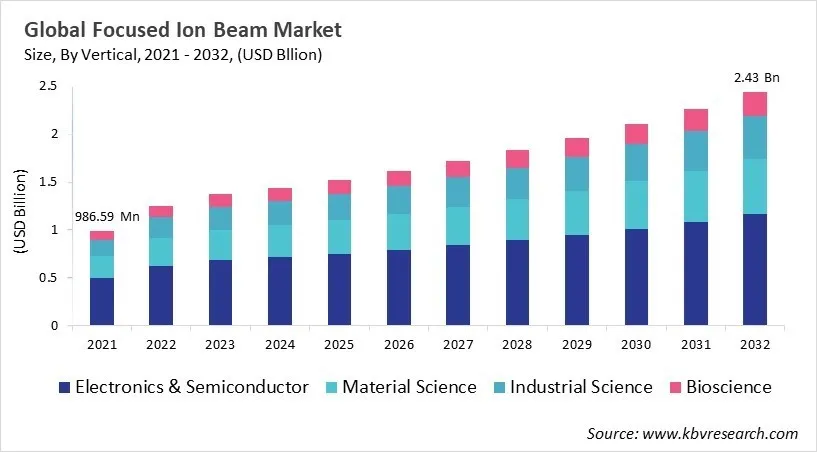
Focused ion beam systems have transformed from specialized research tools in the 1970s–1980s to modern dual-beam FIB-SEM platforms used across semiconductors, materials science, nanotechnology, and life sciences. Key OEMs such as Hitachi High Technologies, Thermo FisherScientific (FEI legacy), JEOL, and TESCAN have gained decades of research and knowledge to incorporate high-precision ion beams, deposition, milling, advanced imaging, and automation. Government-funded programs – like India’s NanoMission, U.S. National Nanotechnology Initiative (NNI), EU Horizon initiatives – have invested robustly in infrastructure, facilitating collaborative access to high-end FIB tools in industrial labs and academic institutions. These collaborations promote partnerships between companies and OEMs such as Thermo Fisher’s Arctis Cryo Plasma FIB, crafted with the UK’s Rosalind Franklin Institute.
Nanotechnology centers in the U.S., EU, India, and Japan that receive government funding have become centers for interdisciplinary research and development that support uses in semiconductors, clean energy, advanced composites, and biotechnology. OEMs make sure that their product strategies match the needs of the public sector by focusing on cryo-capable systems, plasma ion sources for faster milling, correlative light-electron workflows, and software automation. Working with publicly funded labs makes sure that new features are adopted, trained on, and localized. Companies like TESCAN, JEOL, and Hitachi work closely with scientific institutions to make both commercial and custom FIB systems and put them in national research facilities. This solidifies their role in making nanoscale analysis and fabrication possible.
The COVID-19 pandemic profoundly disrupted the Focused Ion Beam (FIB) market, primarily due to supply chain interruptions, manufacturing slowdowns, and international logistics restrictions that delayed production and equipment delivery. Key end-user sectors, including semiconductors and academic research, curtailed capital expenditures amid economic uncertainty, leading to postponed or canceled FIB acquisitions. Additionally, workforce challenges such as limited on-site staffing and disrupted training pipelines hindered R&D and customer engagement. Emerging markets faced further setbacks due to constrained investments, collectively resulting in a marked slowdown in market growth and vendor performance during the pandemic period. Thus, the COVID-19 pandemic had a negative impact on the market.

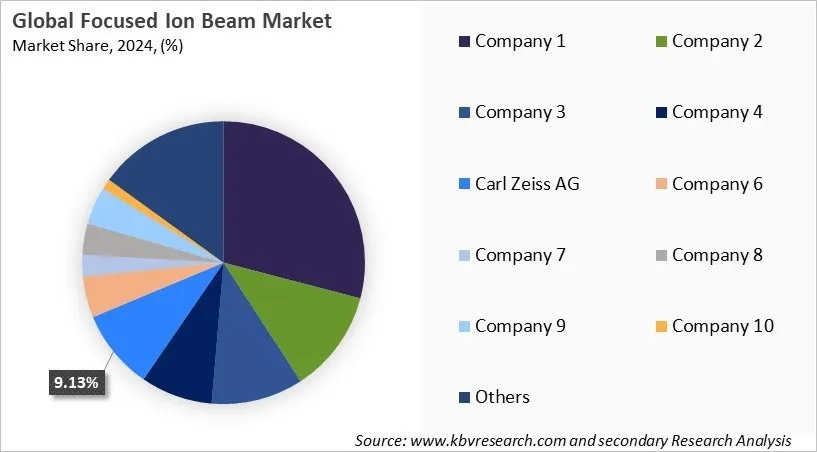
The leading players in the market are competing with diverse innovative offerings to remain competitive in the market. The above illustration shows the percentage of revenue shared by some of the leading companies in the market. The leading players of the market are adopting various strategies in order to cater demand coming from the different industries. The key developmental strategies in the market are Acquisitions, and Partnerships & Collaborations.
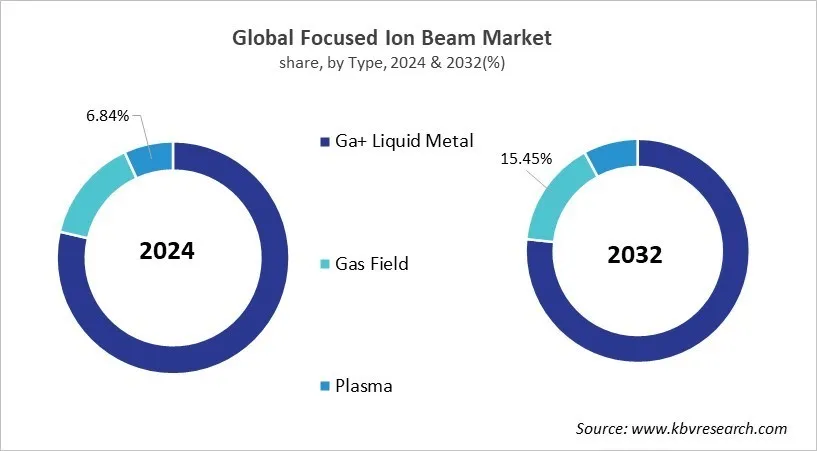
Based on Type, the market is segmented into Ga+ Liquid Metal, Gas Field, and Plasma. The gas field segment attained 14% revenue share in the focused ion beam market in 2024. Gas field ion sources (GFIS) offer unique advantages, including high brightness and low energy spread, which are ideal for ultra-high-resolution imaging. These systems are gaining traction in domain such as surface science, advanced materials characterization, and biological sample analysis. The growing demand for detailed surface imaging in academic and industrial research has supported the adoption of gas field FIB technologies.
Based on Vertical, the market is segmented into Electronics & Semiconductor, Material Science, Industrial Science, and Bioscience. The material science segment recorded 23% revenue share in the focused ion beam market in 2024. FIB systems are increasingly being used in material science research to prepare transmission electron microscopy (TEM) samples, perform microstructural analysis, and investigate surface properties at nanoscale levels. The rise in academic research, coupled with advancements in materials used across industries such as aerospace, energy, and automotive, has propelled the adoption of focused ion beam technology in this field.
Free Valuable Insights: Global Focused Ion Beam Market size to reach USD 2.43 Billion by 2032
Region-wise, the market is analyzed across North America, Europe, Asia Pacific, and LAMEA. The North America segment recorded 35% revenue share in the focused ion beam market in 2024. The Focused Ion Beam market in North America is growing because of strong research and development in semiconductors and advanced materials, as well as strong government funding through programs like the U.S. National Nanotechnology Initiative (NNI). Innovation and adoption in fields like semiconductor device failure analysis, nanofabrication, and biotechnology are helped by the presence of top research universities, federal labs, and OEM headquarters, especially Thermo Fisher Scientific. Coordinated research programs like Horizon 2020 and Horizon Europe help Europe by encouraging cross-border collaborations and shared nanofabrication facilities. OEMs like TESCAN (Czech Republic) and JEOL Europe work closely with academic labs and government-funded centers to support research in energy storage, materials characterization, and cryogenic life sciences.
In the Asia Pacific region, rapid industrialization, semiconductor manufacturing growth, and national nanotechnology programs in countries like Japan, China, South Korea, and India fuel FIB demand. Japan’s Nanotechnology Platform, China’s state-backed semiconductor initiatives, and India’s NanoMission program are expanding access to FIB systems in universities and industrial labs. LAMEA is an emerging market, with growth driven by research infrastructure development in countries like Brazil, Saudi Arabia, and South Africa. Investments are focused on materials science, mining, and energy-related nanotechnology research. However, market penetration remains lower compared to mature regions, leaving significant scope for OEM expansion through training partnerships and shared-access facilities.
| Report Attribute | Details |
|---|---|
| Market size value in 2024 | USD 1.44 Billion |
| Market size forecast in 2032 | USD 2.43 Billion |
| Base Year | 2024 |
| Historical Period | 2021 to 2023 |
| Forecast Period | 2025 to 2032 |
| Revenue Growth Rate | CAGR of 6.9% from 2025 to 2032 |
| Number of Pages | 462 |
| Number of Tables | 385 |
| Report coverage | Market Trends, Revenue Estimation and Forecast, Segmentation Analysis, Regional and Country Breakdown, Market Share Analysis, Porter’s 5 Forces Analysis, Company Profiling, Companies Strategic Developments, SWOT Analysis, Winning Imperatives |
| Segments covered | Voltage, Application, Region |
| Country scope |
|
| Companies Included | Thermo Fisher Scientific, Inc., Hitachi Energy Ltd. (Hitachi, Ltd.), JEOL Ltd., Oxford Instruments plc, Carl Zeiss AG, Veeco Instruments, Inc., A&D Company, Limited, Raith GmbH, TESCAN ORSAY HOLDING, a.s., and Eurofins Scientific SE |
By Wafer Size
By Application
By Substrate Technology
By End Use Industry
By Geography
This Market size is expected to reach $2.43 Billion by 2032.
Increasing Demand for Semiconductor Miniaturization and Circuit Complexity are driving the Market in coming years, however, High Capital Investment and Operating Costs restraints the growth of the Market.
Thermo Fisher Scientific, Inc., Hitachi Energy Ltd. (Hitachi, Ltd.), JEOL Ltd., Oxford Instruments plc, Carl Zeiss AG, Veeco Instruments, Inc., A&D Company, Limited, Raith GmbH, TESCAN ORSAY HOLDING, a.s., and Eurofins Scientific SE
The expected CAGR of this Market is 6.9% from 2023 to 2032.
The Electronics & Semiconductor segment led the maximum revenue in the Market by Vertical in 2024, thereby, achieving a market value of $1.2 billion by 2032.
The North America region dominated the Market by Region in 2024, and would continue to be a dominant market till 2032; thereby, achieving a market value of $845 Million by 2032.
Our team of dedicated experts can provide you with attractive expansion opportunities for your business.






 Unique Offerings