The Europe Web Filtering Market would witness market growth of 11.3% CAGR during the forecast period (2025-2032).
The UK market dominated the Europe Web Filtering Market by Country in 2024, and would continue to be a dominant market till 2032; thereby, achieving a market value of $513.3 million by 2032. The Germany market is experiencing a CAGR of 10.4% during (2025 - 2032). Additionally, The France market would exhibit a CAGR of 12.1% during (2025 - 2032). The UK and Germany led the Europe Web Filtering Market by Country with a market share of 20.8% and 19.3% in 2024.The France market is expected to witness a CAGR of 12.1% during throughout the forecast period.
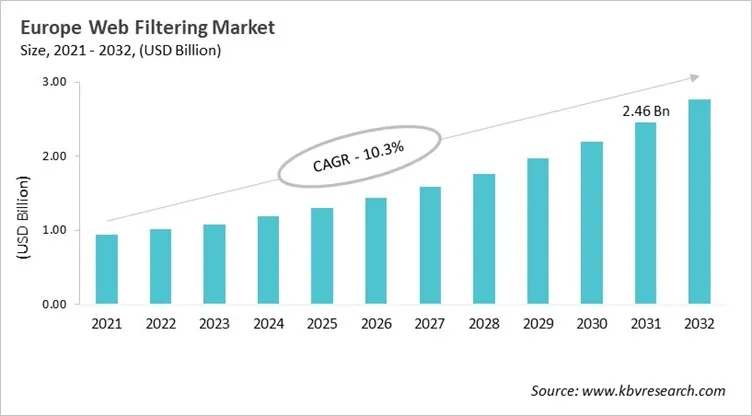
In the last ten years, web filtering in Europe has changed from a simple tool for controlling access and productivity to an important layer of cybersecurity that keeps up with the rise of cloud computing, remote work, and more complex threats. Companies now need more advanced features like the ability to inspect encrypted traffic, create sandboxes, enforce identity-based policies, and connect to secure web gateways and SASE platforms. Regulatory and cybersecurity frameworks like NIS 2, GDPR, and the Digital Services Act have had a big impact on this change. They have made people more aware of cyber-resilience, content governance, and risk mitigation. As a result, European companies are moving away from on-premises proxy appliances and toward cloud-native and hybrid filtering methods that apply the same rules to all devices and environments.
There are three main trends that are driving the European market: moving toward cloud/hybrid deployment, merging filtering with larger cybersecurity platforms, and stricter compliance requirements that call for more advanced filtering capabilities. There is a lot of competition, with global vendors competing with European specialists who stand out by offering localized services, affordable cloud models, support for regional regulations, and strong MSP ecosystems. To deal with Europe's varied infrastructure maturity and strict data sovereignty rules, vendors are putting more emphasis on subscription-based delivery, platform integration, and being ready for regulations. As the market matures, AI/ML analytics, easy deployment across multiple countries, and integrated SASE or managed-security offerings that fit European governance frameworks will be the most important factors in gaining a competitive edge.
Based on Filtering Type, the market is segmented into URL Filtering, DNS Filtering, Keyword Filtering and File-Type & Other Filtering. The URL Filtering market segment dominated the UK Web Filtering Market by Filtering Type is expected to grow at a CAGR of 9.2 % during the forecast period thereby continuing its dominance until 2032. Also, The Keyword Filtering market is anticipated to grow as a CAGR of 10.8 % during the forecast period during (2025 - 2032).
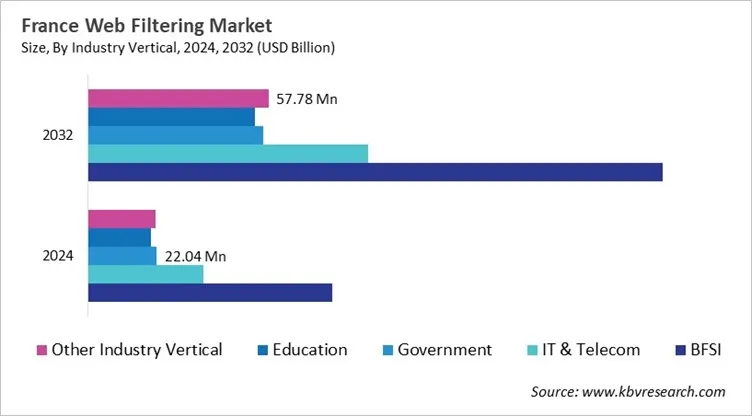
Based on Industry Vertical, the market is segmented into BFSI, IT & Telecom, Government, Education and Other Industry Vertical. Among various France Web Filtering Market by Industry Vertical; The BFSI market achieved a market size of USD $78.2 Million in 2024 and is expected to grow at a CAGR of 11.5 % during the forecast period. The Education market is predicted to experience a CAGR of 13.3% throughout the forecast period from (2025 - 2032).
Free Valuable Insights: The Global Web Filtering Market will Hit USD 10.26 Billion by 2032, at a CAGR of 11.7%
The UK web filtering market is growing quickly because of strict rules, more cyber threats, and more businesses, schools, and governments using digital services. The Data Protection Act (UK GDPR), the NIS Regulations, and planned cybersecurity laws are all examples of compliance frameworks that are pushing organizations to use filtering as part of their overall cyber-risk management. The move to remote and hybrid work, using the cloud, and bringing your own device (BYOD) has sped up the need for AI-enabled filtering that works with Secure Web Gateway and SASE platforms. There are global vendors and UK-based MSPs competing. Schools, large businesses, and small and medium-sized businesses (SMEs) are all using subscription-based models, which are becoming more popular. As filtering becomes a core part of cybersecurity instead of a separate tool, vendors who offer flexible policy controls, compliance with regulations, and easy deployment are getting ahead.

By Organization Size
By Industry Vertical
By Component
By Deployment Mode
By Filtering Type
By Country
Our team of dedicated experts can provide you with attractive expansion opportunities for your business.







 Unique Offerings