The Europe Wealth Tech Solution Market would witness market growth of 13.5% CAGR during the forecast period (2025-2032).
The UK market dominated the Europe Wealth Tech Solution Market by Country in 2024, and would continue to be a dominant market till 2032; thereby, achieving a market value of $1,076.7 million by 2032. The Germany market is exhibiting a CAGR of 12.3% during (2025 - 2032). Additionally, The France market would experience a CAGR of 14.3% during (2025 - 2032). The UK and Germany led the Europe Wealth Tech Solution Market by Country with a market share of 25.3% and 16.8% in 2024.The Italy market is expected to witness a CAGR of 14.2% during throughout the forecast period.
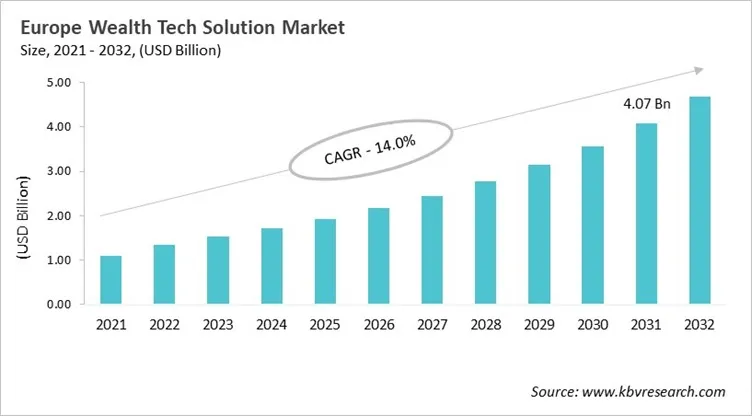
The European WealthTech market has evolved from a fragmented, branch-based wealth-management industry into a digitally enabled, AI-driven, and regulation-supported ecosystem. This transformation has been fuelled by investor demand for personalisation, the rise of digital platforms and robo-advisors, and regulatory frameworks such as MiFID II, PSD2, and GDPR that promote transparency and innovation. The sector is increasingly shaped by cost pressures, ESG investing, and data-centric advisory solutions powered by cloud-native and AI technologies. Consolidation among incumbents and the entry of agile fintechs have intensified competition, leading to a dynamic market defined by open banking, hybrid advisory models, and client-centric innovation. Overall, Europe has become a global hotspot for WealthTech, driven by strong financial infrastructure, regulatory clarity, and a culture of digital transformation.
Three major trends dominate the European WealthTech landscape — AI-led hyper-personalisation, hybrid advisory and platform modernisation, and sustainability-driven digitalisation. Firms are deploying analytics, automation, and intelligent onboarding to deliver scalable yet personalised client experiences. Hybrid models that blend digital efficiency with human insight are gaining traction across investor segments. Meanwhile, ESG investing and regulatory innovation (MiFID II, PSD2, GDPR) are shaping new business models focused on transparency, compliance, and ethical finance. Leading firms are adopting digital-first and partnership-based strategies, consolidating platforms for cost efficiency, and embedding sustainability and data governance at their core. Together, these shifts position Europe’s WealthTech leaders to achieve scale, enhance trust, and meet evolving investor expectations in a fast-changing financial ecosystem.
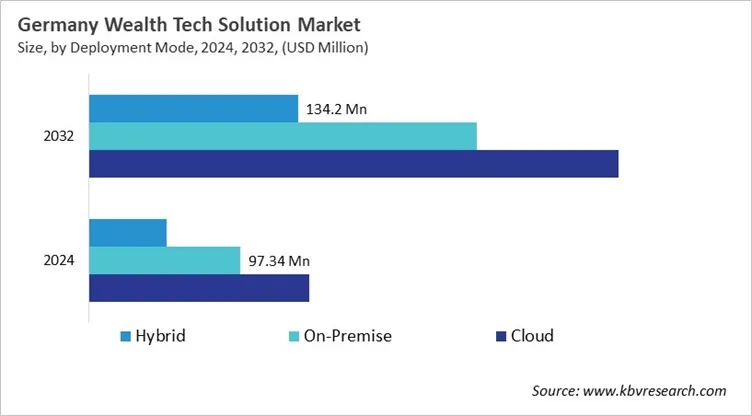
Based on Deployment Mode, the market is segmented into Cloud, On-Premise and Hybrid. Among various Germany Wealth Tech Solution Market by Deployment Mode; The Cloud market achieved a market size of USD $141.4 Million in 2024 and is expected to grow at a CAGR of 11.8 % during the forecast period. The Hybrid market is predicted to experience a CAGR of 13.2% throughout the forecast period from (2025 - 2032).
Based on Enterprise Size, the market is segmented into Large Enterprises and Small & Medium-sized Enterprises. With a compound annual growth rate (CAGR) of 11.4% over the projection period, the Large Enterprises Market, dominate the UK Wealth Tech Solution Market by Enterprise Size in 2024 and would be a prominent market until 2032. The Small & Medium-sized Enterprises market is expected to witness a CAGR of 13.5% during (2025 - 2032).
Based on Business Model, the market is segmented into B2B, B2C and B2B2C / White-Label Platforms. The B2B market segment dominated the France Wealth Tech Solution Market by Business Model is expected to grow at a CAGR of 13.8 % during the forecast period thereby continuing its dominance until 2032. Also, The B2B2C / White-Label Platforms market is anticipated to grow as a CAGR of 15 % during the forecast period during (2025 - 2032).
Free Valuable Insights: The Global Wealth Tech Solution Market will Hit USD 16.48 Billion by 2032, at a CAGR of 13.9%
The UK is one of the most advanced WealthTech markets in Europe, thanks to its strong fintech infrastructure, forward-thinking rules, and London's role as a center for financial innovation. The Financial Conduct Authority's open approach and a culture that values transparency and self-management have made it easier for tech-savvy investors to manage their wealth. Even though there are regulatory problems after Brexit, companies are focusing on automation, AI analytics, ESG tools, and hybrid advisory models to make things more efficient and personalized. Banks, fintechs, and startups are all trying to provide better user experiences and reliable digital-advisory services in a very competitive market. To meet changing investor expectations, success depends increasingly on combining strong regulations, flexible technology, and design that puts people first.

By Enterprise Size
By Deployment Mode
By Business Model
By End User
By Solution Type
By Country
Our team of dedicated experts can provide you with attractive expansion opportunities for your business.



 Unique Offerings