The Europe Video as a Sensor Market would witness market growth of 7.7% CAGR during the forecast period (2025-2032).
The Germany market dominated the Europe Video As A Sensor Market by Country in 2024, and would continue to be a dominant market till 2032; thereby, achieving a market value of $6,777.3 million by 2032. The UK market is exhibiting a CAGR of 6.6% during (2025 - 2032). Additionally, The France market would experience a CAGR of 8.4% during (2025 - 2032).
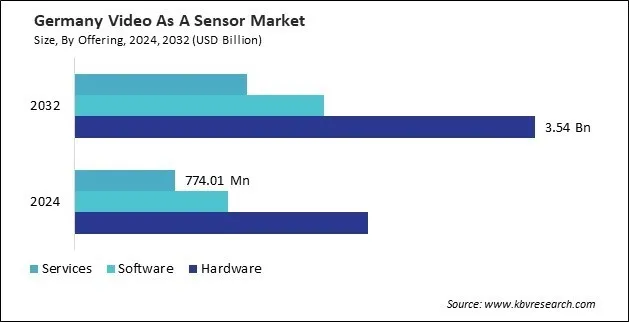
The Video-as-a-Sensor (VaaS) business in Europe has changed a lot in the last several years because of clearer rules, projects to digitize cities, and new ideas from European OEMs. The European Data Protection Supervisor (EDPS) and the European Data Protection Board (EDPB) gave early advise on video surveillance that balanced public safety with rigorous data privacy under the GDPR. This made it easier to understand the rules for using smart camera systems at transportation hubs, for city monitoring, and for important infrastructure.
Free Valuable Insights: The Global Video As A Sensor Market will Hit USD 131.73 Billion by 2032, at a CAGR of 8.1%
Edge computing combined with artificial intelligence (AI) is a dominant trend in Europe, particularly in industrial and surveillance applications. Video sensors embedded with AI capabilities at the edge enable real-time decision-making and reduce reliance on cloud infrastructure, aligning with GDPR compliance and data privacy regulations.
European governments and municipalities are increasingly investing in smart infrastructure—transport systems, energy grids, and urban safety—that leverage video sensors for traffic control, environmental monitoring, and public safety.
The European Video as a Sensor market is marked by robust competition driven by significant innovation in imaging technology, AI integration, and rising demand across industrial, government, and commercial sectors. Major companies are rapidly expanding their capabilities through strategic partnerships, mergers, and investments in advanced sensor technologies. The market landscape reflects a blend of well-established global manufacturers, regional technology specialists, and rising startups.
Europe hosts several global and regional leaders in the video sensing and imaging technology space. Major companies such as Bosch Security Systems (Germany), Axis Communications (Sweden), FLIR Systems (UK), Thales Group (France), and Siemens AG (Germany) are among the most influential players. These firms lead in developing integrated video surveillance, machine vision, and AI-based analytics solutions.
These players maintain a competitive edge through proprietary technologies, AI integration, scalable platforms, and strong distribution networks across the EU.
European firms increasingly collaborate with AI startups and cloud providers to enable edge-based video processing and real-time analytics. For instance:
In the industrial segment, companies such as Siemens and ABB are integrating video sensors in smart factory solutions, emphasizing predictive maintenance and quality inspection.
Based on Offering, the market is segmented into Hardware, Software, and Services.
For instance:
Hanwha Vision Europe recently introduced AI-based surveillance cameras tailored to meet GDPR compliance and privacy standards, incorporating edge AI for people counting, face masking, and object classification. These are being adopted in commercial and public-sector deployments across the UK, France, and Germany.
Milestone Systems enhanced its XProtect software with license plate recognition, motion-triggered alerts, and edge analytics. The update was deployed by logistics and city management agencies across Scandinavia and Benelux to improve vehicle tracking and event monitoring..
Based on Product, the market is segmented into Video Surveillance, Machine Vision & Monitoring, Thermal Imaging, and Hyperspectral Imaging.
Trend: Intensifying deployment of AI-powered CCTV across urban public spaces, driven by both expansion and regulatory shifts.
For instance, London boroughs, including Hammersmith & Fulham and Westminster, have significantly upgraded their CCTV networks—deploying AI-enabled cameras capable of detecting aggressive behavior, loitering, and weapon presence. Local councils spent over £30 million in FY 2023–24, emphasizing automation in crime prevention.
Meanwhile, Paris Police has extended the use of AI-driven surveillance (deployed during the 2024 Olympics) into everyday urban monitoring. This use includes anomaly detection like crowd movement and left objects—an extension of capabilities previously trialed at events.
Trend: Growing utilization of hyperspectral sensors in environmental monitoring, agriculture, and satellite surveillance across Europe.
For instance, the EU-backed Hyper-IP project (European Defence Agency) aims to develop satellite hyperspectral imaging systems for military-grade signal processing—highlighting strong public investment in advanced sensing capability.
Industrial and Earth-observation applications continue to advance; e.g., HAIP Solutions unveiled drone-mounted hyperspectral cameras for precision agriculture—enabling plant stress detection and targeted interventions across Europe.
Based on End-Use, the market is segmented into Commercial, Industrial, Government, and Other End-Use.
European governments are deploying advanced edge-capable video-as-a-sensor systems, such as AI-integrated surveillance camera networks and smart infrastructure, aimed at enhancing public safety, event security, and intelligent urban management—all under stringent privacy frameworks.
European commercial entities—retailers, malls, hotels, and offices—are deploying privacy-conscious AI video sensor hardware, including gesture-recognition systems and smart locks, to optimize operations, enhance safety, and monitor staff performance without compromising customer privacy.
Based on Application, the market is segmented into Security & Surveillance, Traffic Management, Retail Analytics, Healthcare, Manufacturing, Mapping, and Other Application.
Trend: AI-powered gesture and behavior detection is gaining traction in retail and public safety while addressing privacy concerns.
For instance:
Trend: AI-integrated video sensors are being tested for congestion reduction, safety, and emission control in cities.
For instance:
Based on Offering, the market is segmented into Hardware, Software, and Services. Based on Product, the market is segmented into Video Surveillance, Machine Vision & Monitoring, Thermal Imaging, and Hyperspectral Imaging. Based on End-Use, the market is segmented into Commercial, Industrial, Government, and Other End-Use. Based on Application, the market is segmented into Security & Surveillance, Traffic Management, Retail Analytics, Healthcare, Manufacturing, Mapping, and Other Application. Based on countries, the market is segmented into Germany, UK, France, Russia, Spain, Italy, and Rest of Europe.

By Offering
By Product
By End-Use
By Application
By Country
Our team of dedicated experts can provide you with attractive expansion opportunities for your business.



 Unique Offerings