The Europe Transformerless UPS Market would witness market growth of 10.7% CAGR during the forecast period (2025-2032).
The Germany market dominated the Europe Transformerless UPS Market by Country in 2024, and would continue to be a dominant market till 2032; thereby, achieving a market value of $259 million by 2032. The UK market is experiencing a CAGR of 9.4% during (2025 - 2032). Additionally, The France market would exhibit a CAGR of 11.8% during (2025 - 2032). The Germany and UK led the Europe Transformerless UPS Market by Country with a market share of 21.3% and 14.9% in 2024.The Italy market is expected to witness a CAGR of 12.5% during throughout the forecast period.
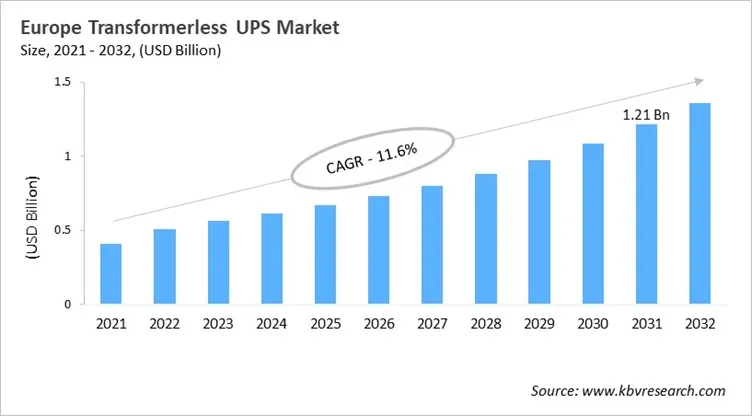
The European transformerless UPS market has grown from a small market to a common power source for data centers, commercial buildings, and industrial infrastructure. The EU Code of Conduct places a lot of importance on energy efficiency and sustainability, which is why these systems are preferred. They are more efficient (up to 98%), smaller, and produce less heat. The growth of digitalization, the expansion of data centers, and edge computing have all sped up adoption even more. Transformerless UPS designs now support modular scalability, IoT integration, and flexible architectures that work well in modern high-density environments. The change is in line with Europe's bigger goals of reducing carbon emissions, making better use of space, and lowering the total cost of ownership.
To stay ahead, top OEMs like Schneider Electric, Eaton, Legrand, and ABB are focusing on innovation, localization, and lifecycle value. Some of the strategies are to make modular systems that are very efficient, increase manufacturing in Europe to meet local demand, and offer digital services like energy analytics and predictive maintenance. Vendors are also making sure their products meet EU energy standards and are focusing on areas like data centers, healthcare, and manufacturing. Efficiency gains, digital integration, regional support, and sustainability are all important factors in the competitive landscape. This makes transformerless UPS the standard for Europe's next-generation critical power infrastructure.
Based on Power Rating, the market is segmented into 10–100 kVA, greater than 100 kVA, and less than 10 kVA. The 10–100 kVA market segment dominated the Germany Transformerless UPS Market by Power Rating is expected to grow at a CAGR of 8.5 % during the forecast period thereby continuing its dominance until 2032. Also, The less than 10 kVA market is anticipated to grow as a CAGR of 9.8 % during the forecast period during (2025 - 2032).
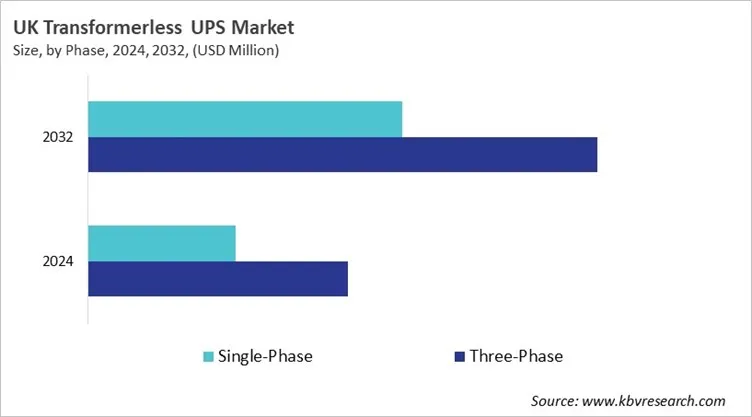
Based on Phase, the market is segmented into Three-Phase, and Single-Phase. Among various UK Transformerless UPS Market by Phase; The Three-Phase market achieved a market size of USD $58.2 Million in 2024 and is expected to grow at a CAGR of 9 % during the forecast period. The Single-Phase market is predicted to experience a CAGR of 10.2% throughout the forecast period from (2025 - 2032).
Free Valuable Insights: The Global Transformerless UPS Market will Hit USD 4.94 Billion by 2032, at a CAGR of 11.1%
Germany's UPS market is growing quickly because of improvements in digital infrastructure, modernization of industries, and the use of renewable energy. This makes it a good time for transformerless UPS to become more popular. Germany's strict goals for sustainability and energy efficiency are in line with these systems' higher efficiency, smaller footprint, and lower energy losses. Demand is growing in data centers, manufacturing, and automation. Modular, scalable, and IoT-enabled UPS designs are becoming more popular for their ability to predict maintenance needs and provide flexibility. Schneider Electric, Eaton, ABB, and Vertiv are the biggest players in the market. They compete on things like lifecycle cost advantages, service quality, and meeting German energy standards. Even though smaller users may be less likely to adopt it because of higher upfront costs and the country's reliable grid, overall growth prospects remain strong as organizations focus on total cost of ownership, operational efficiency, and sustainable power resilience.

By Phase
By Power Rating
By Form Factor
By End-use Industry
By Country
Our team of dedicated experts can provide you with attractive expansion opportunities for your business.



 Unique Offerings