The Europe Self-Healing Networks Market is expected to reach $1.71 billion by 2031 and would witness market growth of 30.4% CAGR during the forecast period (2025-2032).
The UK market dominated the Europe Self-Healing Networks Market by Country in 2024, and would continue to be a dominant market till 2032; thereby, achieving a market value of $431.3 million by 2032. The Germany market is exhibiting a CAGR of 29.3% during (2025 - 2032). Additionally, The France market would experience a CAGR of 31.4% during (2025 - 2032). The UK and Germany led the Europe Self-Healing Networks Market by Country with a market share of 21.3% and 18.9% in 2024. The Spain market is expected to witness a CAGR of 32.6% during throughout the forecast period.
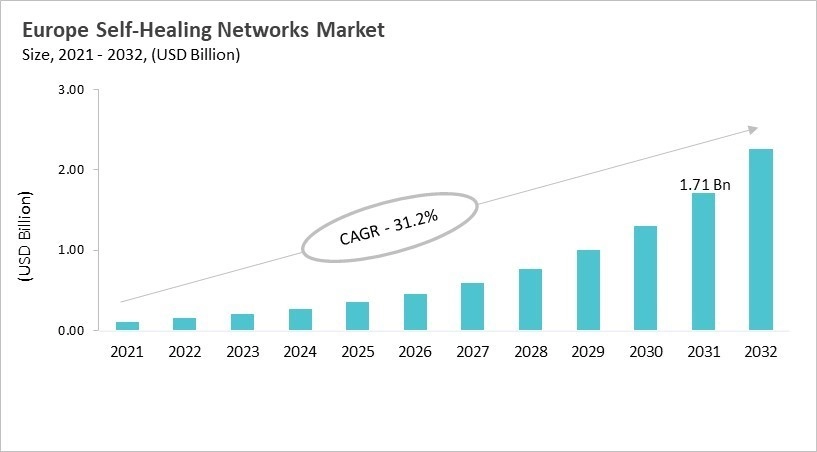
Self-healing networks in Europe mark a significant transition from conventional, human-operated network management to self-sufficient, AI-powered systems that can identify, assess, and rectify disruptions instantaneously. These networks use AI, machine learning, and closed-loop automation to make sure that they are always connected, working at their best, and able to handle problems. This is especially important as 5G networks grow quickly and digital services in healthcare, finance, transportation, and smart city applications become more important. Top OEMs like Ericsson and Cisco are adding agentic AI and predictive analytics to platforms like NetCloud. This lets networks automatically find and fix problems, run on policies, and support zero-touch network management, which cuts down on downtime, mistakes made by people, and other problems.
Intent-based networking and closed-loop automation are helping self-healing networks evolve even more. These technologies let systems constantly sense, analyze, and act on network conditions without needing human help. Strategic partnerships between OEMs, cloud providers, and AI experts, like Ericsson's partnership with AWS, speed up deployment and make operations more efficient by making AI integration more flexible. Policies for digital infrastructure in Europe, such as those in the Digital Europe Programme, encourage the use of autonomous networking by supporting AI, cybersecurity, and strong network frameworks. The combination of advanced AI-native architectures, partnerships between businesses, and government support is putting Europe at the forefront of resilient, self-managing telecommunications that can handle the needs of network environments that are becoming more complex and important to the mission.
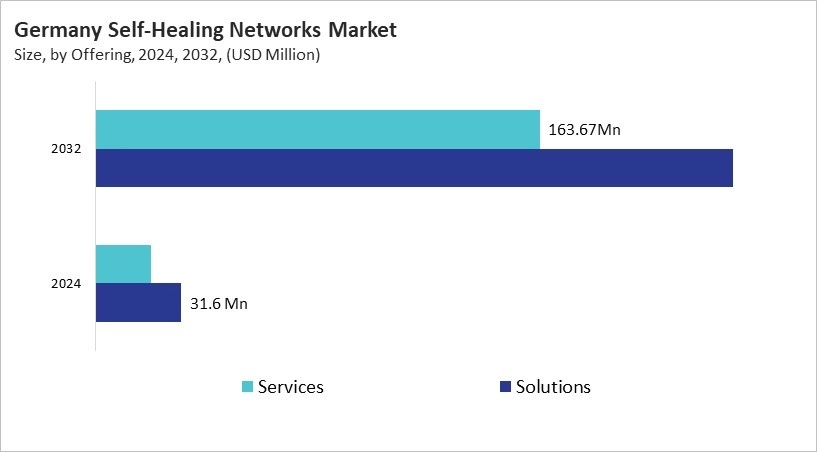
Based on Offering, the market is segmented into Solutions and Services. The Solutions market segment dominated the Germany Self-Healing Networks Market by Offering is expected to grow at a CAGR of 28.7 % during the forecast period thereby continuing its dominance until 2032. Also, The Services market is anticipated to grow as a CAGR of 30 % during the forecast period during (2025 - 2032).
Based on Application, the market is segmented into Network Traffic Management, Networking Configuration & Provisioning, Root Cause Analysis, Network Access Control and Security Compliance Management & Others. Among various UK Self-Healing Networks Market by Application; The Network Traffic Management market achieved a market size of USD $14 Million in 2024 and is expected to grow at a CAGR of 27.3 % during the forecast period. The Network Access Control market is predicted to experience a CAGR of 29.5% throughout the forecast period from (2025 - 2032).
Free Valuable Insights: The Worldwide Self-Healing Networks Market is projected to reach USD 8.46 billion by 2032, at a CAGR of 30.9%
The market for self-healing networks in the UK is growing quickly as operators upgrade old infrastructure to handle more data traffic, a wider range of service needs, and the rollout of 5G across the country. Telecom companies are using AI-powered monitoring, analytics, and automation more and more to find problems before they happen and fix them automatically across core, access, and customer premises networks. This is because they need to cut costs while still providing high-quality service. The move toward virtualization and cloud-native architectures makes self-healing features even more common in network functions and orchestration layers. This makes it easier to recover from faults, scale up, and change services quickly. Strategic partnerships with global vendors like Ericsson and Nokia, as well as working with standards bodies to speed up the adoption of zero-touch networks, are important for the market. These networks will be more reliable and provide a better experience for customers in consumer, enterprise, and public sector applications.

By Enterprise Type
By Offering
By Network Type
By Application
By Industry Vertical
By Country
Our team of dedicated experts can provide you with attractive expansion opportunities for your business.



 Unique Offerings