The Europe Power System Analysis Software Market would witness market growth of 11.4% CAGR during the forecast period (2025-2032).
The Germany market dominated the Europe Power System Analysis Software Market by Country in 2024, and would continue to be a dominant market till 2032; thereby, achieving a market value of $1,607.2 million by 2032. The UK market is exhibiting a CAGR of 10.2% during (2025 - 2032). Additionally, The France market would experience a CAGR of 12.3% during (2025 - 2032). The Germany and UK led the Europe Power System Analysis Software Market by Country with a market share of 22.1% and 16% in 2024. The Spain market is expected to witness a CAGR of 13% during throughout the forecast period.
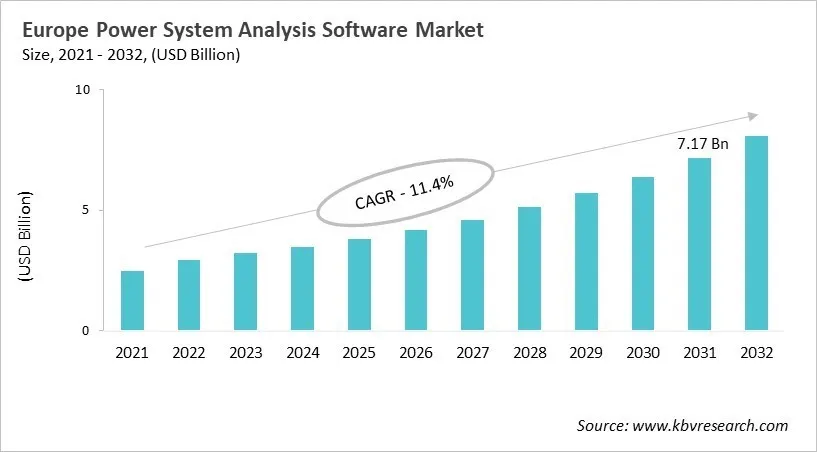
The European power system analysis software market has changed from simple offline load-flow and fault-analysis tools to advanced platforms that support dynamic stability, contingency analysis, and multi-area simulations. This is because the region is a leader in grid innovation and decarbonization. The growth of renewable energy, distributed energy resources, and energy storage has made it necessary to have advanced features like real-time analytics, digital twins, and hybrid cloud deployment. Regulatory requirements for grid resilience, cybersecurity, and decarbonization are speeding up the process even more. Utilities are also treating software as an important part of both planning and operational decision-making, with a focus on interoperability, modularity, and IT-OT integration.
Market trends show that renewables and DERs are becoming more integrated, that analytics-first and cloud-native digital-twin platforms are becoming more popular, and that the focus is on making the grid more modern, resilient, and compliant with regulations. Siemens, ABB, and Schneider Electric are some of the biggest companies that work on modular ecosystem development, service-led deployment, DER/resilience capabilities, and regulatory alignment. Smaller, more specialized companies work on microgrid and advanced analytics. Technical knowledge, adapting to regulations, integrating legacy systems, and providing service support all affect competition. This creates a dynamic environment where incumbents dominate transmission-level contracts and specialists find niche opportunities. This leads to new ideas and customized solutions for Europe's shift to a low-carbon, flexible, and digitally enabled power system.
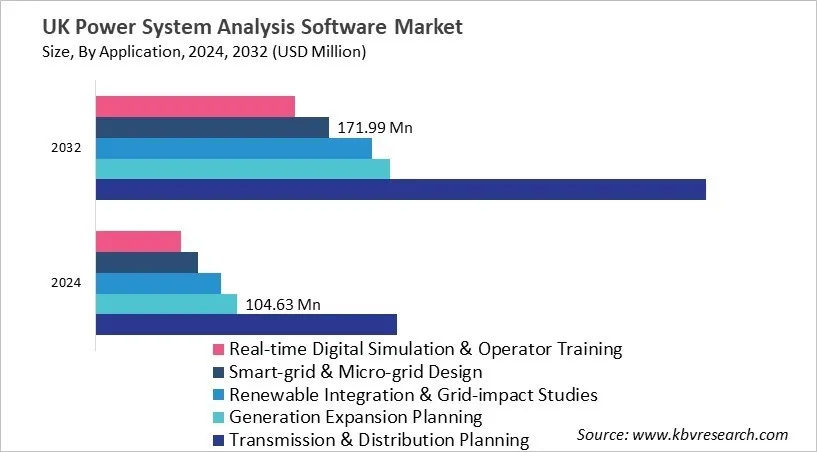
Based on Application, the market is segmented into Transmission & Distribution Planning, Generation Expansion Planning, Renewable Integration & Grid-impact Studies, Smart-grid & Micro-grid Design and Real-time Digital Simulation & Operator Training. The Transmission & Distribution Planning market segment dominated the UK Power System Analysis Software Market by Application is expected to grow at a CAGR of 9.5 % during the forecast period thereby continuing its dominance until 2032. Also, The Real-time Digital Simulation & Operator Training market is anticipated to grow as a CAGR of 11.4 % during the forecast period during (2025 - 2032).
Based on Deployment Type, the market is segmented into On-premise and Cloud-based. With a compound annual growth rate (CAGR) of 9.5% over the projection period, the On-premise Market, dominate the Germany Power System Analysis Software Market by Deployment Type in 2024 and would be a prominent market until 2032.The Cloud-based market is expected to witness a CAGR of 10.6% during (2025 - 2032).
Free Valuable Insights: The Global Power System Analysis Software Market will Hit USD 24.12 Billion by 2032, at a CAGR of 12.0%
The Energiewende, more renewable energy generation, decentralized production, and electrification of transportation and heating are all major changes happening to Germany's electricity system. These changes require a grid that is more flexible, digitalized, and resilient. The 35,000 km transmission network, which is closely linked to Europe, needs advanced power-system analysis (PSA) software to help with load-flow, stability, DER integration, grid expansion, and scenario planning. High levels of renewable integration, regulatory frameworks like the network development plan 2037/2045, and the rollout of smart grids are all driving market demand. On the other hand, legacy-grid complexity, regional differences, and the need for large-scale investments are all problems. Some trends are moving toward dynamic modeling, digital twins, real-time simulation, DER and storage integration, and cloud-based analytics. Competition favors vendors that offer scalable, high-performance solutions that are compliant with German laws. Local businesses and utilities that build their own capabilities also affect how quickly software is adopted. To reach Germany's ambitious energy transition goals, the changing market is putting more emphasis on modular, data-driven, and software-driven grid management solutions.

By End User
By Application
By Module & Tool Type
By Deployment Type
By Country
Our team of dedicated experts can provide you with attractive expansion opportunities for your business.



 Unique Offerings