The Europe Post-Quantum Cryptography Market would witness market growth of 39.1% CAGR during the forecast period (2025-2032).
The Germany market dominated the Europe Post-Quantum Cryptography Market by Country in 2024, and would continue to be a dominant market till 2032; thereby, achieving a market value of $782.3 million by 2032. The UK market is exhibiting a CAGR of 37.8% during (2025 - 2032). Additionally, The France market would experience a CAGR of 40% during (2025 - 2032). The Germany and UK led the Europe Post-Quantum Cryptography Market by Country with a market share of 22.1% and 19% in 2024.The Italy market is expected to witness a CAGR of 40.3% during throughout the forecast period.
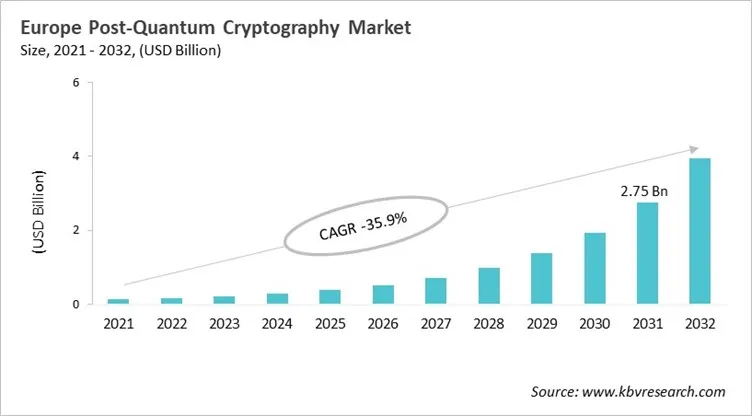
The post-quantum cryptography (PQC) market in Europe has grown thanks to a strong policy-driven approach that focuses on digital resilience, data protection, and technological sovereignty. Early on, EU groups like ENISA and the European Commission saw the risks of the quantum era and gave advice on "store-now, decrypt-later" threats and long-term data security. Regulatory frameworks like the EU Cybersecurity Act and projects like the Quantum Flagship made it easier for member states to work together to adopt new technologies. Europe's universities, research centers, and partnerships with original equipment manufacturers (OEMs) have been very important in moving forward PQC research and pilot deployments. Industry publications have helped raise awareness, making PQC a strategic priority for the finance, government, telecom, and manufacturing sectors. The structured PQC evolution in Europe is shaped by both policy alignment and research depth.
Some of the most important market trends are the use of PQC that follows the rules, the integration of PQC into cloud platforms, telecom networks, and hardware systems, and the widespread use of hybrid cryptographic models. ENISA's rules are affecting how companies keep track of their cryptographic tools, plan migrations, and make sure they follow the rules. Telecom companies and cloud providers are testing protocols that are ready for PQC, and OEMs are putting quantum-safe algorithms into network and enterprise products. Working together with schools, businesses, and the government speeds up testing and standardization. Competition is still collaborative, with global OEMs, local vendors, and research institutions all working together to make Europe's quantum-safe ecosystem and global influence stronger.
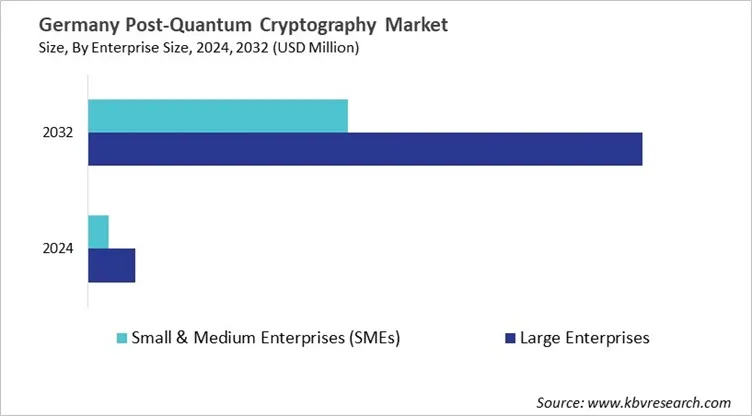
Based on Enterprise Size, the market is segmented into Large Enterprises and Small & Medium Enterprises (SMEs)t. Among various Germany Post-Quantum Cryptography Market by; The Large Enterprises market achieved a market size of USD $45.6 Million in 2024 and is expected to grow at a CAGR of 36.7 % during the forecast period. The Small & Medium Enterprises (SMEs) market is predicted to experience a CAGR of 38.3% throughout the forecast period from (2025 - 2032).
Based on Services, the market is segmented into Design, Implementation, Consulting, Migration Services and Quantum Risk Assessment. The Design, Implementation, Consulting market segment dominated the UK Post-Quantum Cryptography Market by Services is expected to grow at a CAGR of 37.2 % during the forecast period thereby continuing its dominance until 2032. Also, The Quantum Risk Assessment market is anticipated to grow as a CAGR of 38.5 % during the forecast period during (2025 - 2032).
Free Valuable Insights: The Global Post-Quantum Cryptography Market will Hit USD 13.94 Billion by 2032, at a CAGR of 39.6%
Germany is a leader in post-quantum cryptography (PQC) readiness in Europe because it has a strong national cybersecurity policy and a lot of research going on. The Federal Office for Information Security (BSI) actively encourages the use of quantum-resistant and hybrid cryptography that is in line with long-term data protection goals. Germany's automotive, manufacturing, and industrial automation sectors, which need strong security for embedded and connected systems, help keep demand high. Algorithm testing, hardware security, and side-channel resilience are all supported by research institutions like Fraunhofer AISEC. Some trends in the market are more testing of NIST-standardized PQC algorithms, quantum-safe communications, and safe IoT and cloud deployments. Working together between business and academia speeds up both innovation and adoption. Germany's alignment with EU frameworks makes it a central hub for PQC deployment in Europe.

By Services
By Type
By Enterprise Size
By Vertical
By Solution
By Country
Our team of dedicated experts can provide you with attractive expansion opportunities for your business.





 Unique Offerings