The Europe Parametric Insurance Market is expected to reach $7.93 billion by 2031 and would witness market growth of 9.5% CAGR during the forecast period (2025-2032).
The UK market dominated the Europe Parametric Insurance Market by Country in 2024, and would continue to be a dominant market till 2032; thereby, achieving a market value of $1,988.7 million by 2032. The Germany market is exhibiting a CAGR of 8.6% during (2025 - 2032). Additionally, The France market would experience a CAGR of 10.4% during (2025 - 2032). The UK and Germany led the Europe Parametric Insurance Market by Country with a market share of 25% and 20.1% in 2024.
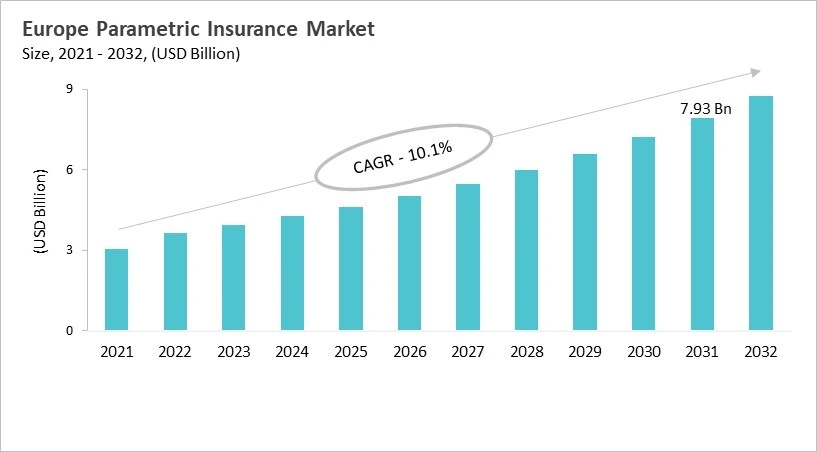
The European Parametric Insurance Market has become a strategically important part of the regional insurance ecosystem. This is because there is a growing need for faster and more transparent ways to transfer risk as climate-related and systemic risks rise. Parametric insurance is different from traditional indemnity-based models in that it uses predefined triggers like weather or seismic indices. This makes it easier to settle claims quickly and gives you more certainty about how much you'll get paid. Improvements in digital infrastructure, satellite imaging, IoT sensors, and data analytics have made triggers much more accurate and lowered basis risk, which has made the market more confident. Adoption has sped up even more because governments and businesses are becoming more aware of the issue, and because organizations like the European Insurance and Occupational Pensions Authority are pushing for modernization and supportive regulatory frameworks. The market's growth fits in well with Europe's larger plans for climate change adaptation and resilience.
The market is competitive because both established insurers and new digital companies are competing on innovation, customization, and operational efficiency. Leading companies are looking for strategic partnerships with tech companies and data providers to improve the accuracy of underwriting and broaden parametric applications to include agriculture, cyber risks, pandemic coverage, and supply chain disruptions. Key differences are digital transformation projects that focus on automated policy issuance, real-time monitoring, and smooth claims processing. Companies also stress regulatory alignment, reinsurance optimization, and client education to clear up any confusion about basis risk and make the market more accepting. Even though more people are getting involved, high capital requirements, data expertise, and complicated compliance rules still make it hard to get in. This creates a competitive but innovation-driven market.
Based on Type, the market is segmented into Natural Catastrophes Insurance, Specialty Insurance, and Other Type. With a compound annual growth rate (CAGR) of 7.7% over the projection period, the Natural Catastrophes Insurance Market, dominate the UK Parametric Insurance Market by Type in 2024 and would be a prominent market until 2032.The Specialty Insurance market is expected to witness a CAGR of 8.6% during (2025 - 2032).
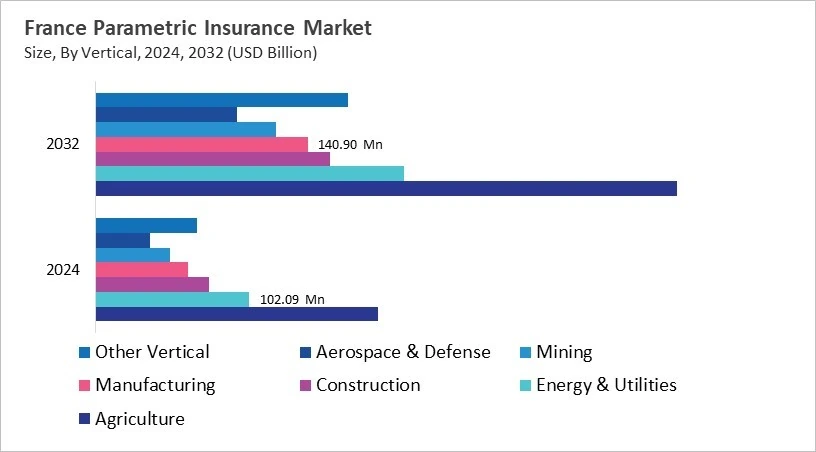
Based on Vertical, the market is segmented into Agriculture, Energy & Utilities, Construction, Manufacturing, Mining, Aerospace & Defense, and Other Vertical. The Agriculture market segment dominated the France Parametric Insurance Market by Vertical is expected to grow at a CAGR of 9.6 % during the forecast period thereby continuing its dominance until 2032. Also, The Aerospace & Defense market is anticipated to grow as a CAGR of 12.7 % during the forecast period during (2025 - 2032).
Free Valuable Insights: The Worldwide Parametric Insurance Market is projected to reach USD 32.57 billion by 2032, at a CAGR of 9.9%
The UK Parametric Insurance Market has grown into a niche part of the larger insurance industry. It pays out quickly and clearly based on pre-set triggers like weather events and other measurable risks, instead of traditional loss assessments. Its growth has been fueled by more unpredictable weather, a need for better ways to transfer risk, and strong support from the UK government and people in the financial sector. Technological advances like AI, IoT sensors, and satellite analytics have made products much more accurate, scalable, and able to handle claims automatically. Regulatory engagement has made the market even more confident while protecting the interests of consumers. Competition is still changing, with established insurers and nimble insurtech companies using new ideas, partnerships, and customer-focused strategies to grow their services in areas like agriculture, energy, infrastructure, cyber risk, and the supply chain.

By Type
By Vertical
By Country
Our team of dedicated experts can provide you with attractive expansion opportunities for your business.





 Unique Offerings