The Europe On-device AI Market is expected to reach $9.46 billion by 2031 and would witness market growth of 26.5% CAGR during the forecast period (2025-2032).
The Germany market dominated the Europe On-Device AI Market by Country in 2024, and would continue to be a dominant market till 2032; thereby, achieving a market value of $2,578.6 million by 2032. The UK market is exhibiting a CAGR of 25.3% during (2025 - 2032). Additionally, The France market would experience a CAGR of 27.3% during (2025 - 2032). The Germany and UK led the Europe On-Device AI Market by Country with a market share of 23.1% and 18% in 2024.The Italy market is expected to witness a CAGR of 27.2% during throughout the forecast period.
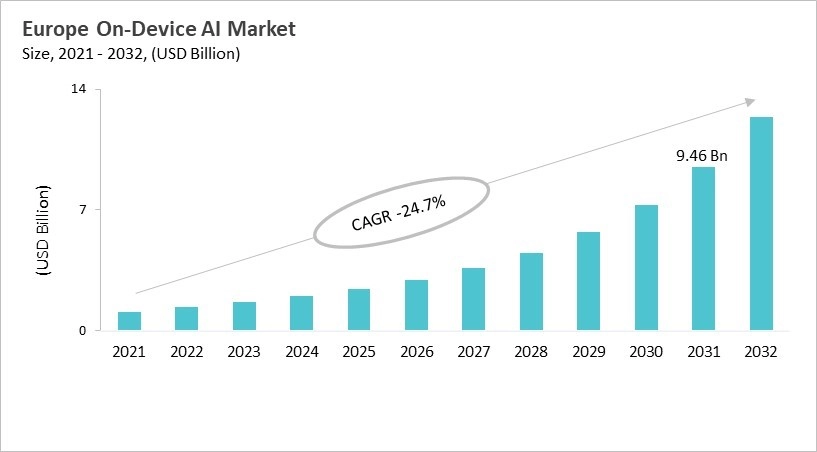
The edge AI market in Europe is all about processing data directly on devices like smartphones, IoT systems, and industrial equipment to make them faster, more private, and more independent. This method fits well with EU data protection laws like GDPR and policy goals for AI that is reliable and independent. The European Commission and national governments work together to promote AI by focusing on safety, ethics, and giving people control over their own data. Increasingly, edge and on-device AI are being used for apps where data can't be easily moved to the cloud. Low-power AI chips and specialized software stacks are helping growth. Industrial IoT, manufacturing, and real-time systems are some of the most important areas for adoption. Overall, on-device AI is at the crossroads of regulation, innovation, and digital sovereignty in Europe.
Digital sovereignty, industrial automation, and ethical AI compliance are some of the most important trends that are shaping Europe's on-device AI market. Governments want more AI processing to happen in Europe so that they don't have to rely on foreign cloud providers and keep data in European jurisdictions. Industries like energy, logistics, and manufacturing use AI in machines to make real time decisions and predict when they will need maintenance. Companies set themselves apart by making privacy, openness, and following the rules important parts of their products. Some of the strategies are working with public R&D programs, putting money into low-power AI hardware, and joining standards bodies. OEMs in different regions, big tech companies, and new innovators are all competing. To be the best in the market, you need to find a balance between performance, compliance, and ecosystem integration.
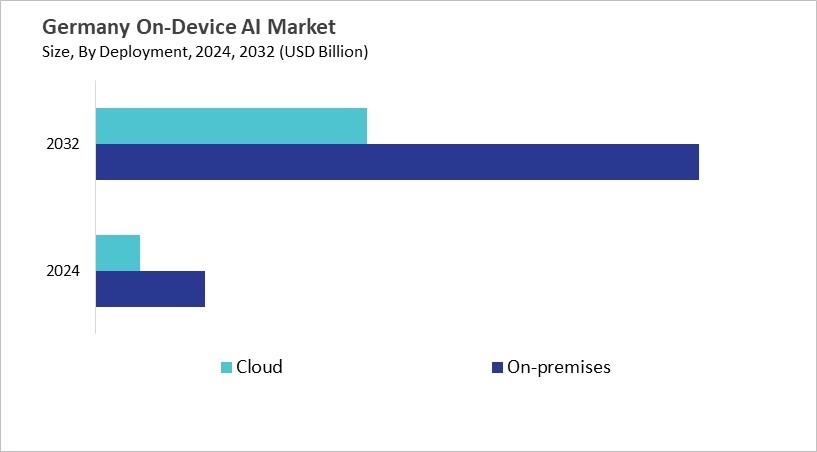
Based on Deployment, the market is segmented into On-premises, and Cloud. Among various Germany On-Device AI Market by Deployment; The On-premises market achieved a market size of USD $324 Million in 2024 and is expected to grow at a CAGR of 24.5 % during the forecast period. The Cloud market is predicted to experience a CAGR of 25.9% throughout the forecast period from (2025 - 2032).
Based on Component, the market is segmented into Hardware, and Software. The Hardware market segment dominated the UK On-Device AI Market by Component is expected to grow at a CAGR of 24.9 % during the forecast period thereby continuing its dominance until 2032. Also, The Software market is anticipated to grow as a CAGR of 25.8 % during the forecast period during (2025 - 2032).
Free Valuable Insights: The Worldwide On-device AI Market is projected to reach USD 54.79 billion by 2032, at a CAGR of 27.1%
Germany's on-device AI market is closely linked to its Industry 4.0 strategy, strong manufacturing base, and large investments in digital infrastructure and research and development. National AI projects, partnerships between the public and private sectors, and leadership in data sovereignty and high-performance computing all help the ecosystem. Industrial automation and the automotive industry are two big drivers. Companies like Siemens, SAP, and major car makers are putting AI into machines and cars for applications that need low latency and are critical for safety. One important trend is combining AI with edge processors and smart sensors that don't need to be connected to the cloud all the time. There are many companies that make chips, including German industrial companies and new startups that work with research institutions. There aren't as many pure-play on-device AI companies in the UK as there are in the US, but partnerships and embedded hardware design make the UK stronger. Germany is a central hub for on-device AI in Europe because it focuses on ethical AI, privacy, and business use.

By Component
By Technology
By Deployment
By Device
By Vertical
By Country
Our team of dedicated experts can provide you with attractive expansion opportunities for your business.




 Unique Offerings