The Europe Next Generation Data Storage Market is expected to reach $31.93 billion by 2031 and would witness market growth of 8.9% CAGR during the forecast period (2025-2032).
The Germany market dominated the Europe Next Generation Data Storage Market by Country in 2024, and would continue to be a dominant market till 2032; thereby, achieving a market value of $6,342.4 million by 2032. The UK market is exhibiting a CAGR of 7.8% during (2025 - 2032). Additionally, The France market would experience a CAGR of 9.6% during (2025 - 2032). The Germany and UK led the Europe Next Generation Data Storage Market by Country with a market share of 20.3% and 17.8% in 2024. The Italy market is expected to witness a CAGR of 9.4% during throughout the forecast period.
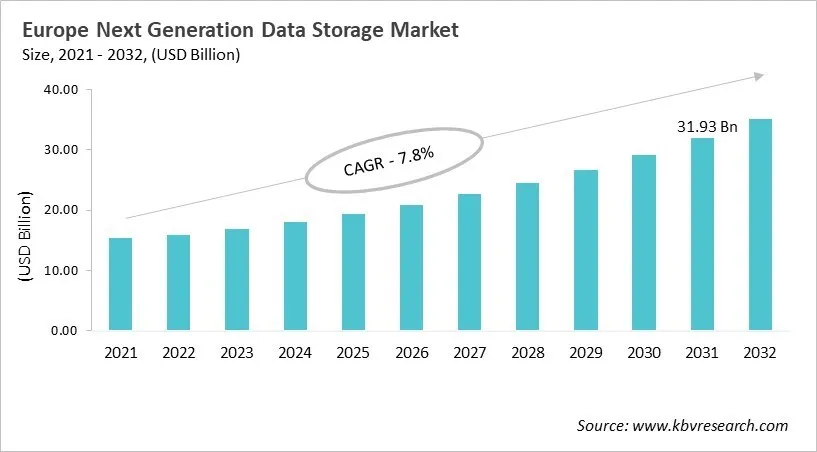
As digital transformation, data-heavy workloads, and strict regulatory requirements change how businesses build their infrastructure, the next-generation data storage market in Europe is changing quickly. Businesses in fields like government, finance, healthcare, and manufacturing are moving away from traditional SAN and NAS systems and toward cloud-native, software-defined, and high-performance storage architectures. This change is happening because we need to support AI, analytics, IoT, and hybrid cloud models while also making sure that data is safe, resilient, and scalable. New technologies like NVMe, all-flash systems, automation, and disaggregated infrastructure are making it possible to use resources more flexibly, with higher throughput and lower latency. Because of this, storage is now seen as a strategic, data-centric platform instead of just a piece of hardware.
Leading OEMs like Hewlett Packard Enterprise (HPE) and Dell Technologies are driving this shift in data storage. HPE emphasizes its Alletra portfolio and GreenLake services for cloud-native infrastructure, AI-driven management, and consumption-based models, making hybrid cloud adoption easier. Dell focuses on PowerStore, PowerScale, and APEX, delivering software-defined, high-performance solutions for diverse enterprise workloads. Both utilize automation and smart analytics to improve management and resilience. These strategies highlight the market's move toward flexible, service-oriented storage platforms tailored to evolving business and data requirements.
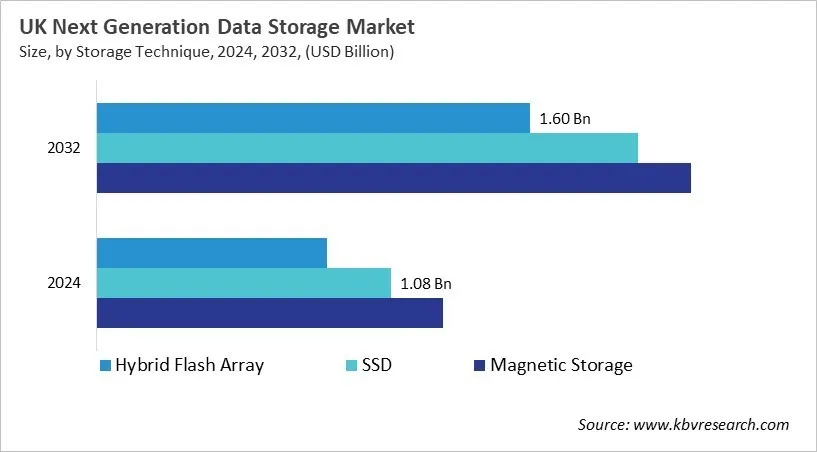
Based on Storage Technique, the market is segmented into Magnetic Storage, SSD, and Hybrid Flash Array. Among various UK Next Generation Data Storage Market by Storage Technique; The Magnetic Storage market achieved a market size of USD $1279.3 Million in 2024 and is expected to grow at a CAGR of 7.1 % during the forecast period. The Hybrid Flash Array market is predicted to experience a CAGR of 8.4% throughout the forecast period from (2025 - 2032).
Based on Storage Type, the market is segmented into Local (on-premise), Remote (Cloud), and Hybrid. The Local (on-premise) market segment dominated the France Next Generation Data Storage Market by Storage Type is expected to grow at a CAGR of 9 % during the forecast period thereby continuing its dominance until 2032. Also, The Hybrid market is anticipated to grow as a CAGR of 10.2 % during the forecast period during (2025 - 2032).
Free Valuable Insights: The Global Next-Generation Data Storage Market will Hit USD 138.73 Billion by 2032, at a CAGR of 9.3%
The next-generation data storage market in Germany is growing quickly as businesses, cloud providers, and public institutions speed up digital transformation and data-driven innovation. As the amount of data from the manufacturing, healthcare, finance, and automotive sectors grows, so does the need for scalable, high-performance, and secure storage architectures that can handle analytics, AI workloads, and hybrid cloud environments. Hybrid and multi-cloud adoption is still a big trend. Companies like HPE and NetApp are making cloud-integrated, AI-optimized storage platforms that strike a balance between performance, flexibility, and operational efficiency. At the same time, strict data sovereignty and GDPR compliance rules have a big impact on how storage is set up, putting encryption, governance, and resilience first. Strong OEM competition, constant innovation, and the need for smart, compliant infrastructure to support Germany's data-heavy digital economy all play a role in shaping the market as a whole.

By End-use
By Storage Technique
By Storage Type
By Storage System
By Country
Our team of dedicated experts can provide you with attractive expansion opportunities for your business.





 Unique Offerings