The Europe Mainframe Modernization Market would witness market growth of 8.9% CAGR during the forecast period (2025-2032).
The Germany market dominated the Europe Mainframe Modernization Market by Country in 2024, and would continue to be a dominant market till 2032; thereby, achieving a market value of $801.1 million by 2032. The UK market is exhibiting a CAGR of 7.8% during (2025 - 2032). Additionally, The France market would experience a CAGR of 9.7% during (2025 - 2032). The Germany and UK led the Europe Mainframe Modernization Market by Country with a market share of 19.8% and 16.9% in 2024. The Spain market is expected to witness a CAGR of 9.5% during throughout the forecast period.
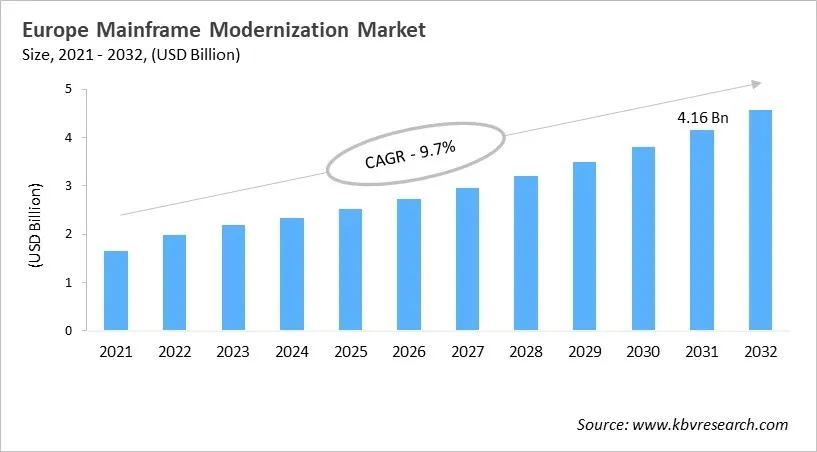
For decades, Europe's biggest companies, especially in banking, insurance, government, and telecommunications, have used mainframes to run mission-critical operations because they are so stable, secure, and reliable. Over time, the need for modernization grew as digital transformation, cloud adoption, AI integration, and open-data initiatives sped up. By the middle of the 2010s, these changes had become strategic and business-driven, moving away from the early cost-focused rehosting efforts of the 2000s. Hybrid and multi-cloud environments, modular modernization frameworks, and regulatory compliance under GDPR, DORA, and the European Cybersecurity Act now define the market, ensuring that legacy systems coexist seamlessly with AI-enabled analytics, open banking, and citizen-centric services.
The latest trends in European modernization focus on using hybrid strategies, AI-driven automation, and sector-specific projects that are in line with regulatory and sustainability goals. Companies use APIs, containerization, and tools from IBM, Micro Focus, and others to connect old mainframes to cloud platforms. AI-assisted code conversion helps fill in skill gaps in the workforce and speeds up project timelines. IBM, Capgemini, Atos, and Sopra Steria are some of the biggest OEMs and integrators that use phased, risk-balanced modernization strategies. They often work with hyperscalers like Microsoft Azure, AWS, and Google Cloud. Regulatory knowledge, automation ability, and ecosystem collaboration are now what drive competition. Niche players and startups are bringing specialized solutions to the market, making the European mainframe modernization market a mature, innovation-driven, and compliance-focused place.
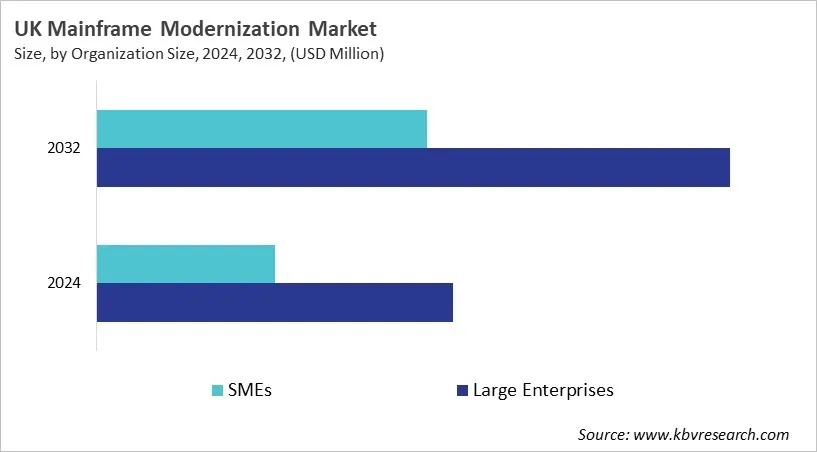
Based on Organization Size, the market is segmented into Large Enterprises and SMEs. With a compound annual growth rate (CAGR) of 7.6% over the projection period, the Large Enterprises Market, dominate the UK Mainframe Modernization Market by Organization Size in 2024 and would be a prominent market until 2032. The SMEs market is expected to witness a CAGR of 8.1% during (2025 - 2032).
Based on Component Type, the market is segmented into Services and Software. The Services market segment dominated the Germany Mainframe Modernization Market by Component Type is expected to grow at a CAGR of 7 % during the forecast period thereby continuing its dominance until 2032. Also, The Software market is anticipated to grow as a CAGR of 7.6 % during the forecast period during (2025 - 2032).
Free Valuable Insights: The Global Mainframe Modernization Market will Reach USD 15.91 Billion by 2032, at a CAGR of 9.5%
Large industrial companies, banks, and public sector organizations that want to change, not get rid of, their legacy systems that support mission-critical workloads are driving Germany's mainframe modernization market. A large installed base of mainframes, a lack of skilled workers, regulatory and compliance pressures, and the Mittelstand's need for digitalization are all important factors that support a practical, step-by-step approach to modernization. Trends stress "modernize around" strategies, which means keeping core functions while updating interfaces, using APIs, integrating hybrid clouds, automating processes, and using AI to help with code modernization. There is competition in the market from global IT services companies like Capgemini, DXC Technology, and Infosys, as well as from local companies like T-Systems. German customers prefer vendors with a strong local presence, knowledge of regulations, and proven modernization frameworks. Niche consultancies meet specific needs for automation and mainframe preservation.

By Organization Size
By Component Type
By Vertical
By Country
Our team of dedicated experts can provide you with attractive expansion opportunities for your business.



 Unique Offerings