The Europe Learning Management System Market would witness market growth of 19.7% CAGR during the forecast period (2025-2032).
The Germany market dominated the Europe Learning Management System Market by Country in 2024, and would continue to be a dominant market till 2032; thereby, achieving a market value of $5,816.5 million by 2032. The UK market is experiencing a CAGR of 18.7% during (2025 - 2032). Additionally, The France market would exhibit a CAGR of 20.5% during (2025 - 2032). The Germany and UK led the Europe Learning Management System Market by Country with a market share of 22% and 20.7% in 2024.The Spain market is expected to witness a CAGR of 21.3% during throughout the forecast period.
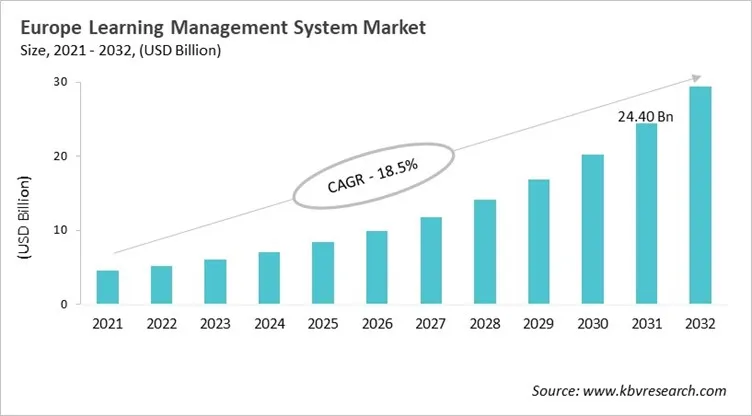
The European LMS market has changed a lot because of government policies that promote digital education, programs to modernize regions, and a focus on making learning accessible to everyone. The Digital Education Action Plan and other programs like it helped schools, universities, and vocational schools all over the world use LMS. Cross-border education programs and rising digital literacy helped early adopters. LMS platforms became very important for managing content, distance learning, and data analysis. The push for lifelong learning and workforce transformation made adoption even more widespread in both the public and private sectors. The COVID-19 pandemic sped up the widespread use of LMS, which is now a key part of digital infrastructure. Europe's strong rules and policies continue to help the market grow over time.
Current market trends put a lot of emphasis on learning ecosystems that work together and are based in the cloud, and that follow standards for data protection and accessibility. More and more LMS platforms are adding AI-powered personalization, adaptive learning, and analytics. There is a growing need in the corporate, government, and vocational training sectors to support reskilling and compliance needs. Digital inclusion and multilingual support are still very important. Vendors pay attention to making sure their products meet regulations, work well with other systems, and can be delivered through the cloud in a way that can be scaled up. Innovation, following the rules, and being flexible all change the way competition works. In general, LMS platforms are an important part of Europe's long-term plan for education and workforce development.
Based on End-use, the market is segmented into Higher Education, K-12, IT & Telecommunication, Government & Defense, Banking, Financial Services, and Insurance (BFSI), Manufacturing, Healthcare, Retail and Other End-uses. The Higher Education market segment dominated the Germany Learning Management System Market by End-use is expected to grow at a CAGR of 15.7 % during the forecast period thereby continuing its dominance until 2032. Also, The Healthcare market is anticipated to grow as a CAGR of 18.9 % during the forecast period during (2025 - 2032).
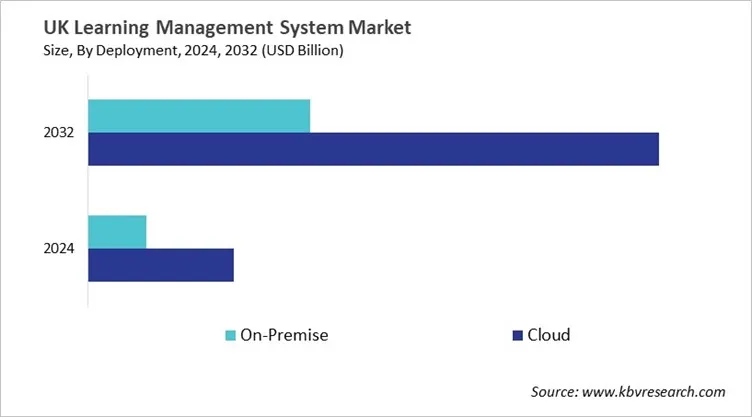
Based on Deployment, the market is segmented into Cloud and On-Premise. Based on Enterprise Size, the market is segmented into Large Enterprises and Small & Medium Enterprises. With a compound annual growth rate (CAGR) of 18.8% over the projection period, the Cloud Market, dominate the UK Learning Management System Market by Deployment in 2024 and would be a prominent market until 2032. The On-Premise market is expected to witness a CAGR of 18.4% during (2025 - 2032).
Free Valuable Insights: The Global Learning Management System Market will Hit USD 108.30 Billion by 2032, at a CAGR of 19.9%
Germany has built a strong LMS ecosystem on top of its advanced vocational and higher education systems and high level of digital literacy. Many schools, universities, and regional learning platforms use open-source platforms like Moodle and ILIAS because they are flexible and can grow with the needs of the users. The way the federal government runs schools makes it easier for schools to use LMS systems that are tailored to their own needs and follow their own curricula. The COVID-19 pandemic sped up the use of digital instruction and made it normal across the country. Concerns about data privacy have slowed down the move to the cloud, but interest in hybrid LMS models is growing. There is a growing need for learning experiences that are easy to use on mobile devices and are centered on the user. There is still a fair amount of competition between open-source platforms and commercial solutions, especially in corporate training.

By Component
By Deployment
By Enterprise Size
By Delivery Mode
By End-use
By Country
Our team of dedicated experts can provide you with attractive expansion opportunities for your business.










 Unique Offerings