The Europe IT Security Market would witness market growth of 12.1% CAGR during the forecast period (2025-2032).
The Germany market dominated the Europe IT Security Market by Country in 2024, and would continue to be a dominant market till 2032; thereby, achieving a market value of $37,303.2 million by 2032. The UK market is exhibiting a CAGR of 11% during (2025 - 2032). Additionally, The France market would experience a CAGR of 13% during (2025 - 2032). The Germany and UK led the Europe IT Security Market by Country with a market share of 20.3% and 17.1% in 2024. The Italy market is expected to witness a CAGR of 13.7% during throughout the forecast period.
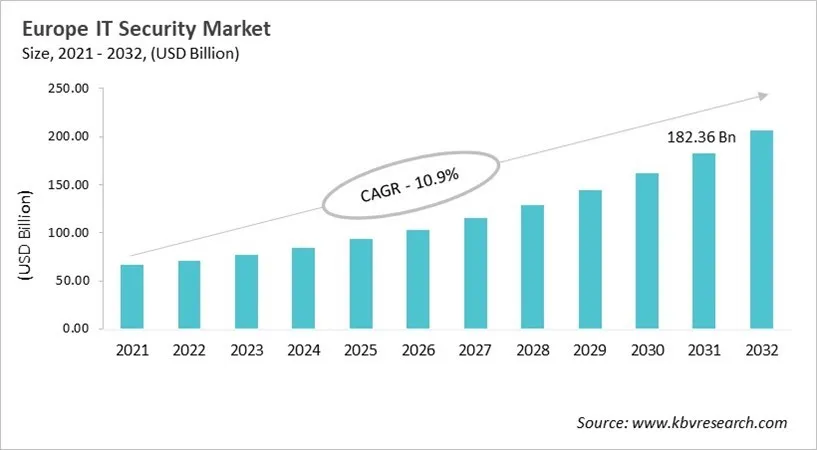
The IT security market in Europe has changed from traditional perimeter-based defense to a mature ecosystem that follows the rules and is shaped by cloud adoption, industrial digitalization, and cross-border integration. Regulatory frameworks like NIS2 and the Cyber Resilience Act have made compliance more difficult, which has increased the need for certified solutions, lifecycle security, supply-chain assurance, and continuous incident reporting. At the same time, ENISA and the European Commission have made governance stronger, pushing businesses to adopt proactive resilience, identity-centric strategies, and unified certification systems. This push for regulation, along with Europe's focus on digital sovereignty, has changed what buyers expect and what vendors offer.
In the competitive landscape, there are both global OEMs and specialized European vendors, each of which is adapting to the region's rules and needs in the industry. Microsoft and other global companies use their size, sovereign-cloud programs, and threat-intelligence sharing, like working with Europol. On the other hand, companies like Siemens focus on keeping OT and hybrid environments safe, which are important to Europe's manufacturing base. Market leaders stand out because they know a lot about specific industries, offer services, and follow regional rules. Niche companies do well because they build trust in their communities and know a lot about the rules that apply to them. These factors make Europe's security market a complicated mix of platform-level consolidation and fragmentation across industries, regulations, and sovereign demands.
Based on Enterprise Size, the market is segmented into Large Enterprises, and SMEs. With a compound annual growth rate (CAGR) of 12.7% over the projection period, the Large Enterprises Market, dominate the France IT Security Market by Enterprise Size in 2024 and would be a prominent market until 2032. The SMEs market is expected to witness a CAGR of 13.6% during (2025 - 2032).
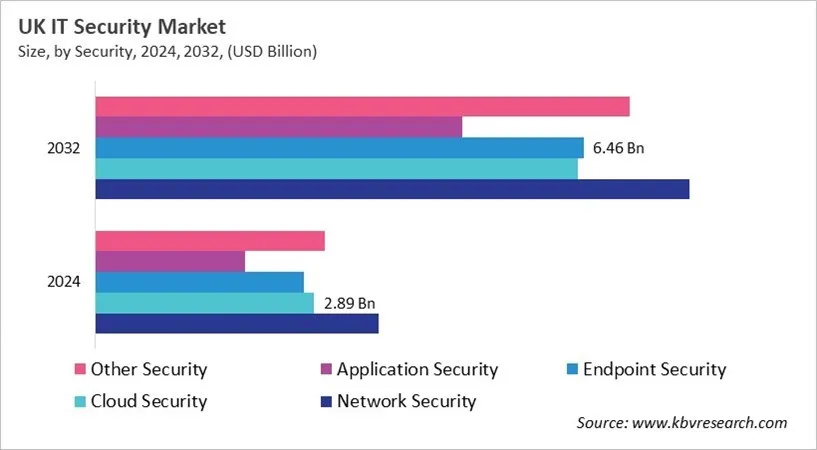
Based on Security, the market is segmented into Network Security, Cloud Security, Endpoint Security, Application Security, and Other Security. The Network Security market segment dominated the UK IT Security Market by Security is expected to grow at a CAGR of 9.9 % during the forecast period thereby continuing its dominance until 2032. Also, The Endpoint Security market is anticipated to grow as a CAGR of 11.4 % during the forecast period during (2025 - 2032).
Free Valuable Insights: The Global IT Security Market will Hit USD 734.02 Billion by 2032, at a CAGR of 12.5%
As digitalization speeds up in important areas like manufacturing, utilities, public administration, and others, Germany's cybersecurity situation is becoming more and more important. This is because these areas are more vulnerable to advanced cyber threats. The BSI's 2024 report shows that the security situation is still "worrying." This is because cybercriminals are becoming more professional, and the number of attack surfaces is growing because of IoT, OT/IT convergence, and cloud adoption. Regulatory pressures, such as the transposition of NIS 2, are forcing businesses to spend money on compliance, resilience, and advanced security architectures like zero-trust, IAM, MDR, and managed security services. The lack of skilled workers makes outsourcing and MSSPs even more popular. There is a lot of competition, with global companies in the mix, but domestic vendors are gaining ground because they meet German expectations for legal, linguistic, and data sovereignty. This is making the market more focused on integrated, resilient, and service-oriented cybersecurity solutions.

By Enterprise Size
By Type
By Security
By Vertical
By Country
Our team of dedicated experts can provide you with attractive expansion opportunities for your business.



 Unique Offerings