The Europe Industrial Automation Services Market would witness market growth of 9.9% CAGR during the forecast period (2025-2032).
The Germany market dominated the Europe Industrial Automation Services Market by Country in 2024, and would continue to be a dominant market till 2032; thereby, achieving a market value of $21,178.9 million by 2032. The UK market is experiencing a CAGR of 8.3% during (2025 - 2032). Additionally, The France market would exhibit a CAGR of 10.9% during (2025 - 2032). The Germany and UK led the Europe Industrial Automation Services Market by Country with a market share of 24.6% and 11.9% in 2024. The Italy market is expected to witness a CAGR of 11% during throughout the forecast period.
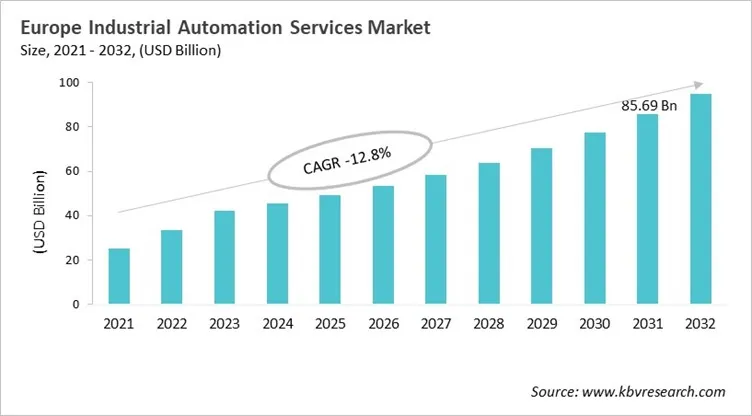
Europe's industrial automation has come a long way since the days of simple electromechanical systems. Today, it uses advanced digital and smart manufacturing thanks to strong engineering traditions and government-supported modernization programs. In the late 20th century, PLCs, robotics, and process automation became very popular, especially in Germany, Italy, and Sweden. This laid a strong foundation. The rise of Industry 4.0 in the 2010s sped up digital automation with the help of cyber-physical systems, the IIoT, and smart factories, as well as EU and national programs. Europe is moving toward Industry 5.0 today, which focuses on manufacturing that is human-centered, sustainable, and resilient. Now, automation services are mostly about system integration, managing the digital lifecycle, AI-enabled analytics, and running operations that use less energy. The European Green Deal's sustainability goals make people want automation solutions that cut down on emissions and make better use of resources even more.
The European market for industrial automation services is very competitive. It is led by global OEMs like Siemens, ABB, Schneider Electric, and Bosch Rexroth, as well as regional integrators and companies that focus on digital technology. Companies compete with more than just hardware these days. They use advanced digital platforms, AI, robotics, and cloud-based automation services. Collaborative robots, human-machine interfaces, and automation that focuses on the workforce are becoming more popular because there aren't enough workers and people need more flexibility. Strong R&D investment, strategic partnerships, and localized service delivery are some of the things that set them apart. Models based on subscriptions and services are growing, making it easier for manufacturers to adopt them on a larger scale. As companies align their automation services with goals for digital transformation, sustainability, and Industry 5.0, competition is getting stronger.
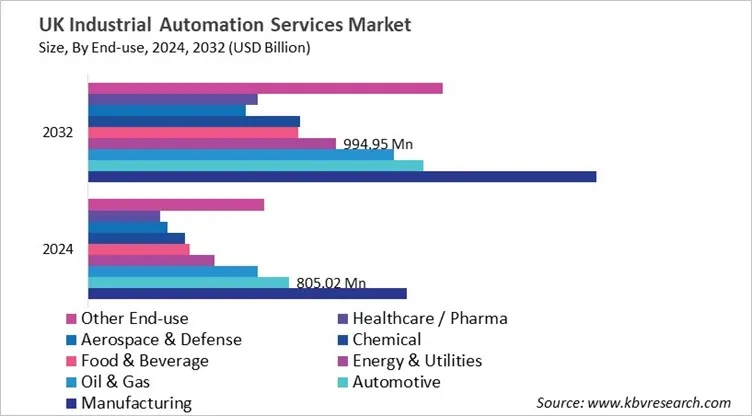
Based on End-use, the market is segmented into Manufacturing, Automotive, Oil & Gas, Energy & Utilities, Food & Beverage, Chemical, Aerospace & Defense, Healthcare / Pharma and Other End-use. Among various UK Industrial Automation Services Market by End-use; The Manufacturing market achieved a market size of USD $1276.7 Million in 2024 and is expected to grow at a CAGR of 6.1 % during the forecast period. The Aerospace & Defense market is predicted to experience a CAGR of 9.2% throughout the forecast period from (2025 - 2032).
Based on Service Type, the market is segmented into Project Engineering and Installation, Maintenance & Support, Consulting Services, Operational Services and Other Service Type. With a compound annual growth rate (CAGR) of 7.2% over the projection period, the Project Engineering and Installation Market, dominate the Germany Industrial Automation Services Market by Service Type in 2024 and would be a prominent market until 2032. The Operational Services market is expected to witness a CAGR of 9.5% during (2025 - 2032).
Free Valuable Insights: The Global Industrial Automation Services Market will Hit USD 373.92 Billion by 2032, at a CAGR of 10.4%
Germany has the largest market for industrial automation services in Europe because it has a strong base in automotive, manufacturing, and industrial engineering. Manufacturers are turning to automation and outside service providers because of rising labor shortages, high labor costs, and pressure to be more energy efficient. Government and regulatory support for Industry 4.0 speeds up investments in smart manufacturing even more. But using old machines a lot makes integration harder and more expensive, which presents both problems and chances for service. Some important trends in the market are a strong demand for turnkey project engineering and installation services, the use of cobots, IoT-based monitoring, edge computing, and predictive maintenance. Automation services that focus on energy efficiency and following the rules are also becoming more important because of the push for sustainability. There is a lot of competition in the market, with global companies and specialized German integrators fighting for system integration skills and the ability to deliver services from start to finish.

By Service Type
By End Use
By Product Type
By Country
Our team of dedicated experts can provide you with attractive expansion opportunities for your business.



 Unique Offerings