The Europe High Performance Computing Market is expected to reach $25.73 billion by 2032 and would witness market growth of 6.5% CAGR during the forecast period (2025-2032).
The Germany market dominated the Europe High Performance Computing Market by Country in 2024, and would continue to be a dominant market till 2032; thereby, achieving a market value of $5,177.7 million by 2032. The UK market is experiencing a CAGR of 5.3% during (2025 - 2032). Additionally, The France market would exhibit a CAGR of 7.2% during (2025 - 2032). The Germany and UK led the Europe High Performance Computing Market by Country with a market share of 22.1% and 17.8% in 2024.The Spain market is expected to witness a CAGR of 8.5% during throughout the forecast period.
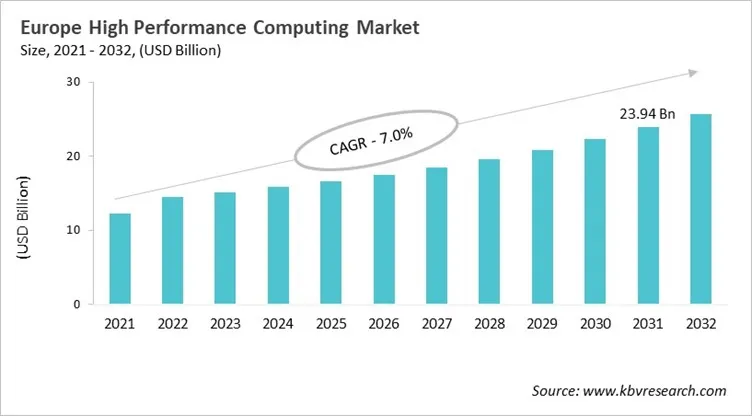
High Performance Computing (HPC) is a key part of Europe's scientific research, industrial competitiveness, and digital sovereignty. The development of supercomputing started with research programs funded by the government that put supercomputers in universities and national labs. The switch to cluster-based architecture made it easier for people in both academia and industry to get to them. Coordinated European projects and ongoing government funding made it easier for people to work together across borders and share infrastructure. The creation of EuroHPC was a big step forward because it allowed Europe to use world-class supercomputers for science, business, and public-sector innovation.
Artificial intelligence, big data, and cloud platforms are all now part of Europe's HPC market. A strong focus on digital sovereignty leads to investments in infrastructure and architecture that are controlled by Europe. Energy efficiency and sustainability are very important, and they affect how systems are built and how data centers work. Heterogeneous, accelerator-based systems are the most common way to support both AI and simulation workloads. Open standards and co-design strategies help people work together. Competition is based on policies, with vendors setting themselves apart by their performance, sustainability, and how well they fit with EU strategic goals.
Based on End Use, the market is segmented into Government & Defense, Healthcare & Bioscience, Education & Research, Manufacturing, BFSI, Media & Entertainment, Transportation, Retail and Gaming & Others. The Government & Defense market segment dominated the Germany High Performance Computing Market by End Use is expected to grow at a CAGR of 3.9 % during the forecast period thereby continuing its dominance until 2032. Also, The Transportation market is anticipated to grow as a CAGR of 6.2 % during the forecast period during (2025 - 2032).
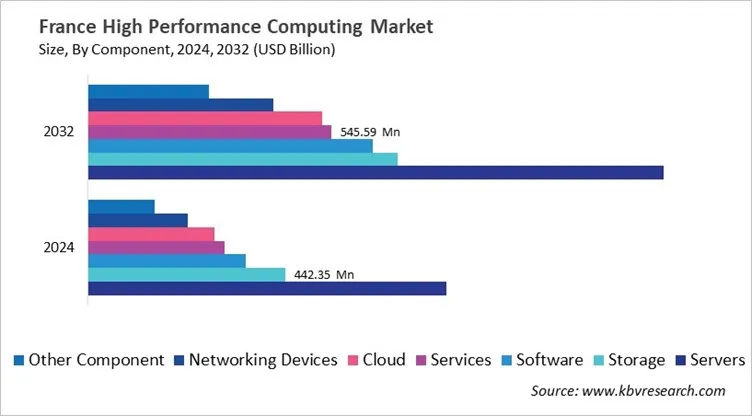
Based on Component, the market is segmented into Servers, Storage, Software, Services, Cloud, Networking Devices and Other Component. Among various France High Performance Computing Market by Component; The Servers market achieved a market size of USD $804 Million in 2024 and is expected to grow at a CAGR of 6.3 % during the forecast period. The Networking Devices market is predicted to experience a CAGR of 8.3% throughout the forecast period from (2025 - 2032).
Free Valuable Insights: The Global High Performance Computing Market will Hit USD 94.91 Billion by 2032, at a CAGR of 6.9%
Germany has one of the most advanced and mature HPC markets in Europe. The country sees supercomputing as a strategic national infrastructure that supports science, industry, and digital sovereignty. There is a lot of demand from the automotive, aerospace, energy, materials science, climate research, and AI fields. Coordination in the public sector makes sure that funding stays stable. National consortia make it possible for universities and research institutions to share access. Close cooperation between business and academia speeds up applied research and new ideas. One big trend is that simulation, AI, and data analytics are all coming together on the same HPC platforms. Energy efficiency and sustainability have a big impact on how systems are designed and run. More small and medium-sized businesses are getting access to HPC, which is bringing more businesses into the industry. Price isn't the only thing that matters in competition. Long-term partnerships, reliability, software ecosystems, and alignment with national research priorities are also important.

By Component
By Deployment
By End Use
By Country
Our team of dedicated experts can provide you with attractive expansion opportunities for your business.



 Unique Offerings