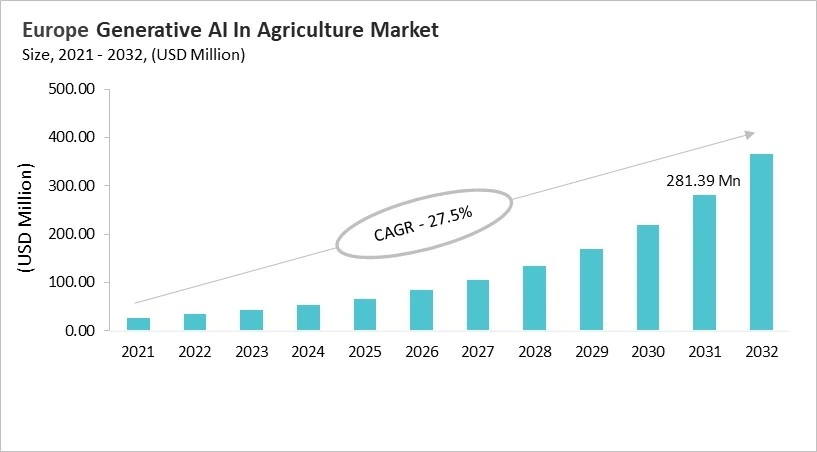
The Europe Generative AI In Agriculture Market is expected to reach $281.39 million by 2031 and would witness market growth of 27.5% CAGR during the forecast period (2025-2032).
The Germany market dominated the Europe Generative AI In Agriculture Market by Country in 2024, and would continue to be a dominant market till 2032; thereby, achieving a market value of $91.3 million by 2032. The UK market is experiencing a CAGR of 26.2% during (2025 - 2032). Additionally, The France market would exhibit a CAGR of 28.5% during (2025 - 2032). The Germany and UK led the Europe Generative AI In Agriculture Market by Country with a market share of 27.2% and 16.6% in 2024. The Spain market is expected to witness a CAGR of 29.4% during throughout the forecast period.
Generative AI in European agriculture has progressed from precision farming and digital farm management systems to sophisticated tools that mimic crop cycles, climate reactions, and resource strategies. The European Commission's policies and research funding from Horizon Europe have a lot to do with its growth. Big OEMs like John Deere Europe and CNH Industrial use AI to connect machinery and cloud platforms so that they can give scenario-based advice on irrigation, nutrients, and crop protection.
Key trends show a strong connection to sustainability frameworks like the European Green Deal and the Farm to Fork Strategy, as well as the growth of publicly funded innovation ecosystems. Public organizations, like the European Investment Bank, help AI get used by providing money and coordinating rules. Competition is based on ecosystem integration, interoperability, and following EU rules. This makes generative AI a key factor in adapting to climate change, making the best use of resources, and long-term digital transformation in European farming.
Based on technology, the generative AI In agriculture market is segmented into machine learning, computer vision, natural language processing (NLP), and GANs. With a compound annual growth rate (CAGR) of 28.5% over the projection period, the Machine Learning Market, dominate the Italy Generative AI In Agriculture Market by Technology in 2024 and would be a prominent market until 2032. The Natural Language Processing (NLP) market is expected to witness a CAGR of 30.2% during (2025 - 2032).
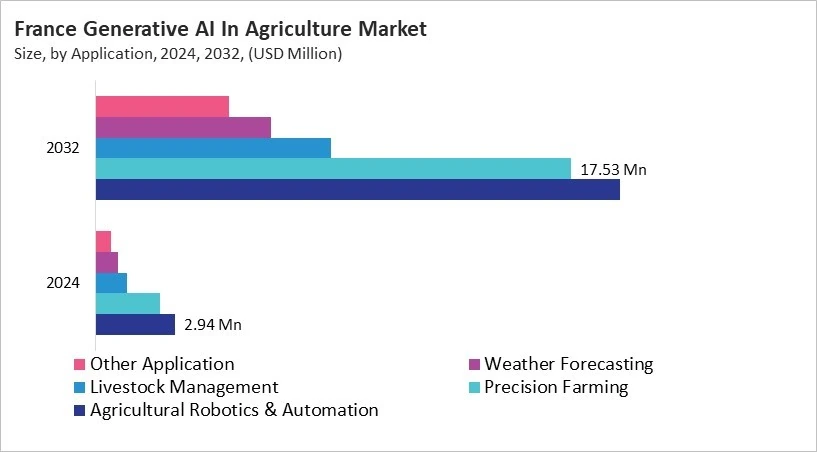
Based on application, the generative AI In agriculture market is segmented into agricultural robotics & automation, precision farming, livestock management, weather forecasting, and other application. The Agricultural Robotics & Automation market segment dominated the France Generative AI In Agriculture Market by Application is expected to grow at a CAGR of 26.9 % during the forecast period thereby continuing its dominance until 2032. Also, The Weather Forecasting market is anticipated to grow as a CAGR of 29.9 % during the forecast period during (2025 - 2032).
Free Valuable Insights: The Worldwide Generative AI In Agriculture Market is projected to reach USD 1.51 billion by 2032, at a CAGR of 28.1%
Germany's farmers are using AI and generative AI increasingly to help them make better decisions on the farm every day, increase yields, and make farming more sustainable. Bitkom and the German Agricultural Society (DLG) have done surveys that show that almost half of farms are already looking into or using AI for things like irrigation, monitoring livestock, and planting based on data. The Federal Ministry of Food and Agriculture (BMLEH) supports digitalization to make the best use of fertilizer, water, and energy. This is in line with the European Green Deal. Market trends show that generative AI is a part of systems for precision farming, predictive modeling, and traceability. There are both domestic agritech startups and research institutes that are working on AI for farming equipment, as well as global machinery companies that are doing the same. Even though things are getting better, there are still problems like people not having the same level of digital skills, gaps in rural connectivity, and high infrastructure costs. Germany's ability to compete in the future will depend on improving broadband access, helping farmers learn how to use technology, and keeping innovation policies that support sustainability.

By Technology
By Application
By Country
Our team of dedicated experts can provide you with attractive expansion opportunities for your business.



 Unique Offerings