The Europe Electric Rice Cooker Market would witness market growth of 9.4% CAGR during the forecast period (2025-2032). In the year 2022, the Europe market's volume surged to 2,160.5 Thousand Units, showcasing a growth of 13.1% (2021-2024).
The online distribution channel for electric rice cookers — including brand websites, e-commerce marketplaces and mobile shopping apps — is increasingly important. With improvements in internet access, digital payments and home delivery infrastructure, consumers are more comfortable buying large household appliances online. The appeal of browsing comprehensive model ranges, comparing features, reading peer reviews and securing convenience of home delivery make online a compelling option for many buyers. Thus, the online distribution channel segment in Germany market consumed 162.7 Thousand Units in 2024.
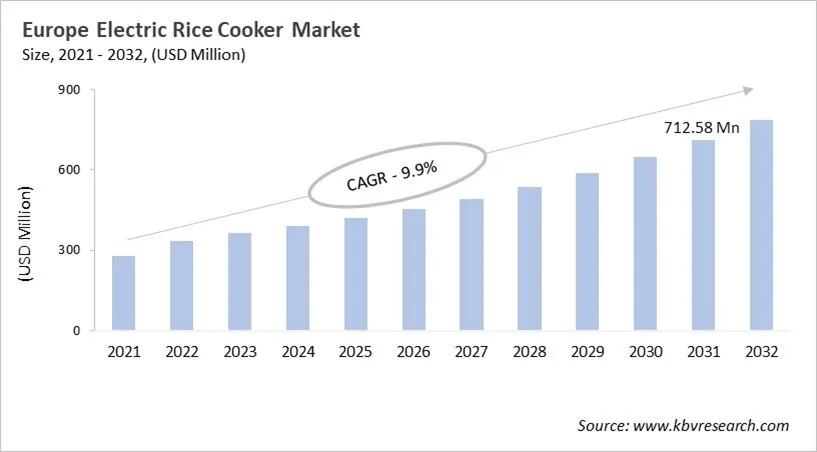
The Germany market dominated the Europe Electric Rice Cooker Market by Country in 2024, and would continue to be a dominant market till 2032; thereby, achieving a market value of $139 Million by 2032. The UK market is exhibiting a CAGR of 8.3% during (2025 - 2032). Additionally, The France market would experience a CAGR of 10.2% during (2025 - 2032). The Germany and UK led the Europe Electric Rice Cooker Market by Country with a market share of 19.9% and 16.6% in 2024. The Spain market is expected to witness a CAGR of 10.6% during throughout the forecast period.
The European electric rice cooker market has evolved from a niche appliance into a significant part of the small household appliances industry, driven by changing consumer lifestyles, multicultural culinary preferences, and the demand for compact, multifunctional cooking devices. Regulatory influences such as the EU’s Ecodesign and Energy Labelling Directives have encouraged manufacturers to improve energy efficiency, sustainability, and innovation, while the rise of multifunction models catering to diverse grains and cuisines has broadened appeal among European consumers. Furthermore, growing urbanization, small living spaces, and a shift toward convenience have positioned rice cookers as practical and energy-efficient kitchen solutions.
Competition in the market is intensifying as both global OEMs and European appliance brands target regional consumers through strategies like premiumisation, local adaptation, and digital-channel expansion. Manufacturers are focusing on high-performance, eco-friendly, and connected models aligned with Europe’s sustainability and circular economy goals. E-commerce and omnichannel distribution are reshaping how rice cookers are marketed and sold, while product differentiation—through design, smart functionality, and energy efficiency—is becoming central to capturing market share. Consequently, the European rice cooker segment is transitioning from niche import status to a dynamic, mainstream category within the region’s small-appliance landscape.
Based on Application, the market is segmented into Household and Commercial. The Household market segment dominated the Germany Electric Rice Cooker Market by Application is expected to grow at a CAGR of 7.5 % during the forecast period thereby continuing its dominance until 2032. Also, The Commercial market is anticipated to grow as a CAGR of 8.5 % during the forecast period during (2025 - 2032).
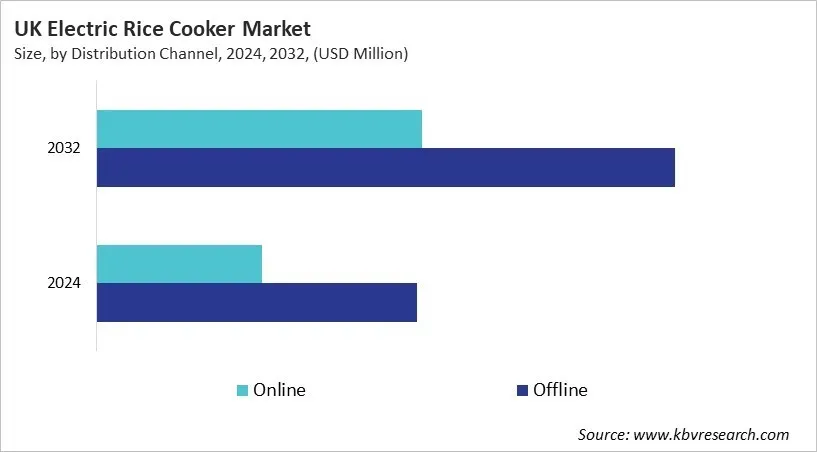
Based on Distribution Channel, the market is segmented into Offline and Online. With a compound annual growth rate (CAGR) of 7.9% over the projection period, the Offline Market, dominate the UK Electric Rice Cooker Market by Distribution Channel in 2024 and would be a prominent market until 2032. The Online market is expected to witness a CAGR of 9% during (2025 - 2032).
Free Valuable Insights: The Global Electric Rice Cooker Market will Hit USD 4.07 Billion by 2032, at a CAGR of 9.7%
Germany’s household appliance market offers promising potential for electric rice cookers, driven by consumer demand for convenience, multifunctionality, and energy efficiency. The country’s stringent Energy Efficiency Act (EnEfG) and emphasis on high energy-performance standards shape both product design and consumer expectations. Urbanisation, smaller households, and growing exposure to global cuisines further enhance adoption prospects. Market trends highlight rising demand for smart, connected, and compact kitchen appliances integrated with IoT systems. However, strong competition from established brands like Bosch, Siemens, and Miele, along with high consumer expectations and electricity costs, requires new entrants to focus on quality, energy efficiency, and localisation to succeed.
`
By Application (Volume, Thousand Units, USD Billion, 2021-2032)
By Distribution Channel (Volume, Thousand Units, USD Billion, 2021-2032)
By Product (Volume, Thousand Units, USD Billion, 2021-2032)
By Country (Volume, Thousand Units, USD Billion, 2021-2032)
Our team of dedicated experts can provide you with attractive expansion opportunities for your business.





 Unique Offerings