The Europe Data Intelligence And Integration Software Market would witness market growth of 15.6% CAGR during the forecast period (2025-2032).
The Germany market dominated the Europe Data Intelligence And Integration Software Market by Country in 2024, and would continue to be a dominant market till 2032; thereby, achieving a market value of $2,933.7 million by 2032. The UK market is exhibiting a CAGR of 14.5% during (2025 - 2032). Additionally, The France market would experience a CAGR of 16.4% during (2025 - 2032). The Germany and UK led the Europe Data Intelligence And Integration Software Market by Country with a market share of 21% and 18.7% in 2024.The Italy market is expected to witness a CAGR of 16.4% during throughout the forecast period.
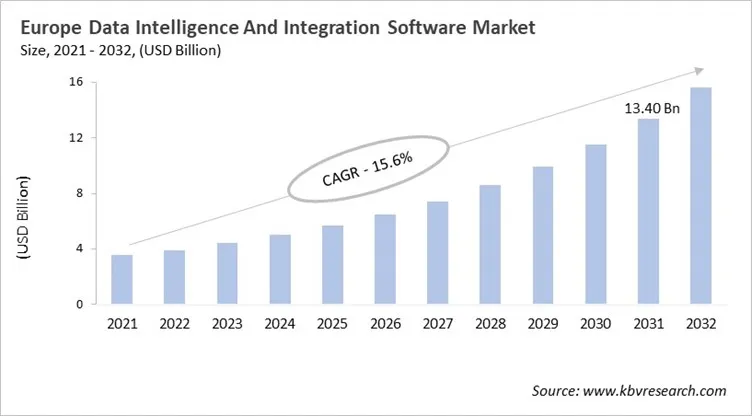
The European market has become a key driver of digital transformation. It has grown from simple BI and ERP tools to sophisticated data intelligence and integration platforms that support hybrid cloud, real-time analytics, and complex data orchestration. This change has happened faster because of strong regional policies that encourage data sharing, interoperability, and good governance. Companies now put the most importance on platforms that bring together different data sources, automate quality checks, make sure lineage, and meet regulatory requirements. Some important trends are the rise of cloud-native and hybrid integration, the growing use of data fabrics and metadata-driven architectures, and the increasing use of AI and machine learning for automation and predicting what will happen next. These changes show that Europe is moving toward data ecosystems that are safe, follow the rules, and are based on intelligence.
Governance, interoperability, and hybrid deployment skills are all important for competition in Europe. This draws in global OEMs, regional specialists, and agile cloud-native vendors. Top companies stand out by using integrated platforms that bring together data intelligence, governance, analytics, and workflow automation. Following strict rules and data sovereignty requirements is a top strategic goal, especially for the public sector and industries that are heavily regulated. Vendors increase their presence in the market by teaming up with cloud providers, system integrators, and industry experts. They also add AI-driven features to improve automation. The market is moving increasingly toward full, end-to-end platforms, but smaller vendors are still competing with modular, low-code, and domain-specific solutions.
Based on Component, the market is segmented into Solution, and Services. The Solution market segment dominated the Germany Data Intelligence And Integration Software Market by Component is expected to grow at a CAGR of 13.5 % during the forecast period thereby continuing its dominance until 2032. Also, The Services market is anticipated to grow as a CAGR of 14.8 % during the forecast period during (2025 - 2032).
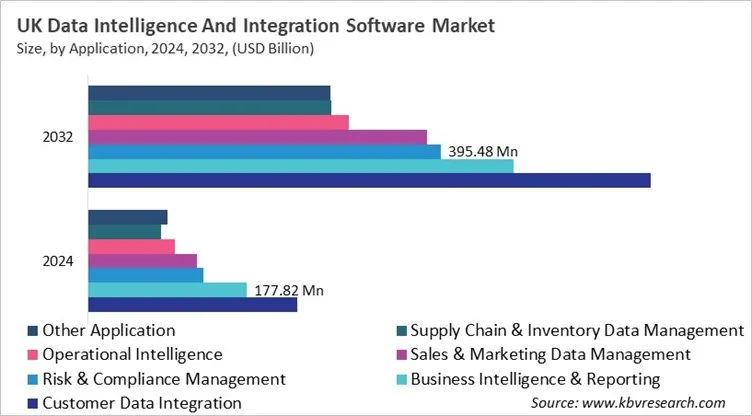
Based on Application, the market is segmented into Customer Data Integration, Business Intelligence & Reporting, Risk & Compliance Management, Sales & Marketing Data Management, Operational Intelligence, Supply Chain & Inventory Data Management, and Other Application. With a compound annual growth rate (CAGR) of 13.4% over the projection period, the Customer Data Integration Market, dominate the UK Data Intelligence And Integration Software Market by Application in 2024 and would be a prominent market until 2032. The Supply Chain & Inventory Data Management market is expected to witness a CAGR of 16.3% during (2025 - 2032).
Free Valuable Insights: The Global Data Intelligence And Integration Software Market will Hit USD 58.35 Billion by 2032, at a CAGR of 16.0%
Germany represents a highly advanced and regulation-driven market for data intelligence and integration software, supported by strong demand from automotive, manufacturing, logistics, and energy sectors. Complex IT environments and “Industrie 4.0” initiatives are accelerating adoption of integrated data management platforms. Strict data privacy, governance requirements, and data-sovereignty concerns push organizations toward secure, compliant, and often hybrid solutions. Key trends include AI-driven analytics, predictive maintenance, metadata management, and data fabrics. Competition involves both global and specialized domestic vendors adapting to Germany’s regulatory and industrial ecosystem.

By Component
By Application
By Vertical
By Country
Our team of dedicated experts can provide you with attractive expansion opportunities for your business.



 Unique Offerings