The Europe Construction Equipment Finance Market would witness market growth of 5.8% CAGR during the forecast period (2025-2032).
The Germany market dominated the Europe Construction Equipment Finance Market by Country in 2024, and would continue to be a dominant market till 2032; thereby, achieving a market value of $5,105.7 million by 2032. The UK market is exhibiting a CAGR of 4.7% during (2025 - 2032). Additionally, The France market would experience a CAGR of 6.6% during (2025 - 2032). The Germany and UK led the Europe Construction Equipment Finance Market by Country with a market share of 19.1% and 16% in 2024.The Spain market is expected to witness a CAGR of 7.1% during throughout the forecast period.
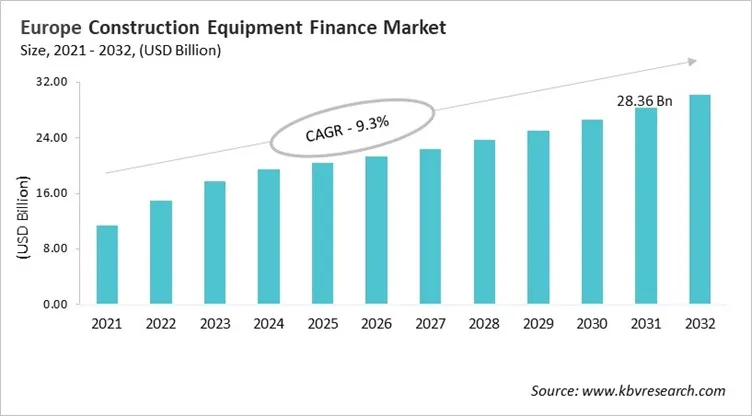
The European market for financing construction equipment has grown from simple purchase loans to a fully developed ecosystem that focuses on the entire lifecycle. OEM-captive finance arms and independent leasing companies now offer packages that include financing, maintenance, parts, telematics, insurance, and support for the value of the vehicle after it is sold. Increasingly, contractors like flexible ways to buy things, like operating leases, rental-finance, off-balance-sheet options, and pay-per-use plans. These structures help with cash flow, lower the cost of starting up, and make it easier to renew a fleet more quickly. The change is happening because machines are getting more expensive, more complicated, and more sensitive to project-based use cycles. OEM-dealer integration makes it even easier to get approvals faster, assess assets better, and make things more convenient for customers. In general, financing has changed from a simple credit function to a strategic service.
Strong EU spending on infrastructure, urban development, renewable energy projects, and stricter emissions rules is all helping the market grow. As electric, hybrid, and telematics-equipped machines become available, lenders change their models to account for technology risk and future residual values. As contractors switch to low-emission fleets, more options for financing and leasing that are linked to sustainability are becoming available. Leading companies stand out by offering contracts that are tailored to how their customers use their products, telematics-enabled monitoring, full-service bundles, and partnerships with dealer networks. Independent leasing companies compete on price, speed, and the areas they can reach, while OEM captives use their deeper knowledge of equipment to their advantage. Competitive advantage now depends on sharing risk, optimizing uptime, and providing support throughout the lifecycle. So, competition is changing from "who pays for the machine" to "who works best with the machine throughout its whole life.
Based on Industry, the market is segmented into Construction, Mining, Rental, Government and Other Industry. The Construction market segment dominated the Germany Construction Equipment Finance Market by Industry is expected to grow at a CAGR of 3.2 % during the forecast period thereby continuing its dominance until 2032. Also, The Government market is anticipated to grow as a CAGR of 4.8 % during the forecast period during (2025 - 2032).
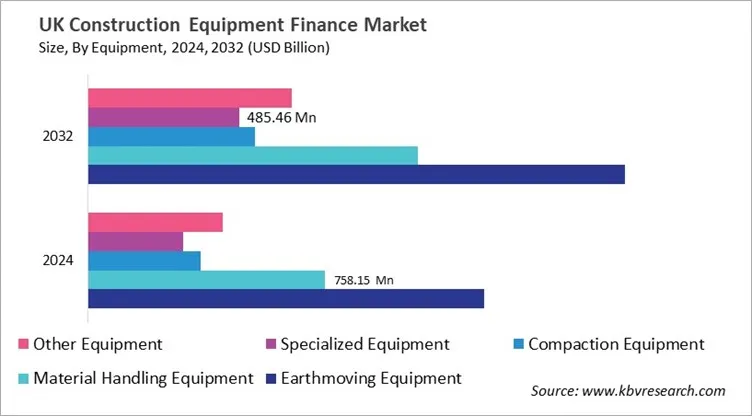
Based on Equipment, the market is segmented into Earthmoving Equipment, Material Handling Equipment, Compaction Equipment, Specialized Equipment and Other Equipment. Among various UK Construction Equipment Finance Market by Equipment; The Earthmoving Equipment market achieved a market size of USD $1268.4 Million in 2024 and is expected to grow at a CAGR of 4.1 % during the forecast period. The Specialized Equipment market is predicted to experience a CAGR of 6.1% throughout the forecast period from (2025 - 2032).
Free Valuable Insights: The Global Construction Equipment Finance Market will Hit USD 144.91 Billion by 2032, at a CAGR of 6.1%
The German construction equipment finance market is strong because there is a lot of manufacturing in the country, a lot of demand for equipment, and a strong construction sector. This means that contractors, rental companies, and infrastructure players all need financing. OEMs like Liebherr, Wacker Neuson, and Zeppelin are increasingly putting together financing, leasing, and service packages to help sell equipment and deal with the rising costs of machines caused by electrification, automation, and Stage V emission standards. To keep their cash flow steady and their fleets up to date, contractors are moving away from outright purchases and toward leasing, renting, and pay-per-use models. Germany's strong rental market also needs money to build and update fleets. Trends toward sustainability and higher upfront costs for electric and hybrid equipment make financing and residual value even more appealing. Supply-chain problems and risks to use affect credit decisions, so lenders must keep an eye on asset risk and contractor cash flow changes. OEM finance arms, independent leasing companies, and banks all compete by offering different services, telematics, flexible terms, and risk management. In general, financing equipment in Germany is becoming a strategic way to get access to modern, compliant, and high-tech machinery.

By Financing
By Equipment
By Industry
By Country
Our team of dedicated experts can provide you with attractive expansion opportunities for your business.



 Unique Offerings