The Europe Building Information Modeling Market would witness market growth of 10.9% CAGR during the forecast period (2025-2032).
The Germany market dominated the Europe Building Information Modeling Market by Country in 2024, and would continue to be a dominant market till 2032; thereby, achieving a market value of $823.6 million by 2032. The UK market is experiencing a CAGR of 9.7% during (2025 - 2032). Additionally, The France market would exhibit a CAGR of 11.9% during (2025 - 2032). The Germany and UK led the Europe Building Information Modeling Market by Country with a market share of 19.2% and 16.7% in 2024.The Italy market is expected to witness a CAGR of 11.6% during throughout the forecast period.
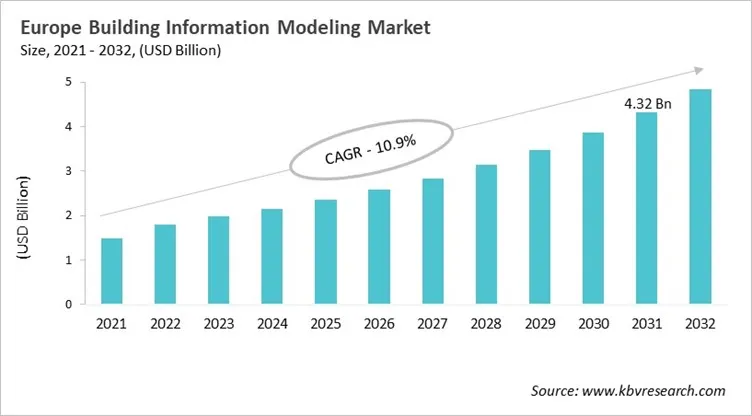
Europe's BIM development has gone from early national pilots and CAD-based modeling to a digital construction ecosystem that is coordinated and driven by policy, with EU-level standards, public procurement mandates, and cloud innovation led by vendors. The area now focuses on lifecycle asset management, sustainability, interoperability, and digital collaboration. BIM is becoming more a part of planning, building, running, and smart infrastructure projects. Harmonized BIM policies, European-based data infrastructure, cloud-enabled CDEs, and digital-twin workflows are all examples of trends that are speeding up the use of these technologies in both the public and private sectors.
Global platform vendors and specialized regional providers compete on lifecycle coverage, interoperability, regulatory compliance, cloud collaboration, and data sovereignty alignment in Europe. Vendors are solidifying their positions by establishing European data centers, endorsing open standards, localizing workflows, and offering value-added services centered on sustainability, analytics, and operational performance. As BIM becomes more common in procurement and asset management, companies that can deliver end-to-end digital asset value instead of just standalone modeling tools will have a bigger edge over their competitors.
Based on Building Type, the market is segmented into Commercial, Industrial, Government / Infrastructure and Residential. Among various Germany Building Information Modeling Market by Building Type; The Commercial market achieved a market size of USD $157.3 Million in 2024 and is expected to grow at a CAGR of 8.4 % during the forecast period. The Government / Infrastructure market is predicted to experience a CAGR of 10% throughout the forecast period from (2025 - 2032).
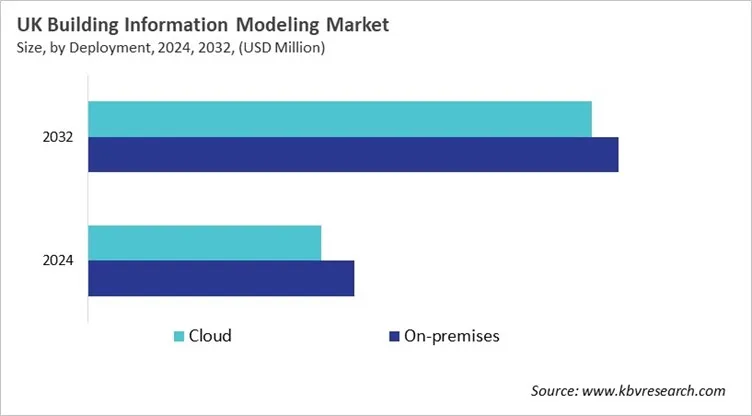
Based on Deployment, the market is segmented into On-premises and Cloud. With a compound annual growth rate (CAGR) of 9.2% over the projection period, the On-premises Market, dominate the UK Building Information Modeling Market by Deployment in 2024 and would be a prominent market until 2032. The Cloud market is expected to witness a CAGR of 10.3% during (2025 - 2032).
Based on Project Lifecycle, the market is segmented into Pre-Construction, Construction and Operation. The Pre-Construction market segment dominated the France Building Information Modeling Market by Project Lifecycle is expected to grow at a CAGR of 11.3 % during the forecast period thereby continuing its dominance until 2032. Also, The Operation market is anticipated to grow as a CAGR of 12.5 % during the forecast period during (2025 - 2032).
Free Valuable Insights: The Global Building Information Modeling Market will Hit USD 18.94 Billion by 2032, at a CAGR of 11.3%
Germany's BIM market is growing because of its strong engineering history, big investments in public infrastructure, and more government requirements. For example, starting in 2020, all federally funded road and rail projects will have to use BIM. Adoption is growing from design and construction to full lifecycle management, thanks to sustainability goals, a mature engineering ecosystem, and the availability of local software vendors and consultants. Some important trends are the increasing use of cloud platforms, the integration of digital twins and the Internet of Things (IoT), and the move toward BIM that focuses on operations. Germany is one of the top adopters in Europe, but it still faces problems like high labor costs, the need to train workers, and slower adoption by smaller contractors. The market is still very promising overall, especially for infrastructure, industrial construction, and retrofit projects.

By Component
By Deployment
By Project Lifecycle
By Building Type
By Application
By Country
Our team of dedicated experts can provide you with attractive expansion opportunities for your business.








 Unique Offerings