The Europe Application Modernization Services Market is expected to reach $14.11 billion by 2031 and would witness market growth of 15.9% CAGR during the forecast period (2025-2032).
The Germany market dominated the Europe Application Modernization Services Market by Country in 2024, and would continue to be a dominant market till 2032; thereby, achieving a market value of $3,054.7 million by 2032. The UK market is exhibiting a CAGR of 14.7% during (2025 - 2032). Additionally, The France market would experience a CAGR of 16.6% during (2025 - 2032). The Germany and UK led the Europe Application Modernization Services Market by Country with a market share of 20.4% and 18.7% in 2024. The Spain market is expected to witness a CAGR of 17.8% during throughout the forecast period.
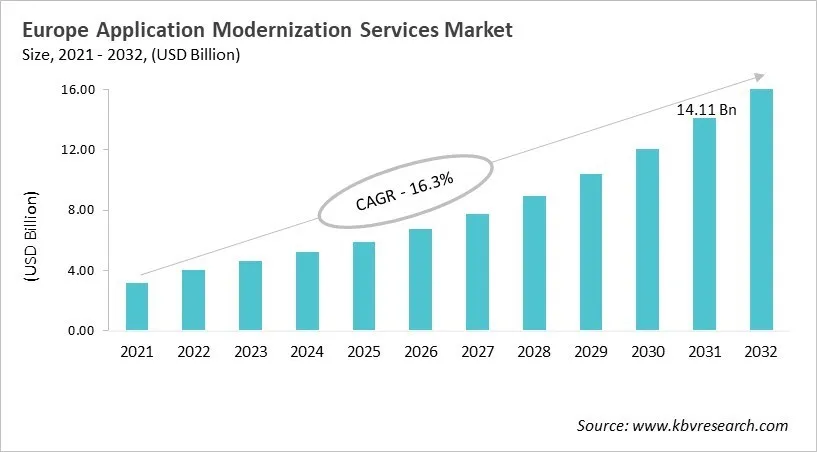
The market for application modernization services in Europe has changed from old, centralized IT systems to cloud-enabled, flexible architectures. This change is due to digital transformation, regulatory compliance, and the need for better operational efficiency. To meet the needs for interoperability, cybersecurity, and cross-border digital services, early modernization efforts focused on optimizing and virtualizing infrastructure, especially in public sector institutions. As cloud computing got better, more and more European businesses started modernizing their architectures. They used frameworks from OEMs like Microsoft, IBM, AWS, and Google Cloud to evaluate, refactor, and replatform applications using scalable cloud services, microservices, and hybrid architectures. Regulatory frameworks, especially the GDPR, have influenced modernization plans by stressing data sovereignty, security, and hybrid deployment models that combine on-premises control with cloud agility.
Cloud-native architectures, automation, and DevOps/DevSecOps integration are all big parts of the market today. These things help companies innovate faster while still keeping their operations stable and compliant. Key leaders use assessment-driven methods to decide if applications should be rehosted, refactored, or replaced. This is often done through hybrid cloud enablement, which strikes a balance between flexibility and following the rules. Strategic partnerships between system integrators and global OEMs improve compliance, interoperability, and delivery in specific areas. There is a lot of competition in Europe, with big names like Microsoft, IBM, AWS, Google Cloud, Accenture, Capgemini, Atos, TCS, and Cognizant setting themselves apart by being experts in hybrid cloud, automation, a specific industry, and following EU digital and cybersecurity rules.
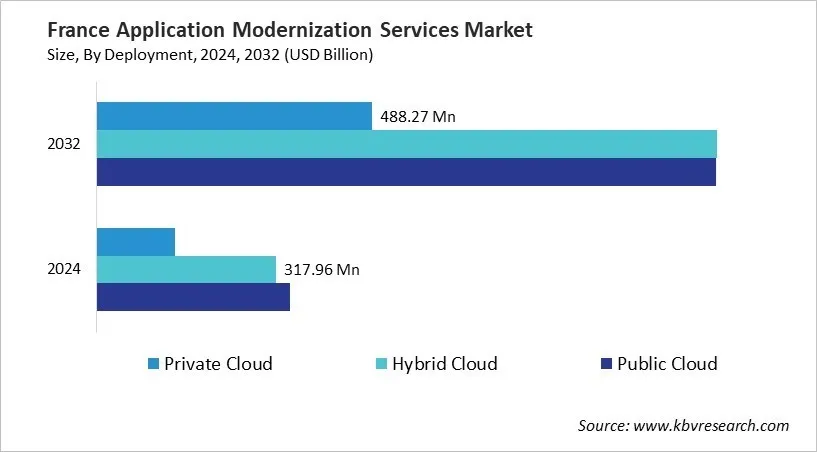
Based on Deployment, the market is segmented into Public Cloud, Hybrid Cloud and Private Cloud. With a compound annual growth rate (CAGR) of 15.9% over the projection period, the Public Cloud Market, dominate the France Application Modernization Services Market by Deployment in 2024 and would be a prominent market until 2032. The Private Cloud market is expected to witness a CAGR of 17.2% during (2025 - 2032).
Based on Service Type, the market is segmented into Cloud Application Migration, Application Re-Platforming, Application Integration, Post-Modernization Services, Application Portfolio Assessment, and UI Modernization. Among various UK Application Modernization Services Market by Service Type; The Cloud Application Migration market achieved a market size of USD $298.7 Million in 2024 and is expected to grow at a CAGR of 13.7 % during the forecast period. The Post-Modernization Services market is predicted to experience a CAGR of 15.7% throughout the forecast period from (2025 - 2032).
Free Valuable Insights: The Global Application Modernization Services Market will Hit USD 62.61 Billion by 2032, at a CAGR of 16.3%
Germany is a very mature and strategically important market for application modernization services in Europe. This is because businesses in manufacturing, automotive, BFSI, telecommunications, utilities, and the public sector want to modernize their old, complicated systems. Some of the most important factors are strict requirements for data sovereignty, security, and compliance with regulations, rising costs of maintaining old systems, and a lack of skilled workers in proprietary technologies. Organizations are using hybrid and sovereign cloud models more and more. These models use containerization, microservices, API-driven integration, and DevSecOps practices, and they often use open-source technologies as well. Modernization in specific sectors includes smart factories, digital banking, services for citizens, and making utilities and logistics work better. There are global hyperscalers, domestic cloud providers, and top system integrators in the competitive landscape. They stand out from each other by their knowledge of regulations, ability to work with hybrid clouds, and ability to deliver modernization in a safe and low-disruption way.

By Enterprise Size
By Deployment
By Industry Vertical
By Service Type
By Country
Our team of dedicated experts can provide you with attractive expansion opportunities for your business.



 Unique Offerings