“Global EtherCAT Market to reach a market value of USD 4.82 Billion by 2032 growing at a CAGR of 9.3%”
The Global EtherCAT Market size is expected to reach USD 4.82 billion by 2032, rising at a market growth of 9.3% CAGR during the forecast period.
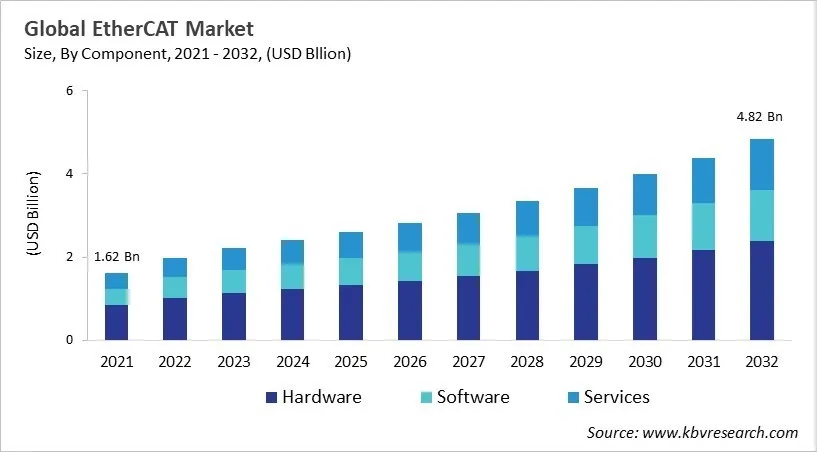
EtherCAT has transformed industrial Ethernet communication with its short cycle times, cost efficiency, and real-time performance. The EtherCAT Technology Group played a crucial role in surging adoption, interoperability testing, and standardization. This has resulted in the integration of EtherCAT into global standards, and extended applications into automotive, semiconductors, robotics, and process automation. With time, there has been significant developments in technologies with features such as safety-over-EtherCAT redundancy, advanced diagnostics, and improved diagnostics, while the ETG’s expanding ecosystem accelerated industry-wide adoption and innovation.
The EtherCAT market has witnessed significant expansion in the forecast period due to elements such as diagnostics, redundancy, and safety. Key players in the market are competing on compliance with standards, ecosystems strength, interoperability, and technical performance. Market players are adopting strategies such as certification, alliances, product innovation, and targeting industries with larger demand, including automotive, medical devices, aerospace, and robotics. The EtherCAT market is experiencing high growth backed by high-performance and premium devices, targeting specialized sectors; however, cost-sensitive segments are also noticeable in the market. Recently, EtherCAT has developed into an important part of the communication standard for industrial automation, supported by ecosystem growth, strong market competition, and technical advancements.
The COVID-19 pandemic had a big effect on the global EtherCAT market by messing up supply chains, manufacturing, and logistics. Restrictions and delays in getting raw materials slowed the production and distribution of EtherCAT devices. At the same time, less activity in industries like automotive, aerospace, and general manufacturing lowered demand. A lot of automation and smart factory projects were put on hold or canceled because of financial uncertainty. This hurt solution providers' revenue streams. Installation, maintenance, and technical support were made even harder by having a small number of workers available on-site and travel restrictions. This delayed both the deployment of new systems and the upkeep of existing EtherCAT networks. Thus, the COVID-19 pandemic had a negative impact on the market.

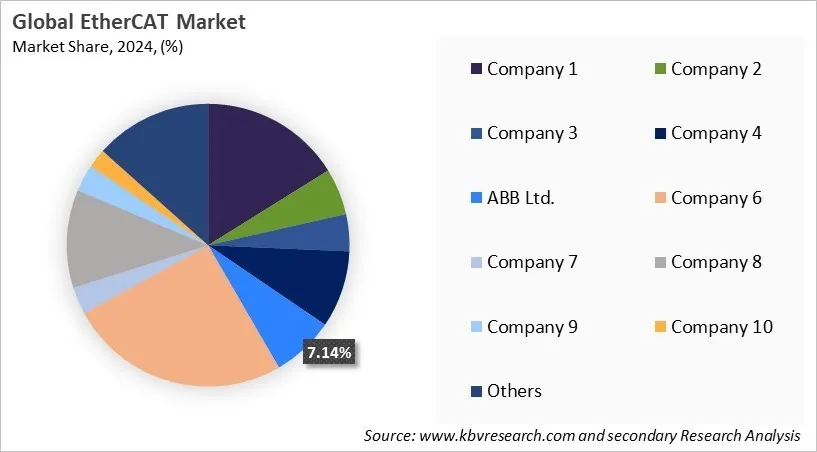
The leading players in the market are competing with diverse innovative offerings to remain competitive in the market. The above illustration shows the percentage of revenue shared by some of the leading companies in the market. The leading players of the market are adopting various strategies in order to cater demand coming from the different industries. The key developmental strategies in the market are Acquisitions, and Partnerships & Collaborations.
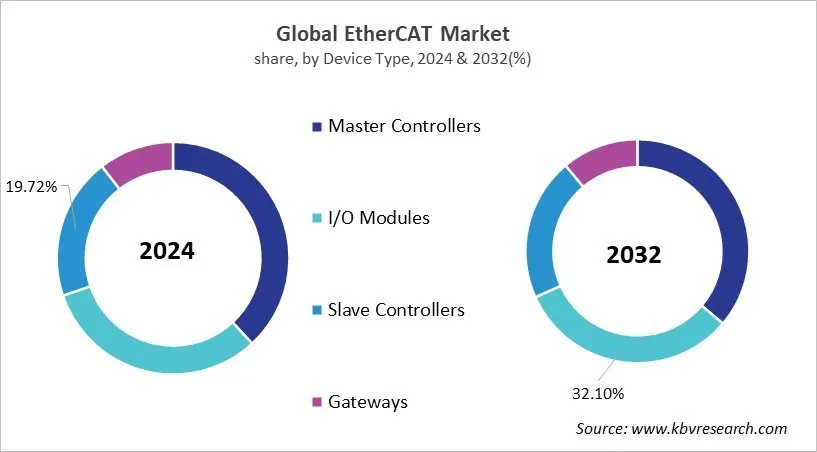
Based on Device Type, the market is segmented into Master Controllers, I/O Modules, Slave Controllers, and Gateways. The I/O modules segment recorded 32% revenue share in the EtherCAT market in 2024. The I/O modules segment acts as a vital interface between controllers and field devices, enabling the collection and transmission of input and output signals. These modules provide the flexibility to connect a wide range of sensors, actuators, and other field equipment, making them indispensable in automation frameworks.
Based on End Use, the market is segmented into Automotive & Transportation, Electrical & Electronics, Energy & Power / Oil & Gas, Aerospace & Defense, Pharmaceutical & Medical Devices, Metal Forming & Assembly, and Food & Beverages. The electrical & electronics segment gained 21% revenue share in the EtherCAT Market in 2024. The electrical and electronics segment leverages EtherCAT to manage highly complex manufacturing processes that require precision and synchronization. The growing demand for consumer electronics, semiconductors, and advanced circuit boards has amplified the need for efficient automation systems.
Free Valuable Insights: Global EtherCAT Market size to reach USD 4.82 Billion by 2032
Region-wise, the EtherCAT Market is analyzed across North America, Europe, Asia Pacific, and LAMEA. The North America segment recorded 35% revenue share in the EtherCAT Market in 2024. In North America and Europe, the EtherCAT market is expected to grow at a significant rate. This is supported by strong acceptance in robotics, automotive, packaging, semiconductor, and manufacturing industries, where real-time control, precision, and safety are important. The region also gets advantages from well-established OEMs, a developed industrial automation eco-system, which surge the integration of EtherCAT. Furthermore, continuous innovations in smart factories and IoT, along with strict compliance frameworks and a focus on safety and interoperability ensuring long-term integration of EtherCAT in mission-critical applications.
The EtherCAT market is estimated to experience expansion in the Asia Pacific and LAMEA region. The market is majorly driven by rapid industrialization, rising investment in automation technologies, and growing manufacturing bases. Regional nations such as India, South Korea, China, and Japan is having strong adoption of EtherCAT in electronics, semiconductors, and automotive industries because of the need for synchronized operations, and high throughput. Furthermore, the LAMEA region is also witnessing expansion driven by growing interest in EtherCAT for process automation, energy, and developing manufacturing hubs. With the increased digitalization, EtherCAT’s scalability, cost-efficiency, and flexibility are anticipated to support wider deployment.
| Report Attribute | Details |
|---|---|
| Market size value in 2025 | USD 2.59 Billion |
| Market size forecast in 2032 | USD 4.82 Billion |
| Base Year | 2024 |
| Historical Period | 2021 to 2023 |
| Forecast Period | 2025 to 2032 |
| Revenue Growth Rate | CAGR of 9.3% from 2025 to 2032 |
| Number of Pages | 486 |
| Number of Tables | 401 |
| Report coverage | Market Trends, Revenue Estimation and Forecast, Segmentation Analysis, Regional and Country Breakdown, Market Share Analysis, Porter’s 5 Forces Analysis, Company Profiling, Companies Strategic Developments, SWOT Analysis, Winning Imperatives |
| Segments covered | Component, Device Type, End Use, Region |
| Country scope |
|
| Companies Included | Siemens AG, Omron Corporation, Mitsubishi Electric Corporation, Schneider Electric SE, ABB Ltd., Beckhoff Automation GmbH & Co. KG, Delta Electronics, Inc., Bosch Rexroth AG (Robert Bosch GmbH), Rockwell Automation, Inc., and Infineon Technologies AG |
By Component
By Device Type
By End Use
By Geography
This Market size is expected to reach USD 4.82 Billion billion by 2032.
The etherCAT market is projected to grow at a CAGR of 9.3% between 2025 and 2032.
Rising demand for high-performance industrial automation is driving the integration of functional safety and reliability in industrial systems.
Siemens AG, Omron Corporation, Mitsubishi Electric Corporation, Schneider Electric SE, ABB Ltd., Beckhoff Automation GmbH & Co. KG, Delta Electronics, Inc., Bosch Rexroth AG (Robert Bosch GmbH), Rockwell Automation, Inc., and Infineon Technologies AG
The Master Controllers segment led the maximum revenue in the Global EtherCAT Market by Device Type in 2024, thereby, achieving a market value of USD 1.74 billion by 2032.
The North America region dominated the Global EtherCAT Market by Region in 2024, thereby, achieving a market value of USD 1.60 billion by 2032.
Our team of dedicated experts can provide you with attractive expansion opportunities for your business.







 Unique Offerings