“Global Enterprise LLM Market to reach a market value of USD 30.35 Billion by 2032 growing at a CAGR of 28%”
The Global Enterprise LLM Market size is expected to reach $30.35 billion by 2032, rising at a market growth of 28.0% CAGR during the forecast period
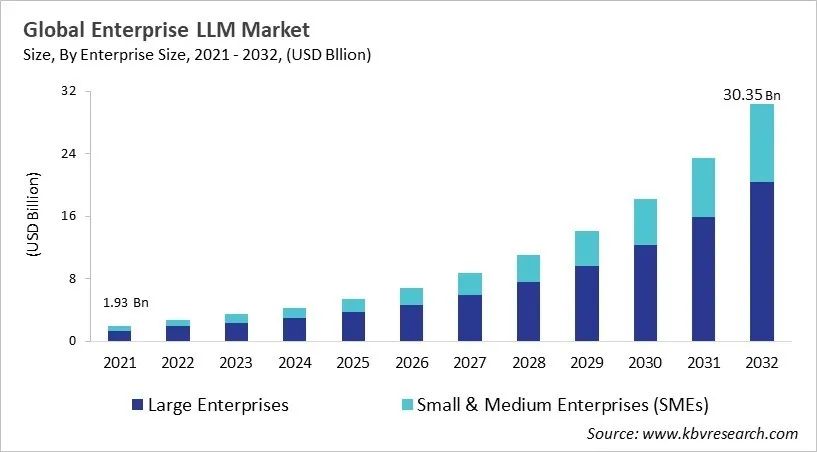
The enterprise LLM market is widely being used in mission-critical infrastructure, supported by a combination of regulatory frameworks, technological capability, and enterprise demand for security, trust, and compliance. Further, the government has also introduced standards such as the EU AI Act and the US NIST AI Risk Management Framework, encouraging enterprises to adopt transparency and risk management as part of their AI integration. OEMs like Microsoft have integrated LLMs into their cloud platforms and productivity suites, with built-in tools such as audit logs, sensitivity labelling, and access controls. These advancements have shifted the focus towards secure, safe, and accountable deployment of LLMs. The key market trends include integration with access systems and enterprise identity, shift to hybrid & private models deployments, and retrieval-augmented generation (RAG) for domain-specific knowledge.
The enterprise LLM market is witnessing fierce competition across multiple dimensions including model flexibility, compliance readiness, measurable business outcomes, and integration with enterprise workflows. Major software and cloud providers are focusing on compliance, governance, and deep productivity suite integration to stay competitive in the market; however, open-weight models such as Meta’s Llama and startups offer alternatives personalized to privacy-sensitive or regulated sectors. The compliance of regulatory frameworks has become a competitive advantage because the providers that meet these regulatory needs across regions earn greater trust.
The major strategies followed by the market participants are Partnerships as the key developmental strategy to keep pace with the changing demands of end users. For instance, In September, 2025, IBM Corporation teamed up with BharatGen to accelerate AI adoption in India through Indic Large Language Models (LLMs). Combining IBM’s enterprise AI expertise with BharatGen’s India-focused, multilingual models, the collaboration aims to develop scalable, culturally aware AI solutions across sectors like education, healthcare, agriculture, finance, and citizen services. Moreover, In August, 2025, IBM Corporation announced the partnership with Arivonix to integrate watsonx.ai into live enterprise data pipelines, enabling real-time AI enrichment with Granite foundation models. This low-code, secure solution supports summarization, classification, and metadata enrichment, offering full governance, auditability, and seamless deployment across business workflows, enhancing operational efficiency and enterprise-scale LLM adoption.
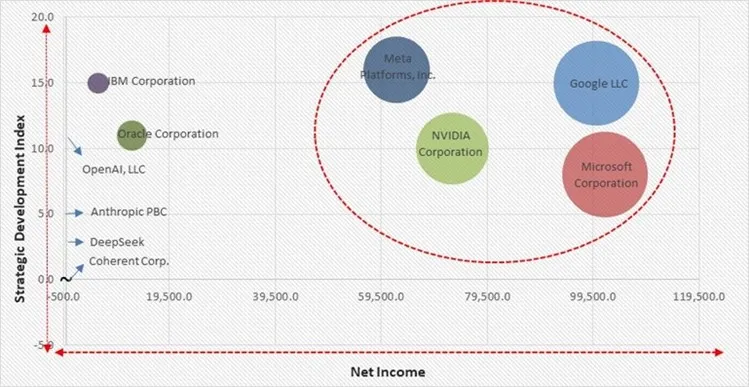
Based on the Analysis presented in the KBV Cardinal matrix; Microsoft Corporation, Google LLC, NVIDIA Corporation, and Meta Platforms, Inc. are the forerunners in the Enterprise LLM Market. In August, 2025, Google LLC announced the partnership with LivePerson to integrate advanced AI, including large language models, into its Connected Experience Platform. This enables enterprises to deliver personalized, proactive customer interactions, optimize journeys, automate complex conversations, support agents in real time, and securely access diverse LLMs, enhancing digital transformation and conversational AI outcomes. Companies such as Oracle Corporation, IBM Corporation, Coherent Corp. are some of the key innovators in Enterprise LLM Market.
The COVID-19 pandemic had a big impact on the growth of the global enterprise LLM market, serving as both a catalyst and a warning sign. The quick switch to remote and hybrid work sped up digital transformation and increased the need for smart automation, virtual assistants, and AI-powered communication tools to handle customer interactions and internal operations. To meet the growing demand for support and information during crises, businesses quickly adopted LLM, often working with cloud providers to do so. But the widespread use of LLMs has also brought to light important issues with data privacy, false information, fairness, and compliance risks, especially in industries that are heavily regulated. This made companies tighten their AI governance, follow new rules, and ask vendors for safe, ethical solutions. So, even though the pandemic led to quick adoption, it also showed weaknesses, which hurt the enterprise LLM market in the end. Thus, the COVID-19 pandemic had a negative impact on the market.

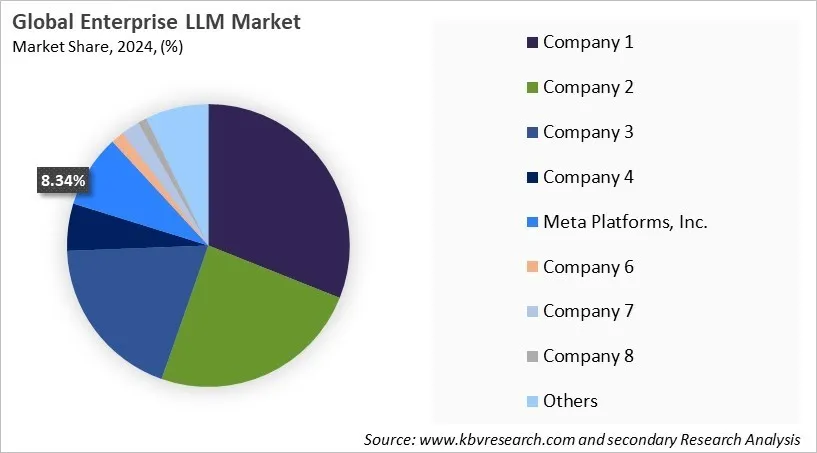
The leading players in the market are competing with diverse innovative offerings to remain competitive in the market. The above illustration shows the percentage of revenue shared by some of the leading companies in the market. The leading players of the market are adopting various strategies in order to cater demand coming from the different industries. The key developmental strategies in the market are Partnerships, Collaborations & Agreements.
Free Valuable Insights: Global Enterprise LLM Market size to reach USD 30.35 Billion by 2032
Based on Enterprise Size, the market is segmented into Large Enterprises, and Small & Medium Enterprises (SMEs). The Small & Medium Enterprises (SMEs) segment attained 31.2% revenue share in the market in 2024. SMEs are increasingly adopting LLMs to automate workflows, enhance customer interactions, and optimize resource utilization. The rising availability of affordable cloud-based AI solutions has made these technologies more accessible to smaller businesses. SMEs leverage LLMs to gain competitive advantages, drive innovation, and improve operational efficiency despite limited budgets.
Based on Model Type, the market is segmented into General-Purpose LLMs, Domain-Specific LLMs, and Custom/Proprietary LLMs. The Domain-Specific LLMs segment recorded 36.7% revenue share in the market in 2024. These models are tailored for specialized industries such as healthcare, finance, legal, and retail, where sector-specific knowledge is essential. Businesses adopt domain-specific LLMs to achieve higher accuracy, compliance with regulations, and better contextual understanding. Their ability to deliver precise and industry-relevant outcomes drives their growing adoption among enterprises focused on niche applications.
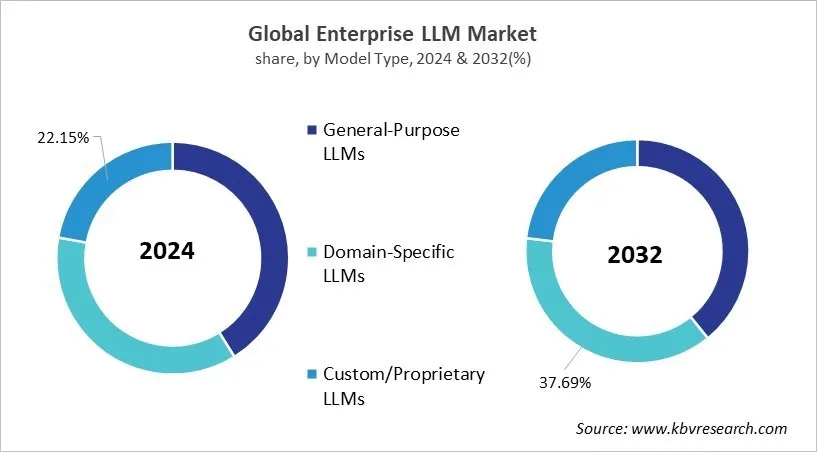
Region-wise, the Global Enterprise LLM market is analyzed across North America, Europe, Asia Pacific, and LAMEA. The North America segment recorded 35.9% revenue share in the market in 2024. In the North America and Europe region, the enterprise LLM market is estimated to witness high growth. This is supported by the strong regulatory oversight across the regions. North America benefits from a well-established AI ecosystem, with tech giants surging adoption as well as integration of LLMs into enterprise workflows. Enterprises are prioritizing safe, compliant integration, with the aim to protect sensitive data. Moreover, the Europe region is also predicted to have expansion in the enterprise LLM market. The expansion is region is supported by favorable regulatory frameworks such as the EU AI Act, which encourages ethical and responsible AI deployment. Organizations in the region are focused on transparency, risk management, and embedding LLMs into existing enterprise systems alongside adhering to stringent compliance standards.
The Asia Pacific and LAMEA enterprise LLM market is anticipated to grow at a high rate in the upcoming years. The growth in the Asia Pacific is driven by growing AI investment, increasing demand for AI-driven enterprise solutions, and rising digital transformation. Enterprises are risingly exploring private and hybrid deployments, and RAG-based architectures, to maintain balance within data privacy & security, and innovation. Furthermore, the LAMEA enterprise LLM market is witnessing expansion backed by enterprises gradually adopting LLM solutions across various sectors. The market adoption is further fueled by rising awareness of AI capabilities and the requirement for automation and efficiency.
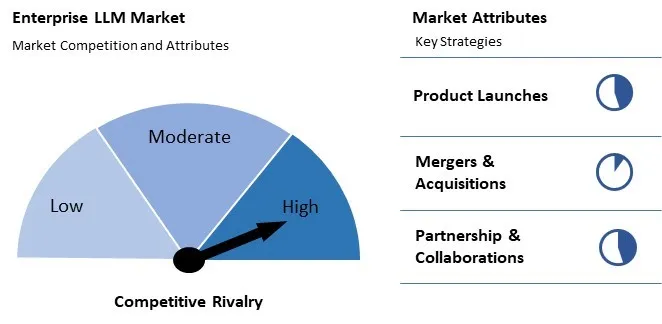
The enterprise LLM market is very competitive because new ideas come out quickly and there is a lot of competition. Players set themselves apart by how well their models work, how flexible they are when it comes to deployment, how specialized they are in a certain area, and how secure and compliant they are. Anbieter compete on how much they spend on research and development, how well they integrate with other systems, and how much they charge for their services. Technical complexity, data privacy risks, and regulatory limits are some of the things that make it hard. New competitors and open-source options force existing companies to keep improving their services and making sure they meet the needs of businesses. The market rewards solutions that can grow, are reliable, and are made as per consumer’s needs.
| Report Attribute | Details |
|---|---|
| Market size value in 2025 | USD 5.38 Billion |
| Market size forecast in 2032 | USD 30.35 Billion |
| Base Year | 2024 |
| Historical Period | 2021 to 2023 |
| Forecast Period | 2025 to 2032 |
| Revenue Growth Rate | CAGR of 28.0% from 2025 to 2032 |
| Number of Pages | 558 |
| Number of Tables | 554 |
| Report coverage | Market Trends, Revenue Estimation and Forecast, Segmentation Analysis, Regional and Country Breakdown, Competitive Landscape, Market Share Analysis, Porter’s 5 Forces Analysis, Company Profiling, Companies Strategic Developments, SWOT Analysis, Winning Imperatives |
| Segments covered | Enterprise Size, Model Type, Component, Deployment Type, Industry Vertical, Region |
| Country scope |
|
| Companies Included | Anthropic PBC, OpenAI, LLC, Google LLC, Microsoft Corporation, Meta Platforms, Inc., Coherent Corp., IBM Corporation, DeepSeek, NVIDIA Corporation, and Oracle Corporation |
By Enterprise Size
By Model Type
By Component
By Deployment Type
By Industry Vertical
By Geography
This Market size is expected to reach USD 30.35 Billion by 2032.
"The enterprise LLM market is projected to grow at a CAGR of 28% between 2025 and 2032. "
Acceleration of digital transformation is amplifying the focus on productivity and efficiency gains across industries.
Anthropic PBC, OpenAI, LLC, Google LLC, Microsoft Corporation, Meta Platforms, Inc., Coherent Corp., IBM Corporation, DeepSeek, NVIDIA Corporation, and Oracle Corporation
The General-Purpose LLMs segment captured the maximum revenue in the Global Enterprise LLM Market by Model Type in 2024, thereby, achieving a market value of $11.9 billion by 2032.
The North America region dominated the Global Enterprise LLM Market by Region in 2024, and would continue to be a dominant market till 2032; thereby, achieving a market value of $10.5 billion by 2032.
Our team of dedicated experts can provide you with attractive expansion opportunities for your business.







 Unique Offerings